|
|
||||
 |
 |
 |
||
|
|
 |
|
|
||||||||||||||||||||
|
|||||||||||||||||||||
|
|
|||||||||||||||||||||
 |
|||||||||||||||||||||
 |
|||||||||||||||||||||
|
|
||||||||||||||||||||
| What we published this week: | Monday | Tuesday | Wednesday | Thursday | Friday | Earlier |
|
|
|
|
|
|
|
Food |
|
Jo
Stuart |
|
Abstracts and fair use are permitted. Check HERE for more details |
 |
| A.M. Costa Rica's Second news page | |
|
San
José, Costa Rica, Tuesday, April 1, 2014, Vol. 14, No. 64
|
|
|
|
|
|
|
|
Food |
|
|
New president will
discover
that there already is a plan By
Michael Krumholtz
of the A.M. Costa Rica staff As the days and hours wind down until Sunday's presidential election, authorities are making some last minute steps before the awaited transition becomes official. Monday the minister of Planificación presented a more sophisticated version of the 2015-2018 national development plan for the benefit of Partido Acción Ciudadana and Partido Liberación Nacional. The plan is a systemized matrix that outlines a series of broad national objectives with measuring indicators and strategic actions. Roberto Gallardo Núñez, the minister, said the plan and a corresponding budget chart are supposed to serve as guides for the next president's term in office. "The national development proposal is an instrument used to serve and guide the new government," Gallardo said. "We need as much time as possible to completely lay it out." The national development plan is not only a framework of advice meant to specify the public needs at a given point in time. It also ties each party's objectives to its stable system of advice and goals. Although Gallardo did not go into specific goals, he said most parties follow along with the same uniform proposals in focusing on improved education, environment, and health policies. "These are the same basic principles that the country has always accepted," he said. On May 8, the heavily favored Luis Guillermo Solís will likely take over Casa Presidencial, barring a monumental surprise. Opposing candidate Johnny Araya Monge suspended his campaign. When the time comes, Solís and his Acción Ciudadana party have 13 stated national objectives. These include a transparent management of finances, more economic opportunities for women, and strengthening the social security system and the pensions from the Caja Costarricense de Seguro Social. Gallardo passed out plan guidelines for both parties, as officially the next president is still up in the air. "We have to try to facilitate solutions for either party in the best way we can," he said. Once the president is elected, his party will work directly with the Ministerio de Planificación in further sorting out and harmonizing the administration's goals. The development plan will not officially begin until Jan. 1, 2015, to replace the preceding plan from the Laura Chinchilla administration. The first edition of the national development plan was released in October.  Consejo Nacional de Vialidad
photo
Workmen have removed the last
bailey bridge at the Río María Aguilar washout site on
the Circunvalación in order to install a permanent bridge. The
job is supposed to be done by the middle of May.Pranksters will have to wait until a day after Christmas By
the A.M. Costa Rica staff
Today is April 1, April Fool's Day in the English-speaking world and even in Iran. But not in Costa Rica. In Latin America, Dec. 28, the religious feast day of the Holy Innocents is the day when pranks and hoaxes may be played. The religious day is in memory of the children who supposedly were slain by Herod, king of the Jews, who was searching for the infant Jesus Christ. But the word is too good to pass up for pranksters. 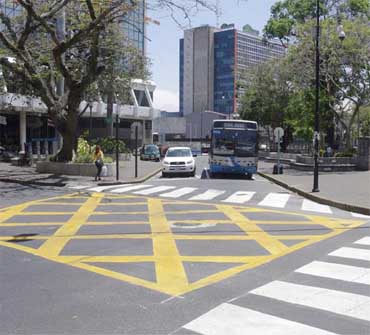 Ministerio
de Obras Públicas y Transportes
photo
Vehicle drivers pay close
attention to the caja amarilla or 'yellow box' at the Morazán park
intersection.Yellow boxes are
profitable
when motorists become trapped By
the A.M. Costa Rica staff
Trying to make the traffic flow better in downtown San José is at least profitable for the transport ministry. The agency reported that 959 traffic tickets have been issued during the first week of the effort. Each brings a 49,000-colon fine, so the total take is about 47 million colons or about $94,000. The transport ministry has established loading zones for commercial deliveries. But the big money makers are the nine so-called yellow boxes that are at high traffic intersections. The boxes are just lines cross-hatched on the asphalt. Drivers have been warned not to be caught within the box when the light turns red. The real offenders at intersections are buses that block traffic by pulling a half length across the intersection. One place where this has happened in the past is the intersection at the northwest corner of Parque Morazán. But no more. Traffic police have been on duty there every day issuing tickets to those who are caught in the intersection.
|
||||||||||||||||||||||||||||||||||||||||||||||
 |
|||||||||||||||||||||||||||||||||||||||||||||||
|
|
|
|
|
|
|
Food |
|
| What we published this week: | Monday | Tuesday | Wednesday | Thursday | Friday | Earlier |
| The contents of this page and this Web site are copyrighted by A.M. Costa Rica.com Ltda. 2014 and may not be reproduced anywhere without permission. Abstracts and fair use are permitted. Check HERE for details | ||||||
A.M. Costa Rica Third News Page |
|
| San José, Costa Rica, Tuesday, April 1, 2014, Vol. 14, No. 64 | |
|
|
|
|
|
|
|
Food |
|
 |
Individuals who wanted to resign from a Costa Rican corporation line up at the Registro Nacional where they had to present papers. This photo was taken Friday, but Monday was the last day to do so. |
 A.M. Costa Rica/Garland
Baker
|
| Deadline to duck corporate tax passes, but active appeal
remains |
|
|
By
the A.M. Costa Rica staff
Monday was the last day for an individual to resign from a responsible position in a Costa Rican company and not face bill collectors seeking the corporate tax. And plenty of people did right up until the deadline. But suppose someone did so by mistake? There is a remedy, but it involves paying the corporation tax, which is about $360 a year for an active corporation and half that for an inactive one. |
The corporation
can be resurrected by creating a new board of directors and having
someone appointed to be responsible. And pay the tax, legal sources say. All of this effort might end up being moot because there is at least one appeal in the Sala IV asking it to declare the law, No. Law 9024, to be disproportionate and unconstitutional. The appeal was filed a year ago, but there has been no decision. Such a decision would require the government to give back all the money that has been collected, which is one reason the Sala IV might opt for expediency instead of the law. |
| Judicial secrecy can be damaging to those who are not guilty |
|
|
By
the A.M. Costa Rica staff
They say that democracy dies in the dark. But while the Sala IV constitutional court has declared legislative meetings to be open and salary information of government employees to be public, the courts themselves are wrapped in secrecy up until a trial. Frequently expats who think they are getting a raw legal deal tell reporters to check the court file. But these documents that are open to the public elsewhere are closed here. So are court hearings that lead up to a public trail. Only lawyers and individuals directly involved have access to this information or hearings. One consequence is that the public is not able to follow the cases and weigh the efficiencies of the judicial process. What happens to someone showed handcuffed and detained on television usually remains a mystery. Just ask Herman Zango Milgran, an engineer who was swept up in the case following the collapse of the high-interest operation called Savings Unlimited in 2002. Zango said that he was unjustly involved in the case that is better known by the name of the Saving Unlimited operator Luis Milanes. Prosecutors appear to have agreed with Zango, and a judge issued an order clearing the man in May 2011. "I got a sobreseimiento definitivo requested by the prosecutor or fiscalia, as they found I had nothing to do and not involved in his activities," Zango said of Milanes.. "The biggest injustice is that the |
court in Costa
Rica took three years to declare it even when the fiscalia requested
the judge to remove me almost immediately when they called me.
They said they always work this way to save process costs to the court
and do this only until the audiencia
preliminar where they clear people and make the accusations
together." The judicial order also cleared men identified as Edgar Enrique Ramírez Bolaños and Edward Bridges. Those close to the case say that investigators and prosecutors involved in the case threw a wide net and investigated a number of individuals who had been connected in some way with Milanes. Prosecutors at the time in 2008 said they thought Zango was handling money for the fugitive Milanes. Zango said that he was hired by Milanes as a consultant to create a casino at the Radisson Hotel in 1999, and he had no more business dealings after that although he sometimes had been contacted on casino matters. Milanes, who is suppose to go to trial over the Saving Unlimited collapse, has long been the operator of casinos in San José even when he was a fugitive. So even though Zango and the other two men were dropped from the case, there was no public announcement to that effect, even though their names had been made public. And, because the file continues to be sealed to outside eyes, the fact was not known. A.M. Costa Rica was able to confirm that Zango had been released from the case because he provided the legal papers. He said that he had suffered damages because his involvement in the case had been reported but not the fact that he had been dropped as a suspect. |
 |
| You need to see Costa Rican tourism information HERE! |
|
|
|
|
|
|
|
Food |
|
| What we published this week: | Monday | Tuesday | Wednesday | Thursday | Friday | Earlier |
| The contents of this page and this Web site are copyrighted by A.M. Costa Rica.com Ltda. 2014 and may not be reproduced anywhere without permission. Abstracts and fair use are permitted. Check HERE for details | ||||||
 |
|
||||
| A.M. Costa Rica's Fourth News page | |||||
| San José, Costa Rica, Tuesday, April 1, 2014, Vol. 14, No. 64 | |||||
|
|
|
|
|
|
|
Food |
|
| Eating fresh fruit and vegetables said to dramatically
reduce risk of death |
|
|
By
the University College Lonfon news staff
Eating seven or more portions of fruit and vegetables a day reduces the risk of death at any point in time by 42 percent compared to eating less than one portion, reports a new study. Researchers used the Health Survey for England to study the eating habits of 65,226 people representative of the English population between 2001 and 2013, and found that the more fruit and vegetables they ate, the less likely they were to die at any age. Eating seven or more portions reduces the specific risks of death by cancer and heart disease by 25 percent and 31 percent respectively. The research also showed that vegetables have significantly higher health benefits than fruit. This is the first study to link fruit and vegetable consumption with all-cause, cancer and heart disease deaths in a nationally-representative population, the first to quantify health benefits per-portion, and the first to identify the types of fruit and vegetable with the most benefit. Compared to eating less than one portion of fruit and vegetables, the risk of death by any cause is reduced by 14 percent by eating one to three portions, 29 percent for three to five portions, 36 percent for five to seven portions and 42 percent for seven or more. These figures are adjusted for sex, age, cigarette smoking, social class, body mass index, education, physical activity and alcohol intake, and exclude deaths within a year of the food survey. The study, published in the Journal of Epidemiology & Community |
Health, found that
fresh vegetables had the strongest protective effect, with each daily portion reducing overall risk of death by 16 percent. Salad contributed to a 13 percent risk reduction per portion, and each portion of fresh fruit was associated with a smaller but still significant 4 percent reduction. "We all know that eating fruit and vegetables is healthy, but the size of the effect is staggering," says Oyinlola Oyebode of the Univrsity College London Department of Epidemiology & Public Health, lead author of the study. "The clear message here is that the more fruit and vegetables you eat, the less likely you are to die at any age. Vegetables have a larger effect than fruit, but fruit still makes a real difference. If you're happy to snack on carrots or other vegetables, then that is a great choice but if you fancy something sweeter, a banana or any fruit will also do you good." The researchers found no evidence of significant benefit from fruit juice, and canned and frozen fruit appeared to increase risk of death by 17 percent per portion. The survey did not distinguish between canned and frozen fruit so this finding is difficult to interpret. Canned fruit products are almost four times more popular than frozen fruit in Europe, so it is likely that canned fruit dominated this effect. "Most canned fruit contains high sugar levels and cheaper varieties are packed in syrup rather than fruit juice," explains Dr Oyebode. "The negative health impacts of the sugar may well outweigh any benefits. Another possibility is that there are confounding factors that we could not control for, such as poor access to fresh groceries among people who have pre-existing health conditions, hectic lifestyles or who live in deprived areas." |
Here's reasonable medical care
Costa Rica's world class medical specialists are at your command. Get the top care for much less than U.S. prices. It is really a great way to spend a vacation. See our list of recommended professionals HERE!amcr-prom
|
|
|||||||||||||||||||||||||||||||||||||||
|
|
|
|
|
|
|
Food |
|
| What we published this week: | Monday | Tuesday | Wednesday | Thursday | Friday | Earlier |
| The contents of this page and this Web site are copyrighted by A.M. Costa Rica.com Ltda. 2014 and may not be reproduced anywhere without permission. Abstracts and fair use are permitted. Check HERE for details | ||||||
| A.M. Costa Rica's Fifth news page |
 |
||||
| San José, Costa Rica, Tuesday, April 1, 2014, Vol. 14, No. 64 | |||||
|
|
|
|
|
|
|
Food |
|
 |
|
| Obesity linked to fewer genes to help digest carbohydrates By
the A.M. Costa Rica wire services
Obesity may be genetically linked to how human bodies digest carbohydrates, according to a new study from Imperial College London. The body uses carbohydrates from food to produce glucose, which is used to fuel bodily functions. The human body can either use this glucose right away or store it in the liver and muscles for when it’s needed. In their study, published in Nature Genetics, researchers examined the connection between body weight and a gene called AMY1, which produces an enzyme found in saliva called salivary amylase. The enzyme goes to work as soon as the first bite. It’s one of the first steps the body takes to digest starchy food. Usually DNA contains two copies of this gene, but researchers have found that various regions throughout the DNA can carry any number of the AMY1 gene and that the quantity of this gene can also vary between different people. The researchers believe that the higher numbers of AMY1 found in humans today is an evolutionary response to the change in diets toward increased starch. Working with colleagues at institutions in other parts of the world, the British researchers looked into the number of AMY1 copies present in the DNA of people from the UK, France, Sweden and Singapore. The UK scientists began their research project by first analyzing genetic data from 481 members of a Swedish family. The family participants were selected by sibling pairs, where one was obese and the other was not. The researchers used this data to develop a short list of genes whose differences in numbers within an individual’s DNA influenced that person’s body mass index. In analyzing this list, the scientists found the gene coding for the AMY1 gene was the one with the greatest influence on body weight. With this finding in hand, they went on to study about 5,000 more test subjects from France and the UK and looked into the association between the number of times the AMY1 gene was repeated on chromosome 1 in each of these people and their risk of obesity. After checking for the amount of AMY1 copies contained in their test subject’s DNA, they noticed that those with a low number of the salivary enzyme producing gene had a greater chance of becoming obese. The researchers then expanded their study to include approximately 700 people from Singapore, both obese and normal weight, and came up with the same results found with the European subjects. The UK scientists found that people with fewer than four copies of the AMY1 had a nearly eight times higher chance of being obese than those who had nine or more copies within their DNA. With every extra copy of the AMY1 gene a person had, the researchers estimated that there was approximately a 20 per cent decrease in the chances of that person becoming obese. Internal clocks in humans found to be more complex By
the University of Michigan news service
Life runs on rhythms driven by circadian clocks, and disruption of these cycles is associated with serious physical and emotional problems, says Orie Shafer, a University of Michigan assistant professor of molecular, cellular and developmental biology. Now, new findings from Shafer and doctoral student Zepeng Yao challenge the prevailing wisdom about how body clocks are organized, and suggest that interactions among neurons that govern circadian rhythms are more complex than originally thought. Yao and Shafer looked at the circadian clock neuron network in fruit flies, which is functionally similar to that of mammals, but at only 150 clock neurons is much simpler. Previously, scientists thought that a master group of eight clock neurons acted as pacemaker for the remaining 142 clock neurons —like a conductor leading an orchestra — thus imposing the rhythm for the fruit fly circadian clock. It is thought that the same principle applies to mammals. Interactions among clock neurons determine the strength and speed of circadian rhythms, Yao says. So, when researchers genetically changed the clock speeds of only the group of eight master pacemakers they could examine how well the conductor alone governed the orchestra. They found that without the environmental cues, the orchestra didn't follow the conductor as closely as previously thought. Some of the fruit flies completely lost sense of time, and others simultaneously demonstrated two different sleep cycles, one following the group of eight neurons and the other following some other set of neurons. "The finding shows that instead of the entire orchestra following a single conductor, part of the orchestra is following a different conductor or not listening at all," Shafer said. The findings suggest that instead of a group of master pacemaker neurons, the clock network consists of many independent clocks, each of which drives rhythms in activity. Shafer and Yao suspect that a similar organization will be found in mammals, as well. "A better understanding of the circadian clock mechanisms will be critical for attempts to alleviate the adverse effects associated with circadian disorders," Yao said. Disrupting the circadian clock through shift work is associated with diabetes, obesity, stress, heart disease, mood disorders and cancer, among other disorders, Yao says. The International Agency for Research on Cancer classified shift work that disrupts circadian rhythms as a human carcinogen equal to cancer-causing ultraviolet radiation. Medal of Honor winners recognize citizen heroes By
the A.M. Costa Rica wire services
A group of Americans who have received the U.S. military's highest honor for bravery is gathering this week in Knoxville, Tennessee, for the premiere of a documentary that chronicles the history of the Medal of Honor. But the group does more than just pay tribute to military valor. For several years now, they have also been honoring ordinary civilians with a Citizen Medal of Honor for acts of bravery and service in communities around the country. It's a snowy day at Arlington National Cemetery in Virginia, near Washington, D.C., Living Medal of Honor winners gather to recognize service members killed in the line of duty. "Thank you for inspiring us then and now with your strength, your will and your heroic hearts," said President Barack Obama at a recent ceremony. And later at the White House, their numbers increase, as a group of veterans from past wars receive the medal for their own valor. They also took some time to recognize non-military valor, however, honoring a group of ordinary citizens for their heroic actions in the face of danger. "We all started to feel this pull and swimming back to the beach became difficult, if not impossible for some of the others. I realized that because of my junior lifeguard training how to recognize that we were in a rip tide," said 19-year-old Connor Stotts, who risked his own life to rescue three friends from drowning during a beach outing in California in 2011. "The thought never crossed my mind that I would just swim back to shore without them," said Stotts. Eight years ago the living Medal of Honor recipients established an award for ordinary people who demonstrated courage, sacrifice and service. "He was a very caring person who loved to teach and he loved his kids and he loved his family," said Sharon Landsberry, remembering the love of her life, Michael. The mathematics teacher is credited with saving students' lives at a Nevada middle school before he was shot and killed by a 12-year old boy last year. Landsberry was the first citizen to be awarded the honor posthumously. "I know my husband would do it over again if it were to happen again that was just who he was. He would put his life up to protect those who he loved," she said. Ronald Rand, who heads the Medal of Honor Foundation, said the award promotes selfless service. "Everyone could be one of those heroes, and if in fact everyone knew that and recognized that and looked for ways to perform those acts, our society would be a truly wonderful team of people focused on the right values and the right outcomes," said Rand. The Citizen Medal of Honor recipients say they hope their acts of valor and service will inspire other ordinary people to help those in need and make a difference in their communities. West Africans express fear over wave of ebola virus By
the A.M. Costa Rica wire services
West Africans are growing more apprehensive as the region's first-ever ebola outbreak spreads. Guinea's president and other leaders are urging people to remain calm, but people across the region say they are scared. The outbreak that began in Guinea’s southeastern forest region last month is causing widespread fear as the death toll rises and the outbreak spreads. Leaders throughout the region have said that there is no reason to panic, but people say they are becoming increasingly worried. "I’m afraid," admitted Steve Doe, a resident of Liberia's capital, Monrovia. "I mean the way it attacks one, you know, and the way it kills. I’m afraid that the outbreak will be known in Liberia or anywhere for that matter. We are all human beings, so yes, I’m afraid." Guinea's Ministry of Health says more than 70 people have died since the first suspected case was treated on Feb. 9. More than 125 people across three countries are now believed to have been affected by the highly contagious virus. The health ministry confirmed last week that the virus had made its way to the capital, Conakry. Aid organizations say this is a worrying development, as the city is densely populated and many people lack access to water and good sanitation. In Liberia, at least two people have tested positive for Ebola. Sierra Leone has also reported suspected cases of the virus. On Saturday, Senegal closed the land border it shares with Guinea in the southeast of the country as a preventative measure. Papa Konaté, who lives in Dakar, said he is scared that this may not be enough, adding that ebola is a disease that can affect anyone. "So of course we are afraid," he said. "We pass people on the streets and then we enter into our homes -- and you see, here in Dakar, there are many Guineans everywhere." Konaté says there are many Guineans who come and go, who leave and come back without a problem. "It’s risky," he added. According to health officials, the ebola cases that were found in Liberia can be traced back to individuals who recently traveled to Guinea. There is no vaccine against ebola and no medication to cure the virus, which is spread through close contact with bodily fluids, such as sweat, blood or saliva, of an infected person or animal. Doctors say the only way to contain the outbreak is to stop further infections. Monrovian resident Ameago Sekou Kamara said he and his family have begun taking precautions to avoid contracting the ebola virus. "Ebola is a deadly disease, so we are following all the measures we have been given by the Ministry of Health and Social welfare," Kamara explained, "like preventing handshakes, stop eating bush meat and avoid coming to where there is information that there is an outbreak. Even if a family member that is very close to you has it, you should not get associated with the person until you have medical advice." West African authorities and aid organizations say they are taking all possible measures to contain the outbreak. They urge people to act wisely and follow preventative measures. NASA is trying to develop lighter and efficient aircraft By
the A.M. Costa Rica wire services
The U.S Aeronautics and Space Administration, NASA, is commonly associated with space exploration, but aeronautics is still a big part of the agency’s research. Engineers at its Aeronautics Research Center, in Hampton, Virginia, are testing new ideas that someday may produce lighter, quieter and less polluting aircraft. By 2030, NASA would like to see planes that burn 60 to 70 percent less fuel, pollute less and are quieter than 2005 models. Scientists say achieving those goals calls for lightweight materials, better aerodynamics, new kinds of fuels and alternative aircraft configurations. In NASA's huge Transonic Dynamics Wind Tunnel, engineers are testing a new design of airplane wing made of a composite material that is considerably lighter than the industry standard, aluminum alloy. Senior aerospace engineer Robert C. Scott says in the future, wings will likely be made out of materials like this. “With advances in material, advances in design and analysis capability and the need for higher efficiency, you’re driving yourself toward very lightweight designs," said Scott. One of those designs is the long, truss-supported wing, says project scientist Richard Wahls. “That allows you to stiffen the wing, keep the wing thin, grow the span to reduce drag," said Wahls. If someone decides to build one of these advanced configurations, they will be able to use the results of tests done by NASA. In another part of the center, researchers are testing a new way of manufacturing composite materials. Instead of aligning the fibers in straight, parallel lines, these fibers are molded around the points of heavy load, explains materials research engineer Karen Taminger. “That allows the fibers to continue to carry the load all the way around the corners instead of being interrupted if we cut that out from a straight aligned composite," said Ms. Taminger. She said new structural designs will allow manufacturers to reduce the weight of airplanes and make them more energy efficient. NASA researchers also want to reduce the pollution that comes out of airplane engines, says Fay Collier, who manages the Environmentally Responsible Aviation project. “We want to take advantage of alternative fuels and the emergence of alternative fuels, and we want to design advanced combustors to minimize the output," said Ms. Collier. To learn what's in the exhaust of an airplane burning a mixture of petroleum and alternative-based fuel, NASA scientists fly a second plane right behind the first one. On-board sensors measure the percentage of pollutants contained in different fuel mixtures. Project scientist Richard Wahls says NASA is constantly looking for ways to revolutionize aviation. “We hope to find technologies that we can accelerate forward through the research, but other technologies, they may not be possible for 20 or 30 years," he said. In the meantime, he says, there are incremental improvements moving the aviation industry towards better, safer and more efficient aircraft. Bariatric surgery reverses Type 2 diabetes, study says By
the A.M. Costa Rica wire services
A new study at the Cleveland Clinic shows that bariatric surgery reverses Type 2 diabetes 90 percent of the time, meaning patients have normal blood sugar levels, sometimes immediately afterwards, and they no longer have to take insulin or other medications to control the illness. Marla Evans enjoys playing with her granddaughter. Eight years ago, Evans had Type 2 diabetes. That was before she underwent gastric bypass surgery. Since then, she has shed 36 kilograms. Ms. Evans participated in a study led by Philip Schauer at the Cleveland Clinic in Ohio, who wanted to see if the surgery could help patients with diabetes. "This disease over time can be very debilitating, causing blindness, kidney failure, amputations, heart attack and stroke if it’s not well treated," he said. High blood sugar levels are the hallmark of diabetes. A few years ago, Schauer published the initial results of the study. He found that the stomach-shrinking surgery reversed Type 2 diabetes. The latest results are the same. "This is very important because it shows that the effect of surgery in lowering blood sugar is durable out to three years. It's not just a short-term effect," said Schauer. Bariatric surgery is an umbrella term for different surgeries that make the stomach smaller. In the most common procedure, the surgeon cuts across the top of the stomach to create a small pouch about the size of a walnut. Food bypasses most of the stomach and enters directly into the small intestine. Afterward, patients have to change their lifestyles and stick with a diet that Ms. Evans said was sometimes difficult to adjust to, but worth the effort. “I like the size I am. I like everything that came out of the surgery. It’s a blessing that you don’t have to take medicine, that you are healthier, that you feel good, that you look fantastic.” The surgery is expensive, but as Schauer said, so is treating diabetes and all its complications. "So in that regard, I think that surgery will factor in as a viable and efficient and economically advantageous treatment," he said. Schauer also found that patients who had the surgery had better blood pressure results, and they could reduce the amount of medicine they used to control it. In addition, they had better cholesterol levels and were generally healthier. Ms. Evans prepares her own food, and eats far less than before. When she thinks about her old lifestyle, she said she misses ice cream. But as for the rest? "No," she said with a laugh, "absolutely not. I have energy. I have a new life. I am not a diabetic any more." Schauer said that with the steep increases in obesity and diabetes around the world, bariatric surgery will become more common even outside of Western countries. New U.N. report predicts extreme weather, drought By
the A.M. Costa Rica wire services
Rising temperatures will bring more extreme weather, food and water shortages, and irreversible changes to ecosystems that result in coral death, forest loss and species extinction, according to a new United Nations report. The study, released by the Intergovernmental Panel on Climate Change at a meeting of scientists and government representatives in Japan, also says the world is ill-prepared to face these risks. World Resources Institute climate analyst Kelly Levin says no region is left untouched. “The biggest take-home message is that climate change is widespread and consequential,” she said. “We see statements with regard to the impacts of coastal flooding associated with sea level rise, and, without adaptation, the idea that by the end of the century we could have hundreds of millions exposed and displaced because of coastal flooding.” Those floods will be more common in Africa and Australia. And, heat waves are expected in North America, Europe, Africa and Asia. The poorest who have the fewest resources to adapt to the new warmer world are the most vulnerable. Levin says food security and economic well-being are also at risk. “The report suggests that with 2.5 degrees Celsius warming we could see 2 percent of income affected," Levin said. "And, at three degrees Celsius or higher, we do not even know what losses could presumably be and that does not even include some of the losses that are much more difficult to quantify, like for loss of biodiversity, loss of ecosystem function.” Despite these dire predictions, the report is not all gloom and doom. “Although it focuses on a cold, analytical and sometimes depressing view of the challenges we face, it also maps the opportunities that are intrinsic in the solution space," said report co-chairman Christopher Fields. "And it looks at ways we can combine adaptation, mitigation, transformation of a society in an effort that can help us build a world that’s not only better prepared to deal with climate change but is fundamentally a better world.” Outside the venue in Yokohama, Japan, activist Christian Teriete with the Global Call for Climate Action joined other activists to urge world leaders to curb climate changing emissions from power plants, cars and buildings. “They have ample opportunity this year and next year at important climate summits and that is when they need to put better policies on the table to save their people and the environment that we depend on from climate change,” Teriete said. The report can help put those ideas into perspective as negotiators work toward a new global climate treaty by 2015, replacing the Kyoto Protocol which expired in 2012. North Atlantic study shows interaction of natural forces By
the Aarhus University news staff
Natural fluctuations in the ocean temperature in the North Atlantic have a significant impact on the climate in the northern hemisphere. These fluctuations are the result of a complex dance between the forces of nature, but researchers at Aarhus University can now show that solar activity and the impact of volcanic eruptions have led this dance during the last two centuries. Imagine a ballroom in which two dancers apparently keep in time to their own individual rhythm. The two partners suddenly find themselves moving to the same rhythm and, after a closer look, it is clear to see which one is leading. It was an image like this that researchers at Aarhus University were able to see when they compared studies of solar energy release and volcanic activity during the last 450 years, with reconstructions of ocean temperature fluctuations during the same period. The results actually showed that during the last approximately 250 years – since the period known as the Little Ice Age – a clear correlation can be seen where the external forces like the Sun’s energy cycle and the impact of volcanic eruptions are accompanied by a corresponding temperature fluctuation with a time lag of about five years. In the previous two centuries, during the Little Ice Age, the link was not as strong, and the temperature of the Atlantic Ocean appears to have followed its own rhythm to a greater extent. The results were recently published in the scientific journal Nature Communications. In addition to filling in yet another piece of the puzzle associated with understanding the complex interaction of the natural forces that control the climate, the Danish researchers paved the way for linking the two competing interpretations of the origin of the oscillation phenomenon. The climate is defined on the basis of data including mean temperature values recorded over a period of 30 years. Northern Europe thus has a warm and humid climate compared with other regions on the same latitudes. This is due to the North Atlantic Drift (often referred to as the Gulf Stream), an ocean current that transports relatively warm water from the southwest part of the North Atlantic to the sea off the coast of northern Europe. Around the turn of the millennium, however, climate researchers became aware that the average temperature of the Atlantic Ocean was not entirely stable, but actually fluctuated at the same rate throughout the North Atlantic. This phenomenon is called the Atlantic Multidecadal Oscillation, which consists of relatively warm periods lasting 30 to 40 years being replaced by cool periods of the same duration. The researchers were able to read small systematic variations in the water temperature in the North Atlantic in measurements taken by ships during the last 140 years. Although the temperature fluctuations are small – less than 1 degree C – there is a general consensus among climate researchers that the phenomenon has had a major impact on the climate in the area around the North Atlantic for thousands of years, but until now there has been doubt about what could cause this slow rhythm in the temperature of the Atlantic Ocean. One model explains the phenomenon as internal variability in the ocean circulation – somewhat like a bathtub sloshing water around in its own rhythm. Another model explains the oscillation as being driven by fluctuations in the amount of solar energy received by the earth, and as being affected by small changes in the energy radiated by the sun itself and the after-effects of volcanic eruptions. Both these factors are also known as external forces that have an impact on the earth’s radiation balance. However, there has been considerable skepticism towards the idea that a phenomenon such as an oscillation could be driven by external forces at all – a skepticism that the Aarhus researchers now demonstrate as unfounded “Our new investigations clearly show that, since the Little Ice Age, there has been a correlation between the known external forces and the temperature fluctuations in the ocean that help control our climate. At the same time, however, the results also show that this can’t be the only driving force behind the AMO, and the explanation must therefore be found in a complex interaction between a number of mechanisms. It should also be pointed out that these fluctuations occur on the basis of evenly increasing ocean temperatures during the last approximately fifty years – an increase connected with global warming,” says Associate Professor Mads Faurschou Knudsen, of the Department of Geoscience at Aarhus University, who is the main author of the article. Ocean temperature has been regularly measured since 1870, which makes it possible to calculate a mean temperature at each point for the period 1870 to the present day. Ocean temperature varies throughout the year and there are significant variations due to weather systems and over longer timescales. Researchers have attempted to make computer simulations of the phenomenon ever since the discovery of the oscillation, partly to enable a better understanding of the underlying mechanism. However, it is difficult for the computer models to reproduce the actual signal that can be read in the temperature data from the last 140 years. Associate Professor Knudsen and his colleagues instead combined all available data from the Earth’s own archives, including previous studies of items such as radioactive isotopes and volcanic ash in ice cores. This provides information about solar energy release and volcanic activity during the last 450 years, and the researchers compared the data with reconstructions of the temperature rhythm during the same period. “We’ve only got direct measurements of the Atlantic Ocean temperature for the last 140 years, where it was measured by ships. But how do you measure the water temperature further back in time? Studies of growth rings in trees from the entire North Atlantic region come into the picture here, where ‘good’ and ‘bad’ growth conditions are calibrated to the actual measurements, and the growth rings from trees along the coasts further back in time can therefore act as reserve thermometers,” explains Knudsen. The results provide a new and very important perspective on the AMO phenomenon because they are based on data and not computer models, which are inherently incomplete. The problem is that the models do not completely describe all the physical correlations and feedbacks in the system, partly because these are not fully understood. And when the models are thus unable to reproduce the actual oscillation, it is hard to know whether they have captured the essence of the phenomenon. An attempt to simply explain how external forces such as the sun and volcanoes can control the climate could sound like this: a stronger sun heats up the ocean, while the ash from volcanic eruptions shields the dun and cools down the ocean. However, it is hardly as simple as that. “Fluctuations in ocean temperature have a time lag of about five years in relation to the peaks we can read in the external forces. However, the direct effect of major volcanic eruptions is clearly seen as early as the same year in the mean global atmospheric temperature, i.e. a much shorter delay. The effect we studied is more complex, and it takes time for this effect to spread to the ocean currents,” explained Knudsen. |
|
|||||||||||||||||||||||||||||||||||||||||||||||
|
|
|
|
|
|
|
Food |
|
| What we published this week: | Monday | Tuesday | Wednesday | Thursday | Friday | Earlier |
| The contents of this page and this Web site are copyrighted by A.M. Costa Rica.com Ltda. 2014 and may not be reproduced anywhere without permission. Abstracts and fair use are permitted. Check HERE for details | ||||||
| A.M. Costa
Rica's sixth news page |
|
||||||||
| San José, Costa Rica, Tuesday, April 1, 2014, Vol. 14, No. 64 | |||||||||
|
|
|
|
|
|
|
Food |
|
||
|
City ambassadors
provide friendly face for tourists By
the A.M. Costa Rica wire services
When business owners in downtown San Francisco, California, wanted to make their neighborhood safer and more attractive to tourists, one of their first actions was to hire "city ambassadors.” Union Square is the heart of San Francisco. It's a vibrant shopping area with dozens of shops, restaurants, theaters, art galleries and hotels, around a large open plaza where visitors can stroll, meet friends and just enjoy the day. Ambassadors spend the day walking around the neighborhood, providing a friendly face and a helping hand. “They are not security guards in the traditional sense," said Russ Keil, who is one of more than 500 business owners who founded the city ambassador team almost 15 years ago. "They are really individuals who are out on the streets, essentially looking for problems but also greeting our visitors.” And they make a good impression on visitors. Keil recalls a recent encounter with a group of Japanese businessmen who were considering renting retail space in the area. “We were meeting on a very busy sidewalk," he said. "They were remarking about how clean the sidewalk was and there was no graffiti. And at that point, one of the ambassadors came walking by and greeted me. This company from Japan was so surprised and said, 'Who was that?' I said, ‘That’s Wayne, he's one of our ambassadors.’” Wayne Alexis approaches people who look like they need help: whether they are tourists who can’t find their way or the city’s homeless who sleep on the sidewalks. Every day, he patrols the 27-block area in his red sweater vest uniform, carrying maps for lost tourists and a cellphone with important numbers on speed dial. “It’s something that I really get pleasure out of doing," Alexis said. "It also gives me an opportunity to exchange information with people.” Alexis is one of eight city ambassadors, according to Karen Flood, spokesperson for the Union Square Business Improvement District. “They welcome tourists," Flood said. "They give directions and inform people about the neighborhood. They serve as the eyes and ears for the police; they are not able to enforce, of course, that's the job of the police, but they do alert the police if there are individuals that are not following the rules and ordinances of the city. They help those in need in our neighborhood, the homeless, and direct them toward social services.” That’s the part of his job Alexis likes best. He recalls working with a homeless man who continually refused any help. “One day, he finally told me, ‘Hey man, I’m ready,’ so I connected him with the Homeless Outreach Team," Alexis said. "He went through a substance program, took him to job counseling, providing the necessary tools to help him make that transition to better his life. One day he came a totally different guy than how he was when I met him on the street. He was clean, shaved. He got a job. I was happy for him. I feel good. It’s a very rewarding job.” San Francisco is not the first city to form an ambassador team. The city modeled its program on a similar one in New York City. Flood says Union Square’s success has inspired other neighborhoods to follow its lead. “When we started in 1999, we were the only business improvement district hiring these ambassadors," she said. "Now there are 12 other districts in San Francisco and four of them hire these ambassadors to serve the neighborhood. We'd love to see our program expand into other cities.” Ms. Flood says the reason for the program’s success is no secret. Behind the neat uniform and big smile is a welcoming attitude - and a great city. |
| Costa Rican News |
AMCostaRicaArchives.com |
Retire NOW in Costa Rica |
CostaRicaReport.com |
| Fine Dining
in Costa Rica |
The CAFTA Report |
Fish
fabulous Costa Rica |
|
|
|
|
|
|
|
Food |
|
| What we published this week: | Monday | Tuesday | Wednesday | Thursday | Friday | Earlier |
| The contents of this page and this Web site are copyrighted by A.M. Costa Rica.com Ltda. 2014 and may not be reproduced anywhere without permission. Abstracts and fair use are permitted. Check HERE for details | ||||||
| from Page 7: Former military leader facing charges in China By
the A.M. Costa Rica wire services
China has charged a former senior army officer with corruption in a renewed campaign against graft. The state news agency Xinhua reported Monday that Lt. Gen. Gu Junshan has been charged with embezzlement, bribery, misuse of state funds and abuse of power. Gu had been deputy head of the People's Liberation Army's general logistics agency, which gave him authority over procurement and contracts for the 2.3 million-member Chinese military. Gu has been under investigation for months after authorities hauled away four truckloads of items from one of his mansions, including a gold statue of one-time Chinese ruler Mao Zedong and cases of high-end liquor. In a campaign against corruption, Chinese President Xi Jinping has vowed to go after powerful tigers, and lowly flies. He said severe graft threatens the Communist Party's survival. |