Your daily
English-language
news source
Monday through Friday

| |
Your daily |
|
|
|
|
|
|
|
|
|
|
|
|
|
|||||||||||||||
|
|
|||||||||||||||
 |
| A.M. Costa Rica Second newspage |
 |
||||||||
| Home |
Tourism |
Calendar |
Classifieds |
Entertainment |
Real
estate |
Rentals |
Sports |
About us |
|
| San José, Costa Rica, Wednesday, March 7, 2007, Vol. 7, No. 47 | |||||||||
 |
| Costa Rica Expertise Ltd http://crexpertise.com E-mail info@crexpertise.com Tel:506-256-8585 Fax:506-256-7575 |
 |
 Click HERE
for great
hotel discounts
|
|
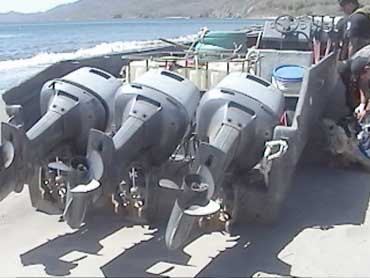 Ministerio de Gobernación,
Policía
Agents examine the launch that carried nearly two tons of
cocaine to Santa Elena on the Pacific over the weekend. Two suspects
still are at large. Even the three 200-horsepower outboards could
not beat police aircraft.y Seguridad Publica Critical thinking in school is topic at Speaker's Forum Special to A.M. Costa Rica
Harry Grzelewski, principal of Country Day Middle School, is the next presenter at the Speaker's Forum. His topic is critical thinking and its role in education. The talk will be Tuesday at 6:45 p.m. in Escazú. "Contrary to popular belief, the future of education is really not about computers," Grzelewski said. "Plenty of schools, private and public, are fully invested in technology. The hardware is in place, the software is available, and every school has plenty of educators who are knowledgeable and can sort through what works and what doesn't. Technology is not coming, it is here. "But the future of education rests in our ability to teach kids how to think. Even the most cutting-edge, on-line, tech-centered newsletters are encouraging schools not to invest in more computers but in better teaching." Grzelewski, a veteran educator, will talk about what teaching kids to think looks like and how it differs from traditional methods in education. He will discuss some of the research that supports this kind of instruction and why critical thinking should be in every school’s curriculum, and be available also to adults, said a release from the forum. More information is available at 289-6333, 821-4708, or 289-6087. A 1,000-colon admission is charged. Medical workers union plans strike Tuesday By the A.M. Costa Rica staff
The union for employees in the nation's hospitals and clinics say it will go on strike indefinitely Tuesday. The issue is salary. The union is the Unión Nacional de Empleados de la Caja y la Seguridad Social. All medical services except emergency will be shut down by the strike, said union officials. Some 15,000 workers are involved. The strike has nothing to do with the free trade treaty with the United States although the union has been a strong opponent to the pact. Luis Chavarría, secretary general of the union, said that salary studies show his union members are underpaid and the central government has made only an offer of a 1,000-colon raise, some $2. In addition to hospitals and clinics, government pharmacies, laboratories, x-ray departments cardiology and radiation therapy will be affected, union leaders said. Man fought off crocodile By the A.M. Costa Rica staff
A man in Palmar fought off a crocodile Monday but suffered injuries to his leg and arm. The man is Rafael Cascante, 20, who is involved in the production of shrimp. He was in waist-deep water cleaning filters for the tanks that hold shrimp.
|
|
If
you want customers
six months from now, you should advertise today! |
 |
|
on our real estate page HERE! |
 |
| A.M. Costa Rica third newspage |
 |
||||||||
| Home |
Tourism |
Calendar |
Classifieds |
Entertainment |
Real
estate |
Rentals |
Sports |
About us |
|
| San José, Costa Rica, Wednesday, March 7, 2007, Vol. 7, No. 47 | |||||||||
| Transport
ministry says it can save money with cold mix |
|
|
By José Pablo Ramírez Vindas
the A.M. Costa Rica staff The transport ministry is starting to use a cold asphalt mixture that officials say has advantages of cost and use over the traditional hot asphalt. The mixture can be used up to 72 hours after manufacture, three times as long as hot asphalt, said the Ministerio de Obras Públicas y Transportes. Karla González Carvajal, the minister, led a show-and-tell tour Tuesday at an asphalt batch plant where some 150 tons of the cold-process asphalt were being produced. The material was to go today in seven trucks to Guanacaste, San Carlos, Pérez Zeledón, Palmar and Turrialba where road resurfacing is taking place. The problem with the traditional hot asphalt is that it has to be applied while still at about 100 degrees C. or 212 F., said the minister. Because of the heat problem, hot asphalt is only applied in cooler climates in the summer. Officials said the cost of production was about 40 percent that of hot asphalt. The Refinadora Costarricense de Petróleo had to produce a special emulsion that does not harden quickly, said Pedro Castro, vice minister. Asphalt is mostly a petroleum product but the ministry's laboratory used a type of rock found near the Colima asphalt plant to add to the mix, he said. Since January several test mixes have been produced. The current mix needs to be put in forms much like concrete requires, but officials are hopeful that another type of emulsifier from the petroleum plant will allow the use of the cold mix to be put down as road sections. The Colima plant will be producing 300 tons of hot mix |
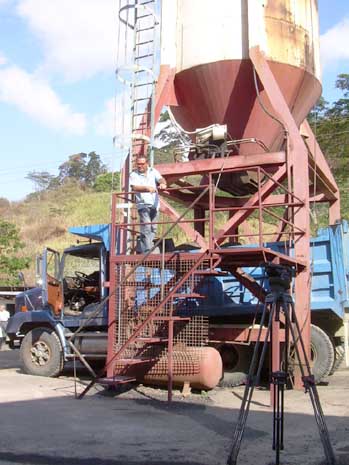 A.M. Costa Rica/José Pablo
Ramírez Vindas
Truck is loaded with cold mix for out-of-town tripin the mornings and 200 tons of cold mix in the afternoons. Other ministry plants might also adopt the cold mix formula, said officials. Cold mix generally is used for patching potholes and can be combined with recycled asphalt which otherwise would have to be dumped. Some types are mixed with water instead of a petroleum base, thus saving more money. |
| Former
banker says he understood risks and blames no one |
|
|
By Dennis Rogers
A.M. Costa Rica special correspondent More witnesses with dramatic stories were the focus at the Tuesday session of the Oswaldo Villalobos trial. Orlando Montero was the kind of down-to-earth person who Costa Ricans call humilde, or "humble." Despite a history similar to another banker, now on the land, that the court heard from early in the trial, his testimony was clear if a little vague on detail. He left a job at the Banco Nacional, where he had reached the level of branch manager, and invested part of his severance with the Villalobos high-interest operation about 1987. Other than establishing an early date for the operation, this prosecution witness mostly favored the defense. As a former banker, he said he understood the extra risk associated with the high return. When Montero was dismissed from the stand, he asked for the opportunity to speak further, and gave an apparently |
impromptu assessment of the
people involved in Villalobos. He insisted they were incapable of the
acts involving money laundering and fraud which they stand accused. A widow of a North American named Jerry Thomas described the circumstances surrounding the loss of their investment and his subsequent health crisis. She was Bertina Pérez who said that they invested $31,000, even though she wasn’t in agreement, to provide extra money for his medical treatment. When the Villalobos operation closed, she said he told her “we lost the money, all that’s left are these checks” which the Banco Nacional would not accept. According to Ms. Pérez, the bank teller told her “the government took the money.” Eventually Thomas went to the U.S. for medical treatment and died alone with no money for his wife and daughter to go there or to bring the body back to Costa Rica, she said. |
| No
decision yet on extra witness who wants to testify |
|
|
By the A.M. Costa Rica staff
There has been no word as of Tuesday if Rainer Hayder will be allowed to testify for the prosecution in the Oswaldo Villalobos trial. Hayder is the man who said he has documentary evidence that will help the prosecution, which is trying to tie Oswaldo Villalobos to the high-interest investment scheme most closely identified with his brother Luis Enrique Villalobos. Both Hayder, in a telephone interview, and Ilem Meléndez, one of the prosecutors, said Tuesday that part of an A.M. Costa Rica story that morning contained incorrect information. The wrong information came from a translating and transcription mistake. |
The story incorrectly said that
Hayder had been in prison and that
Enrique Villalobos visited him there. The story also said he received
some $285,000 back from Villlaobos. Hayder said that it was he who visited not Enrique but Oswaldo Villalobos when the defendant was in the San Sebastian jail for pretrial detention. And, Hayder said, he never got any money back. Hayder said he was coming forward now, in part, because he was unhappy that employees of the Villalobos brothers had their investment capital returned shortly before the businesses closed up when regular investment clients did not. The three judge panel is deciding if he will be allowed to testify. |
| You need to see Costa Rican tourism information HERE! |
| A.M. Costa Rica fourth news page |
|||||||||
| Home |
Tourism |
Calendar |
Classifieds |
Entertainment |
Real
estate |
Rentals |
Sports |
About us |
|
| San José, Costa Rica, Wednesday, March 7, 2007, Vol. 7, No. 47 | |||||||||
|
Are you considering doing
business with a burglar alarm company?
2970-2/8/07If so, you should contact me first for my opinion prometheusthegreek@gmail.com |
From a hotel owner: 'At this time we have a deposit and all looks good!! Thank you for your help, and I must say your paper is impressive, and I had no idea you had such a circulation around the world. Received many inquiries for our hotel for that reason.' She used our classifieds! |
| Flaws
in human rights here listed in U.S. annual report |
||
|
By the A.M. Costa Rica staff
and special and wire service reports. Costa Rica falls short in protecting the human rights of its citizens because of prison overcrowding in certain facilities, inadequate prison medical services in general, substantial judicial process delays particularly in pretrial detention and civil and labor cases, antiquated libel laws and excessive penalties for violations, domestic violence against women and children, child prostitution. and child labor. Plus there is sporadic discrimination against Nicaraguans, but there are no government-endorsed patterns of discrimination. That was the essence of a U.S. report on human rights here. Costa Rica fared much better than other countries in the U.S. State Department 2006 Human Rights report. The department named Sudan, China, Russia, Afghanistan, Egypt, Zimbabwe, Burma, North Korea, Kazakhstan and Iran among the world's worst human rights offenders. The report is required by an act of the U.S. Congress, and State Department workers, with assistance by embassy personnel, prepare a summary of every country. Even the United States did not escape criticism. The report acknowledged that the human rights record of the United States itself has been called into question, saying "our democratic system of governance is accountable, but it is not infallible." Of Costa Rica, the report said: "Although the government worked to improve prison conditions during the year, isolated cases of overcrowding, as well as poor sanitation, lack of health services, and violence among prisoners remained problems in some prison facilities. . . . Illegal narcotics were readily available in the prisons, and drug abuse was common." The report also cited an incident in which seven public security officers witnessed but did not intervene when two guard dogs fatally attacked a Nicaraguan. Nicaragua claimed this showed that its citizens face discrimination and xenophobia in Costa Rica, and the country denounced Costa Rica at the Inter-American Commission on Human Rights. A decision has not been handed down. The report noted the slow resolution of court cases and said that, according to the Ministerio de Justicia y Gracia, as of June 30, there were 1,686 persons in pretrial detention, representing 13 percent of the prison population. And sometimes, those in preventative detention are not segregated from convicted felons, it said. Although Costa Rica did not hold any political prisoners, the report said that former presidents Rafael Ángel Calderón and Miguel Ángel Rodríguez, who were released in October 2005 after nearly one year in custody, asserted that their arrests and preventive detention on corruption charges were politically motivated. They still are awaiting charges. The report also correctly noted that irregular enforcement of property rights and duplicate registrations of title harmed the real property interests of many who believed they held legitimate title to land. The government had not yet modified the law to comply with a 2004 Inter-American Court of Human Rights ruling that the government should reform within a |
reasonable amount of time the press freedom laws on media prosecution, the report said. The Ministerio de Gobernación, Policía y Seguridad Pública said in September that it would work with the Colombian government to determine if any of the approximately 10,000 Colombian refugees living in the country had obtained refugee status under false pretenses. The report noted that the U.N. High Commissioner for Refugees characterized this action as a collective investigation based on nationality and therefore a violation of the confidentiality principle refugees should enjoy. In education, the report noted that the U.N. Children's Fund said that approximately 30 percent of primary school students never entered secondary school and that 47 percent of secondary school students dropped out before graduation. The report also said hundreds of investigations into the commercial sexual exploitation of children were initiated, but few resulted in successful prosecution as a result of governmental inefficiency and an inability to protect witnesses. Minimal coordination among government offices responsible for trafficking-related offenses also frustrated enforcement efforts, said the report. In the labor field, the report said that although the ministerios de Trabajo y Salud shared responsibility for drafting and enforcing occupational health and safety standards, they did not enforce these standards effectively as a result of inadequate allocation of government resources. Elsewhere in Latin America, the report cited Venezuela and Cuba for violating citizens' rights and harassing non-governmental organizations. Assistant Secretary of State Barry Lowenkron says the situation in Venezuela is getting worse with intimidation of the press and efforts to silence the opposition. The report added the Venezuelan government continues to harass the opposition and non-governmental organizations. As for Cuba, the report said the Communist country continues to violate virtually all the rights of its citizens, including the fundamental right to peacefully change their government. It said in 2006 the government increased its harassment of dissidents and others seen as a threat to the government. |
|
| Bush
aid packages seen as a counterbalance to Chávez |
|
|
By the A.M. Costa Rica wire services
President George Bush's latest aid package for Latin America is aimed at combating poverty and strengthening democracy across the region. But some regional experts say the plan, announced just three days before a Bush trip to Latin America, is designed to blunt Venezuela's growing clout on the continent. The announcement of the aid package showed a new side to the administration's relation with the region, which has typically focused on strengthening business ties and trade agreements. It also comes at a time when a key U.S. opponent, Venezuela's President Hugo Chávez, is seeking to increase his nation's outreach on the continent. Since taking office in 1999, President Chávez has vowed to improve social conditions for the poor majority in his country through a series of anti-poverty, health and education programs. Supporters say the programs have been a success in the oil-rich nation, partly thanks to a rise in oil prices around the globe. Jorge Castaneda, former foreign affairs minister for Mexico, says the relative success of the Venezuelan programs is unique to Latin America. "You have a situation now where they have a social policy which means taking basic social services to the urban poor in Latin America," he said. "Health, education, water, controlled prices. It can't last forever, but it's a lot better than what many of these neighbors have elsewhere in Latin America." Castaneda says some of these Venezuelan programs are modeled after similar ones in Cuba. The Communist government in Cuba has long prided itself on education, health and literacy programs for residents on the island, as well as initiatives to send teams of doctors to emergency zones around the world. And just like Cuba, Castaneda says Venezuela is looking to export its social program to countries, such as Bolivia, Ecuador, and Nicaragua. At the same time, Caracas has lent its financial backing to Argentina to issue a joint bond for $1.5 billion. Venezuela's new efforts come at a time of major changes in the international aid and finance sectors, says Albert Fishlow, director of the Institute for Latin American studies at Columbia University. He says there are more possible sources of finance than ever before. The needs in Latin America, he says, have changed. |
"You don't have much need, I would
argue, for massive flows," he said. "And that is for the good, because
every time the
United States promises it's going to do something, it never does. And
the most obvious and saddest case is the Millennium Project." Fishlow and others have criticized the U.S. Millennium Challenge Corp. saying it has been too slow to fulfill its promises. The agency was created in 2004 to increase U.S. aid spending by $5 billion over the following year. Bush appointee John J. Danilovich, former U.S. ambassador to Costa Rica, is chief executive officer of the corporation. Officials at the Millennium Corp. say they have already signed deals worth more than $1 billion with 11 nations, including El Salvador, Nicaragua and Honduras. And days before launching a tour of Latin American nations, President Bush unveiled a new set of aid spending, especially targeted to Latin America. Under the terms of a Millennium Challenge agreement, recipient nations must show a commitment to certain policies, such as political and economic freedom, anti-corruption measures and other reforms. Similar conditions have been common with loans from the International Monetary Fund and other Western agencies. In contrast, Venezuela has not tied its foreign spending to political conditions or promised reforms, says Mark Weisbrot, co-director of the Center for Economic and Policy Research in Washington. "So the Venezuelan government is providing an alternative source of financing, but it's not even trying to tell any of these countries what to do," he said. Weisbrot says the absence of conditions makes Venezuela's spending attractive to other nations in the region. At the time, he said it represents a threat to U.S. leaders who fear losing influence to Venezuela's President Chávez and leftist leaders in the region. "They do think these countries are pursuing reckless, populist policies, and they will eventually learn their lessons," he added. "In the meantime, the loss of influence for the United States is a major concern to the leaders of the Bush administration . . . ." During his Latin America tour, Bush is expected to seek support from Brazilian President Luiz Inacio Lula da Silva to help counter Venezuela's influence. But experts say that Brazil views both the United States and Venezuela as important partners, and is unlikely to take sides. |
| News from
the BBC up to the minute |
BBC sports news up to the minute |
| BBC news and sports feeds are disabled on archived pages. |
|
| A.M. Costa Rica Sports news local and from the wires |
 |
|
|
|
|
|
|
|
|
| San José, Costa Rica, Wednesday, March 7, 2007, Vol. 7, No. 47 | ||||||
| The latest top sports news |
Sports news from VOA |
| Sports feeds are disabled on archived pages. |
|
|
|
|
|
|
|
|
|
| What we published this week: | Monday | Tuesday | Wednesday | Thursday | Friday | Earlier |
|
Check HERE for more details |