mmmm
|
colon exchange rate HERE! |
Your daily English-language
news source
Monday through Friday

|
mmmm
|
Your daily English-language
|
|
|
|
|
|
|
|
|
|
|
|
|
|
|||||||||||||||||||
|
|
|||||||||||||||||||
 |
| Costa Rica Expertise Ltd http://crexpertise.com E-mail info@crexpertise.com Tel:506-256-8585 Fax:506-256-9393 |
 |
 |
|
Mercardo Central fan
Dear A.M. Costa Rica: I read with interest your article " Nothing Fishy about Mercado Central". You mention the new added security. I am a relatively new visitor to San José. However when I am in the city, and that's at least five times a year, I always go into the Mercado Central. My AWE of every building code I have ever been governed by being non existent in the Market is overshadowed by the kindness, helpfulness and variety of the vendors. Federico Fellini could not have staged any movie scene or set to compare with the life inside and surrounding the market. I must say I am saddened by the removal of most of the street vendors who used to surround all four sides of the market on both sides of the street. You failed to mention the variety of sodas inside the market where one can relax and enjoy a wonderful meal or boca not to mention some of the finest ceviche in all of San José while people-watching or Cafe Trebol where José will speak with you in either Spanish or English as he packages your fresh dark roasted beans for the trip north. I try to buy at least 10 kilos for the trip home. They made excellent Christmas presents. As far as security goes, I personally have never noticed. I do say this: if you are intimidated or feel unsafe by the streets of New York: Ditto for you here. If the streets and people of New York or any major city enliven you, then come on down and meet/join the vanishing Costa Rica before it's too late. T. Hegarty
Boston, Mass. Criticism of U.S. fails to consider the facts Dear A.M. Costa Rica: When reading these letters, I don't know what country they are talking about. Is it illegal to use and offer for sale drugs in the U.S.? While it is illegal to do so, isn't everyone informed about the illegality of it's use and distribution, and those incarcerated have decided to ignore the law. If the prison are full of drug addicts, where does the fault fall, on the users/distributors who knowingly break the law or the states that enforce the law on the books. As far as I know, it is illegal to possess and distribute drugs in Costa Rica. Does that fact make Costa Rica a violator of human rights. And since when do we equate the use of drugs and incarceration with human rights. Right now because drugs are illegal we have an illegal drug problem, if they were ever to become legal, then we will have a legal drug problem. The solution might be different, but the problem will remain the same. I live in the U.S. today, even though I am half Costa Rican, and lived many happy years there. One thing I can state with clarity is the LACK of repression in the U.S. What other country do you know of that the burning of it's own flag is protected free speech under its constitution. Try that in Cuba, Russia, China, Mexico, Venezuela, or even Costa Rica and see how much protection you will receive. Try to mount peaceful demonstrations in Washington, Los Angeles, San Francisco, Denver, Kansas, etc. for any public purpose you want, for or against anything, and you can. No Tianamen squares in the U.S. Unfortunately in many cases we even let rioters get away with destruction of peoples lives and property without proper intervention. The U.S. is in the center of world arena. It has placed itself there, because it has the power to do so and the will to act. Sometimes I believe after seeing such criticism, that it would be better to assume the position of an isolationist nation (prior to WW II), and let the chips fall where they may. Although I have a feeling that in a crisis there would be many voices saying, where is the U.S., why don't they help? They have the power and means, yet they do nothing. When you are big and powerful, you are a target, and in a no win situation. Damned if you do and damned if you don't. I personally would rather be damned for trying. As to the man with no name, I am sorry he is a paranoid nutcase. People say these things here all the time, without any consequence. To argue the detail of his allegations is a losing proposition. As the saying goes, "never argue with an idiot, he will bring you down to his level and then beat you with experience." Mike Hankins
Santa Ana, Calif.
Dear A.M. Costa Rica: There have been many reports about the inefficiency of the police force in and around the valley as well as in the outer regions, that one wonders just what their responsibilities are. Is there any use in reporting anything to them? I have known a case where a Gringo was beaten up in his rented home and the police(?) would not even enter the house to check it out. Is the NEW AND IMPROVED police force just for show for the tourist's temporary peace of mind? A report on what they are or are not, similar to your much appreciated report on Costa Rican Wills, would be appreciated. John MacKay
Xpatriate
Dear A.M. Costa Rica: Some in the American press can be pretty hard on the European press; but not half as hard as one of their own. In December, Mathias Dopfner, head of Europe's biggest publishing house, chewed out his fellow Euros for appeasing the world's killers and forcing the U.S. to come in and clean up the mess. "Appeasement cost millions of Jews and non-Jews their lives. Appeasement stabilized Soviet Communism and the German Democratic Republic, in that a large segment of Europe explained away state oppression as the result of ideological differences. Appeasement lamed Europe, as genocide ravaged Bosnia and Kosovo, until the Americans did our work there. Appeasement ruled the day, when Europe looked away from the 300,000 murdered victims of Saddam Hussein in Iraq, and in peaceful self-righteousness gave President Bush bad grades." So what's the reason for all this appeasement? Most Europeans claim it's their great sense of tolerance. But Mr. Dopfner says what it really comes down to is a craven dependence on creature comforts. "Wouldn't we all rather discuss the 35-hour week, the cost of dental insurance, and listen to the television pastors who want to reach out their hands to the murderers? Europe, your name is cowardice." Tough stuff from a tough German. And much of what he had to say would seem to apply also to those in the Canadian press who are French-leaners and that bevy of left-leaners who dominate much of the U.S. press. Jim Edwards
Alajuela Province |
Series of book fairs
set
for San José metro area By the A.M. Costa Rica staff A series of book fairs will make their way through the San José this month. The Club de Libros will sponsor the fairs that are designed to promote reading throughout the Central Valley. The fairs will feature book swaps as well as readings, food and drinks, and music shows. The first fair will take place this Sunday at Parque España during the final day of the Transitartes art festival. The second fair will be the following Tuesday at the Librería Universal on Avenida Central. The third fair will take place next Thursday and will feature a special
section devoted to the works of Jules Verne, author of "Around the World
in 80 Days." The final fair will take place March 13 at the Centro Nacional
de la Cultura, Antigua Fanal, just east of Parque España.
|
|
Los Arcos Subdivision, very upscale, extremely safe.
Walk
to Hotel Cariari, restaurants, mall, Fun & Water park, etc Large
5 bedrooms, 4 1/2 baths, maids quarters, open air BBQ room with large water
fountain, 2 dens, office area, large living room, new paint, new bath and
floor tile, garage. $1,250 monthly with lease (minimum 1 year). Will
lease w/option. Will furnish.
|
 |
|
with the observations of Dr. Lenny Karpman Click HERE! |
 6- 6- |
|
|
A.M. Costa Rica But you knew that already, right? |
|
|
||||
| For most of its history, Japan has
been isolated from the rest of the world geographically and culturally.
Some of its art and culinary heritage come from China, directly or secondarily
via Korea, but most of both have been reworked and refined to the point
that they bear little resemblance to their origins. Japan’s land mass is
small and mountainous. Therefore, the cuisine has evolved with a paucity
of quantity of ingredients and styles and extreme quality of subtle sophistication
and artistic presentation.
Sight and smell are much more important than they are in other cuisines. Soups and stews with aromatic ingredients are often served under a lid to enhance flavor and to preserve the scented steam for the nose of the patron. The four absolute adjectives are precise, minimalist, fresh (ingredients) and harmonious. Simple miso soup demonstrates the levels of subtle sophistication. A top flight restaurant would shave the flakes fresh from a fermented block after the diner is seated, add kelp (kombu) for flavor enhancement, strain and stir in top quality miso and add a thin strip of citron peal along with perfect small cubes of tofu and a few paper thin slices of green onion. The lid would stay on until the diner removed it and sniffed like a wine taster in Bordeaux. Each dish would be matched to the color, texture, shape and general appearance of the plate and reflect a philosophical message through green, yellow, red or purple leaves, sprigs of pine needles, spring flowers or translucent sheets of radish. The standard here in Costa Rica is less, but not bad. Most Japanese-style restaurants pay lip service to the principles with wood and bamboo in evidence, Asian plants, antiques, typical prints, attractive stoneware and artistic presentations of properly seasoned typical dishes, representative of the fare served in department store luncheonettes and cafeterias in Japan. Fish and seafood are very good in those places with high volume and careful purchasing practices. Local salt water fish add a fine dimension to sushi and sashimi. Flash frozen Norwegian salmon may even be superior to the local sockeye in Japan or king and silver salmon in California. Missing are sea urchin and flying fish roe, red clams, baby scallops, herring eggs on seaweed, fresh water eel, raw quail egg yolks and a few other standards. A quick aside about health concerns when eating uncooked seafood. Salt water species are less likely to have parasites than their freshwater counterparts, and nearly all seafood is flash frozen on shipboard these days to further reduce risk. Fugu poses a threat from the poison in its gall bladder. If you see it in a menu, avoid it unless you are in Japan and the chef has all the pedigree papers to ensure safety training. To help you choose from the 15 or 20 Japanese restaurants that offer 1.) good food 2.) at reasonable prices 3.) in a charming setting, I have arbitrarily eliminated the ones that serve Korean, Filipino, Thai or other Asian dishes. "Yes, but" I hear you saying. You are right. I acknowledge that the Japanese dishes as well as |
all the others at Tin Jo are outstanding. To be practical they are excluded as are other places that serve fusion food or still other places (not Tin Jo) where there has ever been a question of fish freshness or quality. In the expensive group that I arbitrarily eliminated, Fuji and Sakura (cherry blossom) are very nice indeed, but more costly than today’s criteria. For best value, it is hard to beat Matsuri in Curridabat’s Crystal Plaza. Missing are the visuals and the presentations. No chopstick rests. No placemats. No bamboo. A three-story ceiling. The bento boxes are wood painted black, rather than lacquer. A step up from food court dining, but not atmospheric or precise enough for this comparison. Ever present, are fresh, generous portions of good fish and standard dishes, perhaps the most affordable filling Japanese meals in town. I particularly like a small newcomer, Shogun. A tiny corner opposite Banex on the Santa Ana to Belen road hides the jewel. The décor is lovely. The place settings and food presentations are precise and tasteful. The flavors are exact. The kitchen chef and sushi chef are Ticos with lots of experience, including stints at Sakura. Its only downside may be survival. Across the road, Auto Mercado has a sushi-to-go counter and virtually next door to the market, Matsuri has just opened a new branch with the promise of identical menu and prices to its Curridabat operation in a smaller setting. In its first week, Matsuri attracted crowds at lunch time. The accoutrements, however, are also identical, including fake flowers and plants and without chopstick holders, placemats or much charm. With a much lower ceiling, it feels a lot warmer and may be more acceptable. Ichiban, another rival in the new Belen Mall, is off to a deserved fast start, as well. Good food with nice presentations. Shogun gets ´´´, my patronage and best wishes to prosper in a difficult marketplace. It is a warm, cozy nook that feels, tastes, smells and looks like suburban Japan. $$-$$$ It is open from 12 to 3 p.m. for lunch and 6 to 11 p.m. for dinner Tuesdays through Sundays. |
|||
| Festival begins to celebrate special Semana Santa squash and its products | |
|
One of the staples of Costa Rican Easter celebrations was venerated Thursday afternoon with the opening of the Feria del Chiverre. The annual festival, which takes place in Laguna de Alfaro Ruiz, near Zarcero, celebrates the arrival of the Chiverre squash. The large white squash is made into a sweet jelly around Easter in Costa Rica. The fair will run daily through March 13. Each day, residents from the community will share traditional |
meals and drinks as they prepare
for Semana Santa.
The squash is almost as large as a watermelon and has a very hard skin. Inside the contents are similar to a pumpkin but are white. Costa Ricans use the squash in many ways, mostly sweet and based on brown sugar, white sugar, in convervas and the famous miel de chiverre or chiverre honey. The plants are one of Laguna de Alfaro Ruiz’s staple crops. The fair celebrates the coming of Semana Santa as well as the regional development that Chiverre plantations have brought. |
|
|
|
with the observations of Dr. Lenny Karpman Click HERE! |
| Subdivision woes stressed
About 50 protestors representing 340 families from Escapulus de Palmares were at Casa Presidencial Thursday unhappy about attempts by Banco Popular to evict them from their 4-year-old subdivision. Protestors say the homes were built on a landfill and the structures are breaking up. Sewer water backs up into the homes, too, they said. They want the place declared uninhabitable, which will
give them certain legal rights to press their case.
|

A.M. Costa Rica/Saray Ramírez
Vindas
|
|
|
|
|
of the A.M. Costa Rica staff Costa Rica will share $150,000 with Honduras and Guatemala to promote disaster preparedness. The money will be used for a six-month advertising campaign. Officials gathered at Casa Presidencial Thursday to view some television commercials and hear some radio spots. Jorge Requena, representative of the International Development Bank in Costa Rica, said that prevention of disasters is good business. The investment in prevention will result in massive savings of money governments will not have to spend after a disaster strikes. The bank is providing the money for the campaign. Officials estimate the cost of natural disasters last year to be some $3.2 trillion worldwide. Costa Rica has been particularly hard hit with flooding on the Caribbean coast during all of the presidency of Abel Pacheco. Four times bridges, public buildings, homes and highways have been heavily damaged by runaway rivers in that area since May 2002. Before any disaster a mechanism or tool for prevention can save lives, said Requena. Mirna Lievano de Marques, a regional adviser for the bank for Central America, said that Costa Rica always has shown an interest in disaster prevention or mitigation. Patricia Barrantes of Barrio Los Aserrines in Hatillo 2 |
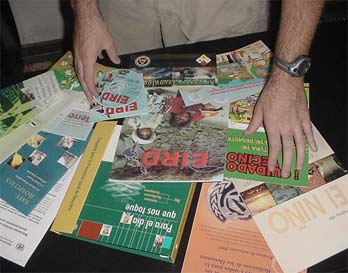
A.M. Costa Rica/Saray Ramírez
Vindas
A table full of literature as well as a CD are available to instruct
about disaster mitigation.
south of San José said that a local disaster committee and training helped with save two lives during flooding there. In addition to advertising, massive amounts of literature are available, both for adults and children. One interesting book for youngsters features a little worm that gives tips on being safe during earthquakes. Among other reminders, Gusy the Worm tells youngsters to make sure the gas is turned off in case of an emergency and to take time to put on shoes to protect feet. |
|
has some 50 exhibitors By the A.M. Costa Rica staff Arts and crafts vendors descended upon Parque España Thursday morning to open an arts festival that will run through the weekend. The festival, entitled Transitartes, will run finish Sunday afternoon. The park is located in central San José across from the INS building. The fair features over 50 displays that include jewelry, candles, decorations, and even kids toys. Lucy Santofimio is one of the vendors at the fair and her religious statues are attention grabbers. Each of the statues, which vary in height from one to three feet, are very detailed and ornate. Miss Santofimio says that she likes the fairs because it allows her to get out of her shop in Santa Ana. "The weather for the fair is perfect," she added. "It’s always better to look at art with the sun on your shoulders." |
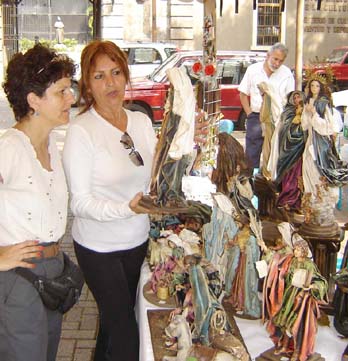
A.M. Costa Rica/Joe Medici
Two shoppers consider the purchase of an elaborate statute of the Virgin
Mary. |
|
|
|
|
|
|
|
|
| What we published this week: | Monday | Tuesday | Wednesday | Thursday | Friday | Earlier |
|
|