Your daily English-language news
source
Monday through Friday
|
|
|
Your daily English-language news
source
|
|
|
|
|
|
|
|
|
|
|
|
|
|
||||||||||
|
|
||||||||||
|
|
|
and other literature on Costa Rica? We got it all (mainly because amazon.com has it all). Check out our Costa Rican bestsellers HERE! |
Buy — sell — rent Check out
|

Many weekend events
By the A.M. Costa Rica staff The weekend will be an interesting one. Friday night the Museo Nacional plans a discussion about the stars and then some hands-on stargazing. Saturday, the hobbyists who collect Costa Rican money will be meeting in the lobby of the Museos del Banco Central under the Plaza de La Cultura. Sunday there is an evening of music planned at the Centro Nacional de Artes y Cultura east of Parque España. The Little Theatre Group debuts its "The Mysterious Mr. Love" by Karoline Leach tonight at 7:30 p.m. in the Blanche Brown Theater in Bello Horizonte. For the politically minded, the Democrats Abroad have a registration session for U.S. citizens and a video about the war in Iraq Saturday at 11 a.m. in the Gran Hotel Costa Rica. The stargazing starts at 7 p.m. with a presentation by José Alberto Villalobos Morales. After a chat about the heavens, visitors to the museum just east of the downtown in the Bella Vista Fortress will be invited to train a telescope on stars and planets. In addition, some powerful binoculars will be available. The museum has promised that Venus and Saturn will make appearances as well as the Orion Nebula. The money swap by hobbyists is a regular event on the last Saturday of the month. In addition to money, coffee notes will be available for exchange or sale. The session starts at 10 a.m. In addition, visitors will be able to drop by the money museum where the history of Costa Rican coinage is displayed since colonial times. The event Sunday is under the Ministerio de Cultura, Deporte y Juventud. Friday and Saturday the center has plays scheduled in Spanish. La Calle de la Gran Ocasión is Friday and Un Viejo con Alas is Saturday. Both begin at 8 p.m. Admission is 1,000 colons or about $2.50. On Sunday the showtime is 5 p.m. for a warmup to Arnulfo y las Criaturas Maravillosos. The entrance fee is just 500 colons, less than $1.25. The Sunday presentation is designed for the family with the chorus of the Escuela Municipal de Música de La Unión performing at 5 p.m. At 5:30 p.m. the group of clowns, Paraguas Rojo perform, followed by the show for children put on by Teatro Contraluz. Regulatory agency ducks
By the A.M. Costa Rica staff The acting director of Costa Rica’s financial watchdog agency told legislators Thursday that his agency only was involved in monitoring physical cash transactions made at banks. The acting director said that his agency has nothing to do with electronic transfers. The official is Juan Muñoz and the agency is the Superintendencia General de Entitades Financieros. He was testifying before the Comisión Permanente Especial de Narcotráfico of the Asamblea Nacional. Lawmakers are interested in closing the loopholes that exist in current laws about money laundering. Mario Calderón, a legislator, said he was worried because many financial transactions that are categorized as suspicious by the Superintendencia are done via electronic means. Both Muños and another employee of the financial watchdog, Martín Rojas, agreed that many transactions are done electronically. But neither the banking laws nor the anti-drug laws give the Superintendencia the power to keep track of such funds, the men said. The Superintendencia always has had a narrow view of its role. The agency came into the news when the Luis Enrique and Oswaldo Villalobos Camacho high-interest operation failed. The agency said that it had evaluated the money exchange house run by Oswaldo Villalobos and found nothing wrong. However, it said that it did not evaluate the high-interest operation conducted in the adjacent room. The agency said it did not have the legal authority to go beyond those financial agencies that are registered by it. The commission will be hearing soon from the Superintendencia General
de Valores, the agency that supervises stocks and bonds, and the Superintendencia
de Pensiones as well as the Unidad Especial de Narcotráfico, the
top drug-fighting agency.
Crime survey planned
By the A.M. Costa Rica staff Crime in Costa Rica is a big issue, and no one denies that crime has increased over the last 10 years. But just how serious is crime. That’s a question the Ministerio de Gobernación, Policía y Seguridad Pública wants to answer. The ministry and the Program of the United Nations for Development in Costa Rica have signed an agreement to devise a questionnaire about the perception of citizens toward criminality in the country. The survey will be done within three months, according to ground rules established when an agreement was signed Thursday. |
|
|
|
|

A.M. Costa Rica staff
|
|
|
|
|
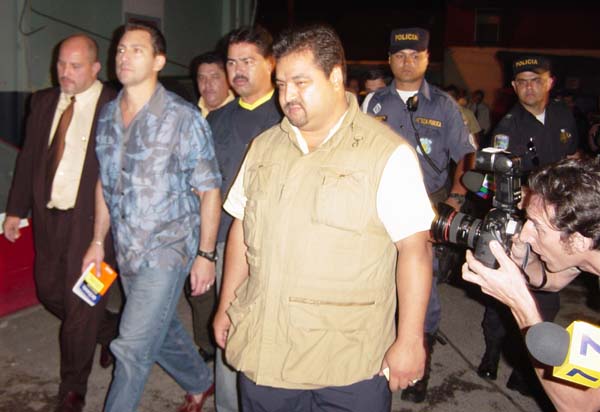
The story of the dead financial analyst and the fleeing phony physician has captured the front pages in much of North America, so when the suspect was caught in Costa Rica Thursday afternoon, it was like old home week for New York metro journalists. The fugitive, Dean Faiello, turned up in Sámara Thursday. The police said they tracked him down. The suspect’s lawyer said that he called police on behalf of his client. International press, mostly from New York, have been pouring into Costa Rica since Monday. Police there disclosed Feb. 19 that Faiello went to Costa Rica. According to the man’s lawyer, Moisés Leonardo Vincenzi Zuñiga, his client is simply a tourist who did not know he was being sought until he saw news stories in the local papers. Vincenzi, who also represents the Rev. Minor de Jesús Calvo Aguilar in the assassination of radio commentator Parmenio Medina Pérez, said he flew to Sámara about noon Thursday to meet with his new client. The lawyer said that Faiello was enjoying himself at the hotel for five days: "He did not know they were looking for him," the lawyer said. But police were. Although the New Jersey native is being held for overstaying his tourist visa, he is the principal suspect in the death of Maria Cruz, a respected New York financial analyst. She vanished April 13 and turned up only this Feb. 18, neatly stuffed into a suitcase under fresh concrete at Faiello’s former Newark, N.J. residence. Faiello has been convicted in New York of pretending to be a dermatologist. He did not finish college and has no medical license. But he did have a dermatology practice in Manhattan. Police suspect that Ms. Cruz was one of his patients and that she died of a reaction to anesthesia. Rogelio Ramos, minister of Seguridad, gave a litany of charges during a quick afternoon press conference. All were related to the illegal practice of medicine. Ramos noted that Faiello jumped $5,000 bail and came to Costa Rica Sept. 18. It was Ramos who said that police work tracked down the suspect. Faiello has been convicted in New York of the illegal practice of medicine, but he has not been charged in the death of Ms. Cruz. |

A.M. Costa Rica staff
Ramos also said that officials have two alternatives in sending the suspect back to the United States. He can be expelled for violation of immigration rules or he can be extradited. The extradition process is likely to be a long one because Vincenzi, the lawyer, also was the advocate for Keith Anderson of Anderson’s Ark, which the U.S. Internal Revenue Service has called a tax evasion system. Anderson nearly obtained Costa Rica citizenship, which would have precluded his extradition. Eventually, he was extradited. Faiello, 44, returned by vehicle to San José last night about 7:30 p.m. in custody. He was accompanied by Marco Badilla, director general de Migración y Extranjería. Lawyer Vincenzi came back by plane and waited to accompany his client to the immigration holding cells on Avenida Primera. Faiello was detained in the Villas Playas Sámara hotel where he had spent five days. Sámara is on the west coast of the Nicoya Peninsula on the Pacific Ocean. Many of the New York City reporters and cameramen expressed a strong desire to travel to the beach to find out additional information. Among those covering the story were Jeane MacIntosh of the New York Post, Michele McPhee of the New York Daily News, Sarah Wallace of WABC-TV in New York and a crew from New York’s Channel 2. |
|
|
|
|
PORT-AU-PRICE, Haiti _ Widespread lawlessness and chaos is gripping Haiti's capital, where President Jean-Bertrand Aristide is facing increasing pressure to resign. Die-hard backers of the embattled leader are terrorizing people they suspect of non-allegiance to Aristide, including a flood of foreigners desperate to leave the country. The streets of Port-au-Prince have gone from dicey to treacherous. Normally clogged with all manner of vehicles, the roads are now the domain of the brave, or the foolhardy. Many streets are littered with burned-out cars, concrete blocks and old tires, put there as barricades by President Aristide's most ardent supporters: ruffians known locally as "chimeres," or "ghosts." At one barricade, a gang of about 20 young males surrounds all who stop. An 18-year-old who declines to identify himself says his goal is to slow any attacks by rebels from the north, who have pledged to take Port-au-Prince by force unless President Aristide resigns. The youth says, "if the rebels come, no matter what they do, we will defend ourselves any way we can." The gang allows a reporter to pass unharmed. Elsewhere in the city, other motorists are not so lucky. Many Aristide backers see the international community as conspiring to remove their president from power, and foreigners are increasingly coming under attack. At Port-au-Prince's international airport, |
American missionary Rodney Smoker
and his aged grandmother wait anxiously to board a flight out of Haiti,
after surviving a hair-raising encounter with the "chimeres."
"Just coming to the airport, we went through a neighborhood and they [thugs] jumped on us," he said. "There were about 15-to-20 guys. They jumped on our van and were going through all of our stuff, ripping through all of our stuff. My grandma was crying," he said. Smoker is abandoning Haiti after 18 years of missionary work. He says he is heartbroken, and has come to wonder whether his efforts to bring a better life to Haiti's people have been in vain. "It is hard, because they have so much potential, they have so much love," he said. "They have character. But then there is the bitterness, the hatred that is in them, it is in their hearts. That is what kills me. Sometime I think, 'Wow, is it even worth it [to be in Haiti]?'" Standing in line behind Smoker is another missionary, Irma Carr, who says she fears a bloodbath in Haiti between President Aristide's backers and opponents, with millions of innocent people caught in the crossfire. "I pray not, but there very well could be [a bloodbath]. Look at all the lives that have been taken already. I would not be surprised. That is why we are leaving. Our church is evacuating us," she said. Those still in Port-au-Prince, Haitian and foreigner alike, face the prospect of the complete dissolution of public security and a situation that grows more tense and desperate by the hour. |
|
|
|
Most countries in hemisphere protect rights |
|
|
WASHINGTON, D.C. — The majority of Western Hemisphere governments respected the human rights of their citizens in 2003, although problems persist in many of these nations as well as in other neighboring countries where the governments' human rights performances were poor, according to the U.S. State Department. The State Department issued its annual Country Reports on Human Rights Practices Wednesday. Promoting respect for universal human rights is a central dimension of U.S. foreign policy, the State Department said. The 2003 report indicates that the majority of hemispheric nations generally respected the human rights of their citizens, even though problems may persist in these countries. A few nations in the region, however, received poor marks for their human rights practices in the State Department report. The report found that human rights abuses in Cuba "worsened dramatically" as the regime of Cuban dictator Fidel Castro continued to commit numerous serious abuses and denied Cuba's citizens the right to change their government. The report pointed to the sentencing of 75 dissidents to lengthy prison terms for exercising their fundamental rights as evidence of the government's poor performance. The report was also critical of the Castro regime for ignoring petitions, which contained thousands of signatures, calling for a national referendum on political and economic reforms. The State Department report found that the Colombian government's human rights record remained poor, despite "significant improvements in some areas." The report found an increasingly small percentage of reported human rights abuses were attributed to Colombian security forces. Kidnappings, killings and forced displacements also declined. However, some members of the security forces continued to commit serious abuses, including unlawful and extrajudicial killings. Moreover, the report said that some members of Colombia's security forces also collaborated with the Self-Defense Forces of Colombia (AUC) paramilitary group, which committed serious abuses. The AUC has been designated by the State Department as a terrorist organization. The report further found that Colombia's civilian judiciary was inefficient, overburdened, and undermined by corruption, rarely bringing to trial high-ranking members of the security forces charged with human rights abuses. The Haitian government's human rights record also remained poor in 2003, the State Department said. The government of Haiti's President Jean-Bertrand Aristide "frustrated efforts to form a legitimate Provisional Electoral Council, and his supporters, henchmen and civilian attaches associated with the national police killed members of opposition parties and violently disrupted their demonstrations," the report found. Legal impunity in Haiti also remained a "major problem," the report said. In Venezuela, the government's human rights record was deemed to have
remained poor in 2003. "Although there were attempts at improvements in
a few areas, serious problems remained," the State Department report said.
|
The State Department found that Venezuelan
police and the military committed extrajudicial killings of criminal suspects,
with the police linked to vigilante death squads responsible for hundreds
of killings. Corruption, lengthy pretrial detention, and severe inefficiency
in the judicial and law enforcement systems were also problems, the report
said.
In addition, the report indicated that Venezuelan government officials "conducted illegal wiretapping of private citizens and intimidated political opponents." The State Department pointed out that Venezuela's President Hugo Chavez, officials in his administration, and members of his political party frequently criticized the media, opposition, labor, the courts, the Catholic Church and human rights groups. Government supporters interpreted these remarks as tacit permission for violence and then threatened, intimidated and harmed individuals opposed to the Chavez administration. The report said that the Chavez administration also abused its legal powers by requiring all television and radio stations to air over 136 hours of speeches by Chavez and administration officials. Threats and government pressure against the media also continued, as did legislative efforts to limit the media's exercise of freedom of expression. The State Department noted that conditions for independent labor unions also deteriorated in Venezuela, as the Chavez government refused to recognize the elected leader of the Confederation of Venezuelan Workers, ordering the arrest of its secretary general and forcing him to flee the country. He sought asylum in Costa Rica. Despite improvements in some areas, serious problems also remained in the Dominican Republic, where the government's human rights record remained poor. Members of the Dominican security forces continued to commit unlawful killings, the report said. Also, "the police and, to a lesser degree, the military tortured, beat or otherwise abused detainees and prisoners," the department added. Other serious problems in the Dominican Republic included poor or harsh prison conditions, lengthy pre-trial detention and trial delays, and the use of excessive force by police to disperse demonstrators. Reports of forced labor, unsafe labor conditions and trafficking in persons were also identified as problems. In Guatemala, the State Department said, the government complied with the Peace Accords of 1996 by completing the demobilization of the Presidential Military Staff (EMP), which had been implicated in serious human rights abuses. However, despite improvements in some areas, the government's human rights record was poor in 2003, as serious abuses persisted. Among those abuses were killings by individuals linked to security forces and politically motivated killings by non-state actors. There were also reports of violent deaths, killings, and "social cleansing," in which persons deemed socially undesirable were killed. The State Department concluded that the federal governments of Mexico and Brazil generally respected the rights of their citizens, despite serious problems in some of their states. The Western Hemisphere portions of the State Department's Country Reports on Human Rights Practices are posted online HERE! |
|
|
|
| Dear A.M. Costa Rica:
I find it almost humorous that the U.S. would issue a human rights report on Costa Rica. Certainly the U.S. has all the same problems it mentions with this country. Crowded prisions are probably equally a problem in the U.S. Domestic violence is certainly an issue in the U.S. Long detentions? Well Guantanamo Bay comes to mind. Police abuse? I read articles every day about such abuses in the US. In global terms, the U.S. would appear to be one of the most punitive countries in the world, with Bush's Texas leading the pack in executions. There is no capital punishment in Costa Rica due to respect for human rights. In fact, much of Latin America abolished the death penalty due to the fact that it was applied so liberally by sleazebag dictators for political reasons in Latin America in the past, many of whom were supported by the U.S. government. Really, it is almost funny if not downright ironic that the U.S. has the arrogance to issue reports about the rest of the world when many of the |
same problems are present in the
U.S. and in some cases, the world would say, even worse.
I remember hearing that some South Americans decided to monitor elections in the U.S., noting that the U.S. considers itself a watchdog in the affairs of other sovereign nations. Maybe we ought to issue a report on the human rights abuses in the U.S.? We certainly have a record equal to, if not better than, the US. The irony goes further when one considers that the U.S. has never been slow to fund and support governments famous for human rights abuses. Ie. China and many Middle Eastern countries. There have never been any great disdain for trade agreements with those on the naughty list either. So what's their point? Really, I would prefer to see my tax dollars used on something other than a pretense of the "moral high road" judging other countries on human rights. Let the U.S. clean up it's act, take the board out of it's own eye, before pointing fingers at the rest of the world! Robbie Felix
Quepos 2/27/04 |
|
|
|
|
|
|
|
|
| What we published this week: | Monday | Tuesday | Wednesday | Thursday | Friday | Earlier |
|
|