|
Your daily English-language news
source
|
at the speed of
|
|
|
|
|
|
|
|
|
|
|
|
|
|
||||||||
|
|
||||||||
|
Beach Resort/Hotel, Nicoya Peninsula Visit our WEB at www.brightbay.info
for details then book a room for $55/Night for a couple at the most convenient
significant Resort to San José on the Nicoya Peninsula.
|
Listen
to the sounds of the small creek!
Tropical home, 5 bedrooms & 2 baths, with nice, large exterior
tiled corridors all around. Fruit garden of 1,730 meters. Corner lot. Basketball
court and children’s playground w/slide included. Sprinkler system. Two
phone lines. Cable available. Large separate laundry room. Walking distance
to center & transportation. By owner, $168,000 make
offers! Partial financing available for 13 years at 7.5% annual
interest rate.
|
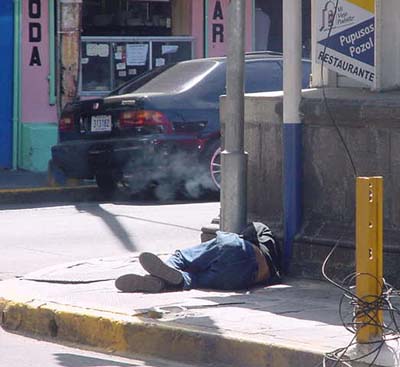
| Crack cocaine
is the root of street kid problems By Jay Brodell
When the topic is street children, observers see the youngsters as victims, as pawns to be manipulated for the advantage of adults. |
A.M. Costa Rica
|
| In fact, the youngsters are decision-makers
who frequently prefer the freedom they have on the street.
Such a view clashes with that of social workers who structure programs
for street children as victims. That is not to say that victimization does
not take place, but many times it is the younger child being victimized
by an older child or teen.
Street children play a role in a number of social evils, including drug trafficking, child prostitution, assaults and property crimes. But they do so with full knowledge of their actions, despite their ages. Then they grow up to be more efficient at crime and parents of more street children. Crack cocaine is the currency. Case Alianza estimated in its report on the situation that 80 percent are addicted. The percentage is closer to 100. The culture on the street is complex with its own norms and standards. Only by extensive efforts can a child be directed into a more normal lifestyle. The most successful at this is Gail Nystrom of Fundación Humanitaria. And she can count just a handful of children she has saved from the street. Her many failures are on the street today. She knows them by name. They have made an affirmative decision to rejoin the drug culture instead of the more traditional life of school and work that the foundation offers. Casa Alianza did a study and estimated that some 1,500 children are on the streets of Costa Rica. Others estimate as few as 20 true street children in all of San José. The problem is one of definition, and failure to clearly define terms can lead to a lot of official wheel-spinning. Throughout the marginalized barrios of San José youngsters roam in gangs. But most have some type of home to which they can return. Others live in hotels as prostitutes, according to social workers. Even a cracked-out youngster asleep in a doorway may rouse himself and stagger off to some form of home. So the term "street children" really is not helpful to discussions of the problem, particularly when the words are not clearly defined. A nighttime patrol through Barrio Cuba and Cristo Rey does not often turn up bands of youngsters, although someone like Ms. Nystrom can point out the vacant buildings and lots where the youngsters accumulate. For much of the evening, the youngsters are in the |
seedier downtown areas hustling to
make money to support their drug habit. Some earn upwards of 50,000 colons
a day (about $130) with a combination of theft, begging and prostitution,
say social workers.
Sometimes adults guide them into serious crime. Sometimes the adults are policemen, say the social workers and youngsters. In San José, crack cocaine is easily available, perhaps more so now that the United States has tightened up its southern borders after terrorists attacked New York and Washington. A crack rock for smoking costs just 500 colons here (about $1.30). Various downtown lunch spots and other retail outlets sell crack along with more traditional legal products. Youngsters are being seen more and more in the drug industry. Two 14 year olds went to jail a week ago when police caught them carrying 250 grams of cocaine from San José to Liberia by bus. That is nearly $4,000 worth of cocaine here and perhaps 10 times as much in value in the United States or Europe. Recent arrests of persons who enjoy sex with children show the frequency of that type of behavior here. Sex visits where foreigners come here specifically to become involved with minors are the dark side of Costa Rica’s tourism industry. Casa Alianza says it has filed more than 250 complaints with a special prosecutor on sex crimes, and that office is flooded. The majority of the male and female children involved are not being coerced. They participate willingly as sex partners or models for child pornography in order to earn money for drugs. At least three of the 20 or so youngsters now on the streets in San José have tested positive for HIV/AIDS, a social worker reports. Some social workers blame the government for failing to provide funds. But part-time refuges for the youngsters have not proved successful. The youngsters simply use the refuges as bases from which to pursue their illegal activities. More and more, social workers suggest locking up the children in prison-like conditions to force them to quit their drug habits. Such forcible actions run counter to Costa Rican tradition. Yet it is clear that child abuse, child prostitution, street children, child crime and all the other associated ills are directly tied to the drug trade. And the failure of society to find a clear answer to the plague of hard drugs perpetuates the condition of the children on or near the streets. |
|
|
|
|
CARACAS, Venezuela — Hundreds of thousands of people took to the streets and plazas again Sunday in support of a petition drive they hope will lead to early elections to remove President Hugo Chavez from power. These people say they easily surpassed the 15 percent of registered voters required by the constitution to begin an amendment process. But the embattled Chavez shows no sign of giving in. Anti-Chavez crowds chanted, cheered and sang as the sun set over the country. They were buoyed by the turnout for what opposition leaders call the big sign-up. All over the country people stood in long lines to sign petitions calling for, among other things, a change in the constitution that would allow an early election. Sunday was to have been the day of a referendum for voters to either approve or disapprove of Chavez continuing in power. But the non-binding electoral action sought by the opposition was rejected by the Venezuelan Supreme Court last month. Later, opposition leaders embraced a plan presented by former U.S. President Jimmy Carter to seek a change in the constitution that would shorten the presidential term. This would allow for an election sometime before August, when a binding referendum could be organized under the current constitution. If Chavez was worried by the turnout, he showed no sign of it. During his weekly television |
appearance, he celebrated his fourth
year in office, and declared a victory over what he describes as rich oligarchs
who want the country for themselves.
He said that if anyone wants to remove him from office, they must follow the law established by the constitution, not the dictates of what he called the "owners of the old power of the oligarchy." Chavez called the opposition's general strike, which started on December second, a failure because banks and most stores will reopen this week. Opposition leaders say they are easing the strike, in order to prevent businesses from going bankrupt. They say this is a tactical move, not a sign of weakness. Petroleum workers are continuing their strike, but government spokesmen say the oil sector is starting to recuperate. Oil production is now at over one million barrels a day, up from around 200,000 barrels a month ago. This, however, is still only about a third of normal output. Venezuela was the world's fifth largest oil producer before the strike, and a main supplier of crude oil to the United States. Oil revenue accounts for a third of the government's budget. So far, experts say, the strike has cost the country around $4 billion in lost oil revenue. They also say damage to some petroleum industry facilities may never be undone. |
| Day of mourning
here in Costa Rica By the A.M. Costa Rica staff Today is an official day of mourning for Costa Rica in honor of the seven Space Shuttle Columbia astronauts who died Saturday morning over Texas. U.S. Ambassador John J. Danilovich said that President Abel Pacheco has declared that all flags in the country be flown at half staff today. In a prepared statement he said he appreciated the condolences and expressions of solidarity that the people and government of Costa Rica had shown. Symphonic orchestra
By the A.M. Costa Rica staff Chosei Komatsu, the Japanese conductor, is the new director of the Orquesta Sinfónica Nacional, Guido Saénz, minister of Cultura, Juventud y Deportes said Monday. The new conductor said that he would raise the orchestra in a short while into the front ranks of the musical world. Komatsu was among 140 persons who sought the job. Some 12 finalists were asked to conduct during the 2002 season, and the names of three finalists were sent to the minister by the selection committee. He made the choice. Komatsu will take the job at the beginning of 2004. Komatsu is principal director of an orchestra in Tokyo. Komatsu was musical director of the Kitchener-Waterlook Symphony in Canada and has directed most of the principal orchestras there. He also worked in the United States with the Baltimore, Md., and Buffalo, N.Y., symphonies. Sabotage suspected
By the A.M. Costa Rica staff A Playa Ocotal, Guanacaste, hotel reported suspected sabotage after its swimming pool turned an "emerald green," said the hotel manager. Eric Duranton, manager of Bahia Pez Vela Hotel, said that the change in the water occurred just over two weeks ago. Analysis showed that some chemical had been added to the pool. Around one-and-a-half years ago the hotel switched from using chlorine to a product called ChlorFree. ChlorFree is a non-chemical method of maintaining pools. It utilizes a specially designed battery capsule to ionize water, killing bacteria. ChlorFree’s costs are considerably lower than chlorine. Duranton said that he believes the hotel pool was sabotaged. Stephen Verdon, president of the company that provides ChlorFree, said that this is the eighth hotel his company supplies that has reported such problems with its pools. Up until now, according to Duranton and Verdon, no sabotage complaints have been filed with the authorities. Verdon said the incident is in the hands of his lawyer. U.S. citizens warned
By the A.M. Costa Rica wire services WASHINGTON, D.C. — The U.S. State Department is warning Americans to exercise caution while traveling in the south Mexican state of Chiapas citing threats against foreigners and businesses that serve them. The State Department says that recently there have been disturbing incidents involving violence and threats of violence against foreigners and businesses that cater to foreign tourists in remote areas. It says that in many parts of Chiapas "there also is no effective law enforcement of police protection." The travel advisory says U.S. citizens should avoid traveling in areas where disputes are known to be ongoing, including rural areas east of Ocosingo, and the entire southeastern jungle portion of the state to the east of Comitan. Zapatista rebels in Chiapas took up arms against the Mexican government in 1994. Ecuador reaches financial
By the A.M. Costa Rica wire services WASHINGTON, D.C. — The International Monetary Fund has announced it has reached a financial aid agreement with Ecuador. The fund said Friday that it has drafted a lending agreement based on economic programs Ecuador will implement. The arrangement must now be reviewed and approved by fund management. The fund gave few details, but said it hopes to complete the review process as quickly as possible. Ecuador has been eager to finalize a loan package with the fund so that the government can begin negotiations with other lenders to restructure its international public debt. In September, the fund and Ecuador were unable to reach agreement on a $240 million loan package. The fund said at the time that Ecuador's budget, government wages and impending elections were all factors that needed to be addressed.
|
Mexican U.S. consulate
staff arrested for fraud
Special to A.M. Costa Rica WASHINGTON, D.C. — Three Mexican employees of the U.S. Consulate in Nuevo Laredo were arrested by the U.S. Diplomatic Security Service Thursday and charged with conspiracy to commit visa fraud, said Richard Boucher, a State Department spokesman. The arrests are "in connection with an ongoing investigation of illegal visa issuance at the consulate," Boucher explained. Sergio Genaro Ochoa-Alarcon, Benjamin Antonio Ayala-Morales and Ramon Alberto Torres-Galvan — all citizens of Mexico — appeared in federal court in Laredo, Texas, this morning. Each was charged with conspiracy to commit visa fraud. U.S. official voices
Special to A.M. Costa Rica WASHINGTON, D.C. —Ann Veneman, the U.S. agriculture secretary, says the European Union's moratorium on food derived from biotechnology is in violation of its World Trade Organization obligations. In remarks to agriculture journalists Veneman said Friday that the United States is losing patience with the union and that its action challenges the organization's integrity. The policy also hurts other countries, she said, because it spreads
"unnecessary" fear about the safety of biotechnology. The United States
says that foods derived from biotechnology are as safe as traditionally
grown food.
|
|
• Martha Alvarado • e-mail: marthaeliasib@hotmail.com •383-5594 and 294-2346 Small groups, too! |
|
|
|
|
WASHINGTON, D.C. — The United States next year will change the design of its currency and include a color other than green on the bills. The U.S. Treasury Department said it plans to introduce "significant changes" in the appearance of the dollar at least every seven or eight years as part of an intensified campaign to stop the counterfeiting of U.S. notes, said Peter Fisher, undersecretary of Treasury. In an address Sunday to the Banknote 2003 Conference here Fisher said that "continuous improvement" in design features coupled with strong law enforcement is the most effective defense against counterfeit dollars. "The overarching goal for U.S. currency design is to maintain confidence in our notes, both at home and abroad," he said. The dollar is widely used around the globe, with 60 percent of circulating Federal Reserve notes held outside the United States, according to Fisher. He said new technology has also made it easier for counterfeiters around the world to make quality copies of U.S. notes. According to the Bush administration's budget |
proposal for 2004, U.S. law enforcement
officials discovered $47.5 million in counterfeit money in 2002. Of the
total, 39 percent was computer generated, up from only 0.5 percent in 1995.
To combat the increasing sophistication of the tools available to counterfeiters, the Treasury Department has initiated "a process of continuous cycles of design change" and will in 2003 unveil a new design for the dollar that will, for the first time, include the use of a color other than green, Fisher said. The new design will be accompanied by an extensive public education campaign both domestically and overseas, said Fisher, who noted that security features work "only if the public knows about and uses them to authenticate currency." He said the education campaign would likely face a special challenge in the United States, where the currency design introduced in 1928 lasted nearly 70 years and where residents have only recently had to adapt to relatively minor changes in the physical appearance of the dollar. The more dramatic redesign to be introduced in 2003 "will require extensive foreign and domestic marketing campaigns to educate consumers, banks and law enforcement officials," Fisher said. |
|
|
|
Louis Milanes |
Luis Enrique Villalobos Camacho |
|
This newspaper seeks the prompt return of two men who ran high-interest investment operations that have gone out of business. Luis Enrique Villalobos Camacho, 62, was associated with Ofinter S.A., a money exchange house, and with his own private investment business that had about $1 billion in other people’s money on the books. Villalobos closed his business Oct. 14 and vanished. Louis Milanes operated Savings Unlimited and several casinos in San José. He left the country with other members of his firm the weekend of Nov. 23. He may have as much as $260 million in his possession. Both operations catered to North Americans. |
Villalobos had about 6,300 customers. Milanes
had about 2,400.
Villalobos and Milanes are the subjects of international arrest warrants. Associates of both men have been jailed. A.M. Costa Rica has posted a $500 reward for information leading to the detention of either man with the hopes that others will make similar pledges. The newspaper believes that investors only will see some of their money when the two men are in custody. Milanes has few supporters in San José. On the other hand, as the letters frequently on this page show, Villalobos still has supporters who believe that he will reappear and settle his debts. They believe he is in hiding because of a predatory Costa Rican government. |
| What we published this week: | Monday | Tuesday | Wednesday | Thursday | Friday | Earlier |
|
|