A.M. Costa Rica photos
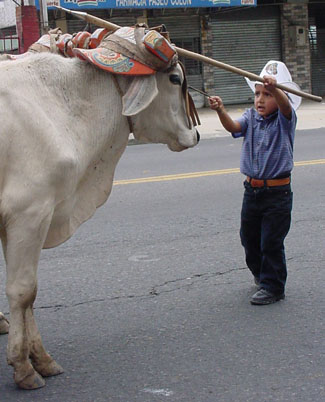
A boy, left, gets the attention of two animals at least 20 times
his weight and commands them with the traditional boyero's metal-tipped
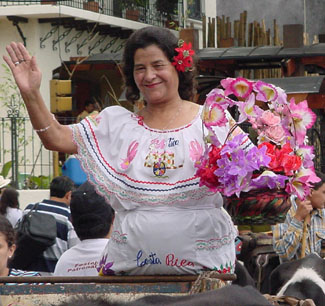
lance. Above, the parade queen, Digna Montes Astura basks in the crowd's
applause.|
Your daily English-language news source Monday through Friday |
|
|
|
|
|
|
|
|
|
|
|
|
A.M. Costa Rica photos
A boy, left, gets the attention of two animals at least 20 times
his weight and commands them with the traditional boyero's metal-tipped
lance. Above, the parade queen, Digna Montes Astura basks in the crowd's
applause. |
|
|
|
The official beginning of the holiday season took place Sunday when about 70 two-wheeled oxcarts, carved saints, oxen in training and their handlers paraded down Paseo Colon into the downtown. The vividly painted oxcarts ("carretas") have long been a symbol of Costa Rica and you could have your pick among the various types on parade. They ranged from the multi-passenger tourist cart used by the Butterfly Farm to the rustic "cureña," or sideless working cart. The ox handlers are "boyeros" in Spanish, and, despite the historical significance, the entry of the carts and their holiday link is only five years old. The first parade was in 1997 after a presidential decree linking the carts to the holiday kickoff. Entrants from all over Costa Rica carried their home city’s name, including the participants from San Isidro de Coronado who carried a model of their patron saint (and the patron of farmers) in the parade. The statue of San Isidro Labrador (Saint Isidro, the plowman) and of his two oxen were carried appropriately atop a real oxcart. Oscar Cordova of San Antonio de Excazú directed a cart that carried a statute of Saint Joseph, the patron of the capital, and the child Jesus. The queen of the event was Digna Montes Astura, who clutched a bouquet and |
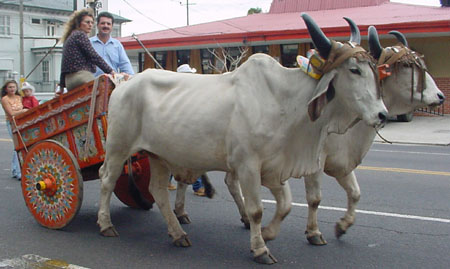
happily proclaimed that this was her second year in that position. A number of out-of-town participants overnighted so they could be ready for the 9 a.m. start. Although carts were used in one form or another in the colonial period, horses and mules were the more important form of long-distance transport. It was the coffee boom in the 19th century that demanded that Costa Ricans devise a way to transport the golden grain from the central valley to boats at Puntarenas, according to literature provided by the boyeros. The rustic cart was transformed into a cargo vehicle. As the road to the sea improved, as many as 700 carts a day made the long trip. . It was not until early in the 20th century that an Italian immigrant in Escazú came up with the idea of adorning the carts with intricate colorings in the style that was typical of the Sicilian carts of his home. Although some geometric designs could be seen on earlier carts, historians generally place the development of the more ornate vehicles in the 1930s. The vehicle with each wheel a single piece of tree trunk encircled by an iron belt makes a distinctive sound. The best words to describe the passage of such a cart on a modern road such as Paseo Colon would be a continual growl. The giant animals, some six feet high at the shoulders are carefully matched in pairs. A few younger animals marched without carts Sunday to get a feel for the route and the process. And, too, some younger boyeros handled animals that were 20 times their own weight. Traffic was blocked on Paseo Colon eastbound from about 8:30 a.m. to well after noon as cleanup crews followed up on the debris left by paraders and spectators. The Parade of Lights in mid-December will be the next major public spectacle, followed by a horse parade and carnival in the week after Christmas. |
|
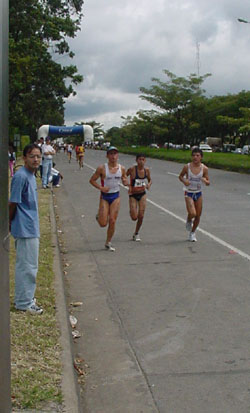
A.M. Costa Rica photo
While we were having that second bagel Sunday morning, the Costa Rican
Triathelon Association had these young people and others like them out
swimming three-quarters of a kilometer, biking 20 kilometers and running
a 5K in the Sabana Park area.
Senate wants to hear Ashcroft discuss views The U.S. Senate Judiciary Committee has asked Attorney General John Ashcroft to testify about controversial legal measures in the anti-terrorism campaign. In an interview with NBC television, Democratic Sen. Patrick Leahy, chairman of the Judiciary Committee, said the country is owed an explanation about the measures. A Justice Department spokesman said that Ashcroft has agreed to testify before the Senate committee during the first week of December. Both Democrats and Republicans have criticized some anti-terrorist actions as violations of civil liberties, including the detention of hundreds of people rounded up after the Sept. 11 terrorist attacks. Some lawmakers have also criticized President Bush's order allowing secret military tribunals to try non-citizens suspected of involvement in terrorism. However, Republican Sen. Richard Shelby defended the Bush Administration moves, saying extraordinary times require extraordinary measures.
|
Opposition candidate
claims
victory in Honduras By the A.M. Costa Rica wire services The main opposition candidate in Honduras has claimed victory in Sunday's presidential election. Ricardo Maduro, the candidate of the National Party, said he has a clear lead over Rafael Pineda of the ruling Liberal Party. Official results were not yet available,but some exit polls showed Maduro with a 9 percentage point lead. Maduro is a former central bank chief and now a businessman. Pineda is a former grade schoolteacher. The two conservatives dominated a field of five presidential candidates. Both pledged to fight crime and improve the country's slumping economy. Honduras is one of the poorest countries in the Western Hemisphere and suffers from a high crime rate. The winner of the presidential race will replace incumbent President Carlos Flores, who is barred by the constitution from running for a second term. Latin summit in Lima condemns terror Leaders from Latin America, Spain and Portugal have wrapped up a two-day summit in Lima, Peru, by condemning terrorism and pledging increased cooperation against it. The delegates from 21 countries adopted the measures Saturday at the conclusion of the 11th Ibero-American summit. As part of the final document, delegates vowed to fight terrorism in the wake of the Sept.11 attacks against the United States. They also expressed their solidarity with the United States. In addition to terrorism, the conference focused on ways to boost the world economy following the slump after the attacks. Delegates also discussed ways to aid the Argentine economy as the recession there enters a fourth year. Other topics included fighting drug trafficking and tackling poverty inLatin America. Cuban President Fidel Castro was notably absent from the conference. He said he would miss the conference for the first time and instead stay home as Cuba recovers from a devastating hurricane. Fujimori says Montesinos was an error Former Peruvian President Alberto Fujimori said he made what he calls a "grave political error" in hiring former spychief Vladimiro Montesinos as his top aide. Fujimori says he assumes responsibility for hiring Montesinos, who is jailed on corruption charges that brought down the Fujimori government one year ago. Fujimori made his remarks in a videotaped message broadcast Friday in the Andean nation. He has been living in self-imposed exile in Japan since late last year when the scandal ended his 10-year presidency. The Peruvian government has asked Japan to extradite the disgraced former president so he can stand trial for murder and other offenses. Japan refuses to extradite Fujimori, who claims Japanese citizenship through his parents. Lima does not have a formal extradition agreement with Tokyo. The charges against the former president are based on allegations he
supported a death squad known as the Colina group, which took part in two
state-sponsored massacres in the 1990s.
|
| What we published this week: | Monday | Tuesday | Wednesday | Thursday | Friday | Earlier |