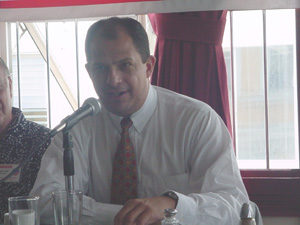
| Solís, as the candidate's
coordinator for foreign affairs, is a likely foreign minister in an Araya
government, he agreed after his talk.
So his words carried weight. In short, he sees a very tight race, played
out on the television screen with possible influences by third-party candidates
with from 75 to 80 percent of those eligible finally voting. Thanks
to television, "the shallowness is going to be horrendous," he said of
the campaign.
No matter who wins, Solís said, the new president will
not have a strong mandate due to the close vote, he predicted. "Bipartisanship
remains a strong element of Costa Rican politics," he said.
The current president, Miguel Angel Rodriquez, is a member of Partido
Unidad Social Cristiana. He can't run again. But Abel Pacheco of the same
party is showing more strength in surveys than Araya.
Solís said Pacheco, a career politician, is perceived as not
being a politician by the public. He admitted that Pacheco seems to be
less stiff in public than his candidate, Araya, who has a habit of keeping
his chin in his chest.
The election is Feb. 3, the first Sunday of that month
Two minor party candidates concern Solís, he said. One is Ottón
Solís, the charismatic candidate of the new Acción Ciudadana
Party. The other is Otto Guevara of Movimiento Libertario. Both these candidates
can take votes away from the major candidates, and a showing of more than
5 percent of the popular vote by Ottón Solís would mean trouble
for Araya, Luis Guillermo Solís said.
The speaker likened the minor party candidates to Ralph Nader's candidacy
in the U.S. presidential elections, a sore spot for U.S. Democrats in Costa
Rica, many of whom feel Nader pulled enough votes from their party to give
the election to George Bush.
Solís said that scandals involving the major parties would help
the minor candidates who stress anti-corruption proposals. Solís
referred directly to news reports Monday of how current deputies had interceded
with government officials to win visas for Chinese immigrants. He characterized
the visas as having been sold.
Despite the abundance of other issues to be addressed in Costa Rican
life, the campaign will be played out over these four, he predicted:
• security,
• the cost of living,
• the quality of social services, including health,
education and housing,
• and corruption.
Revamping the Costa Rican economy, which still principally is agrarian,
is vital, he said, noting that the major national economic indicator, the
gross domestic product, is in "serious condition" and that the colon is
overvalued.
His solution, he said, is a return to the strong welfare state
of 20 years ago where governmental power, made more efficient, can provide
low-interest housing loans, eliminate poverty and champion health reforms.
A strong central government is vital to development, he said. Economic
reverses in the 1980s deflated the state's power then.
"Capitalist progressive states are strong states," he said. He got no
argument from the more than 40 Democrats in the audience at the Gran Hotel
Costa Rica, particularly when he invoked the name of U.S. President Franklin
Roosevelt, also a Democrat, who pioneered social legislation in the 1930s.
Ironically, most of his audience are U.S. citizens who will not be voting
in Costa Rica's elections.
To make his point about a strong central government, Solís displayed
his Costa Rican cedula of identity. Many U.S. students he has met here
feared the cedula as an example of author George Orwell's Big Brother,
he said. Then he produced his U.S. Social Security card and characterized
it as being worse in terms of personal privacy than the cedula. The point
was that the United States maintains a stronger central government.
Solís, trained as an historian, is a political science professor
and an associate dean at the University of Costa Rica and project manager
of Trans-border Cooperation in Central America as part of the Foundation
for Peace and Democracy |
Solís makes these points:
Some of Luis Guillermo Solís' other points in his talk Monday:
• Peasants are dying all over the world, including in the United States,
in part, because of globalization and increased commerce in agricultural
products. "You subsidize agriculture, or they die."
• "Central America is a real mess" because of irresponsible treatment
of the regional agenda. There is increasing poverty, tension at borders
and a lack of a regional vision. "We need the rest of the region"
even though "some Costa Ricans think we should have appeared in the middle
of Europe. . . " instead as part of Central America.
• Costa Rica's alliances with other Latin countries have weakened. There
is no dialogue with the Southern Cone of Chile and Argentina. More contact
needs to be engineered with Mexico, the United States and Canada, which
have created the North American Free Trade Alliance.
• There are all sorts of reasons for Nicaragua and Costa Rica to have
better communication. Despite the possibility that Daniel Ortega, the Sandinista
leader, might be elected president in Nicaragua, Costa Rica must deal with
whatever government comes to power there democratically, no matter
what the United States does.
• "In Spanish the word for 'accountability' is hard to find." Nevertheless
there is a need for public control of public action, perhaps more access
to records and what is being called transparency of government.
• As abortions are outlawed, abortions are continuing to be performed
in Costa Rica," but "it's going to be many, many years" before Costa Rica
legalizes abortion as has been done in the United States, in part, because
of the influence of the Catholic Church.
• Journalists should be liable if they say something that is not true.
The press should be responsible for what it publishes.
|
IBM gets even smaller
IBM researchers created and demonstrated the world's first computer
circuit within a single molecule, which may someday lead to a new class
of smaller and faster computers that consume less power than now, the company
said Monday.
The researchers made a fundamental logic circuit that is the basis for
all of today's computers from a carbon nanotube, a tube-shaped molecule
of carbon atoms that is 100,000 times thinner than a human hair.
In making the ``voltage inverter'' circuit, also known as a ``NOT''
gate, the researchers encoded the entire inverter logic function along
the length of a single carbon nanotube, the company said.
The processors at the heart of today' s computers are basically vast
and intricate combinations of the NOT gate.
More important, the output signal from IBM's new nanotube circuit is
stronger than the input. This phenomenon, called ``gain,'' is essential
for assembling circuit elements into useful microprocessors. Circuits with
a gain less than one are ultimately useless — the electrical signal becomes
so faint that it cannot be detected. Since IBM's nanotube circuit has a
gain of 1.6, IBM is hopeful that even more complex circuits could be made
along single nanotubes. |
|
We are featured
Hispanicvista.com, the Hispanic point of view, a bilingual website based
in California, is featuring A.M. Costa Rica this week because this
publication is a new arrival on the newspaper scene. You can check them
out at http://www.hispanicvista.com/index.asp |
|