Your daily English-language news
source
Monday through Friday
|
|
|
Your daily English-language news
source
|
|
|
|
|
|
|
|
|
|
|
|
|
|
||||||||||||
|
|
||||||||||||
|
easy go A new 500-colon coin will replace the bills of the same value. Meanwhile., the Banco Central de Costa Rica is phasing out the silver-colored 5-, 10- and 20-colon coins that were made in the 1980s and early 1990s. Already brass coins of these smaller denominations circulate. The 500-colon coin a few millimeters larger in diameter than a commemorative coin produced in 2000 to mark the 50th birthday of the Banco Central. That earlier coin was easily confused with a 100-colon coin. |

A.M. Costa Rica photo
|
| Search continues today
for missing tourists By the A.M. Costa Rica staff Coast guard rescue operations will resume at daybreak today as officials still are holding out hope that two tourists dumped in the sea Saturday will be found alive. A full day of searching found nothing Sunday. The mishap took place Saturday about 2 p.m. when a 22-foot tourist boat containing six passengers became caught in heavy debris at the mouth of the swollen Río Matina and overturned. Missing is Frank Verweij and a woman, both from The Netherlands. Four other passengers and the boat’s captain were saved. The boat was the Tropical Wind captained by Carlos Luis Chavarría. It is one of a fleet of boats operated for the tourist trade, principally in the nearby Tortugero Canal. The first that persons on shore heard about the accident was when one of the passengers, Viola van Wonderen, swam to shore and sought aid. Some 90 minutes later the Servicio Nacional de Guardacostas managed to locate Chavarría. About 5 p.m. the coast guard launch Cabo Blanco picked up three other passengers. They were identified as Naf Hidie Marie and Derna Knans of Switzerland and Raimon De Vries of The Netherlands. However, the names are incomplete due to the Costa Rican tradition of using the middle name as a primary surname. The Dutch man’s wife is believed to be one of the missing. The missing man was identified by his parents in Holland, as was Ms. Wonderen. The passengers went to Hospital Tony Facio in Limón where all were reported in good health. The craft was believed to be returning to the Tortugero Canal from the sea when it ran into heavy debris that had been swept downriver by the recent rains. Officials said that individuals in lifejackets could survive several
days in the sea, and Chavarría. was firm in saying that everyone
wore a lifejacket.
Theft of Intel chips
By the A.M. Costa Rica staff Investigators grabbed three persons Thursday and said they were involved with the theft of computer chips from the Intel Corp. facilities in San Antonio de Belén. The trio were taken in to custody when they showed up at a shopping mall to meet with someone they thought would purchase the computer chips, according to the Judicial Investigating Organization. The deal involved the sale of microprocessing chips worth about 5 million colons, said investigators. A later police raid in San Francisco de Dos Rios, where one of the suspects lives, resulted in the confiscation of chips worth 20 million colons, said agents. In all, the value of the purloined chips was more than $1 million, they said. The investigation began months ago when agents found out someone was selling microprocessing chips. These are the brains of a computer. An undercover agent represented himself as a buyer, and that is what led to the arrrests Thursday, said investigators. The Judicial Investigating organization did not say how the chips were being taken out of the Intel plant nor did it fully identify the arrested individuals. Prince will attend
By the A.M. Costa Rica staff Prince Albert of Monaco will be a guest at the Baile de Gala that will benefit the Cruz Roja Costarricense and the Oficina de la Primera Dama, Leila Rodríguez. The dance will be Wednesday night Albert, the son of Grace Kelly, the U.S. screen star, will arrive about 12:30 p.m. Tuesday. About 1:30 he will place a floral tribute at the Monumento Nacional in Parque Nacional in downtown San José and then go to Casa Presidencial for a meeting with Abel Pacheco. At about 3:30 p.m. he will receive the keys to the city and then be feted at a state dinner Tuesday night in the Teatro Nacional. President Pacheco is the host. Albert is the heir to the principality of Monaco. Wednesday morning he will be off to Parque Nacional Volcán Poás. Later in the day he will help issue a joint declaration about his visit. He will spend some time in private touring the country before he leaves Sunday afternoon. Officials announced last week that Albert wold visit, but they declined to issue a schedule at that time for security reasons, they said. Candle ceremony
By the A.M. Costa Rica staff The World Day against AIDS, today, will be marked in San José by a day-long series of events at Parque Central on Avenida 2. The event will end with the lighting of candles of hope about 4 p.m., according to an announcement by the Municipalidad de San José A number of children’s choruses will perform as will the Banda
de San José.
117 fewer guns on streets By the A.M. Costa Rica staff Fuerza Pública officers report that they confiscated 117 firearms in the downtown San José area since January. Some of these were weapons involved in robberies or domestic violent cases. Some 74 were grabbed when police investigated crimes where someone threatened another person with a gun. |
|
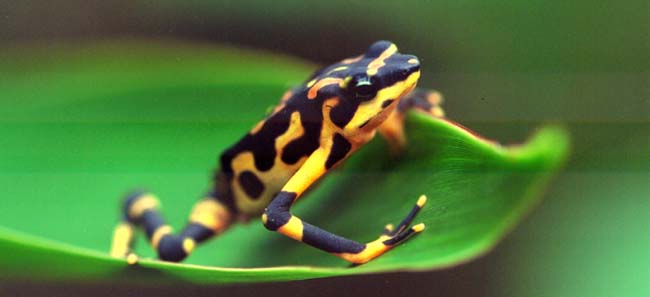
Atlanta Botanical Garden photo/Sunny
Reynolds
|
|
|
|
| By the Atlanta Botanical Garden
news staff
ATLANTA, Ga. — Last sighted in Costa Rica before 1996 and presumed extinct, the harlequin toad (Atelopus varius) has been re-discovered in a Central American rainforest reserve. The tiny toad’s distinctive yellow-and-black markings, believed to ward off predators, once made it easy to identify when the species populated Costa Rican and Panamanian streams. Globally, many species of amphibians have gone extinct due to the triple threat of habitat loss, fungal disease and global warming. Atleopus is one of the most susceptible and the first affected in amphibian decline, known as an "indicator species." Ron Gagliardo, curator of tropical collections at the Atlanta Botanical Garden here in the U.S. state of Georgia, is working in cooperation with Costa Rica’s Ministerio de Ambiente y Energía to document and protect these rare toads. Costa Rica leads the hemisphere in protected lands, with more than 25 percent of its territories set aside in the national parks system and as private reserves. The political climate of this country is receptive to the preservation of national resources. Gagliardo, representing the Atlanta Botanical Garden, received two grants for his scientific conservation work and is starting his trip to Costa Rica today. "There is no doubt this is an important discovery," said Gagliardo. "You could say that the Atelopus has become the ‘poster child’ of global amphibian species decline," he explained. "For example, in the last 10 years, we believe that over 50 percent of approximately 70 Atelopus species known have gone extinct. With this find, we have another chance at seeing Atelopus thriving in its native Costa Rica. Because of the dedication of Costa Rica to protecting its natural resources, it is not surprising that the harlequin toad resurfaced in a private reserve in this country." Gagliardo has a cordial relationship with government representatives of several Central and South American countries, and a long and rewarding history of work with endangered toads, poison frogs and tree frogs native to this region. His field experience includes a 1994 introductory visit to La Selva Biological Reserve in Costa Rica to explore Dendrobatid habitat. Some of these are known as the poison dart frogs that populate areas near streams here. He also has studied tropical botany, and done amphibian field research, as well as collecting expeditions in 2001 and 2003 in cooperation with the Costa Rica environmental ministry. These trips resulted in a display of the animals in Atlanta with interpretive signage, and a successful captive breeding program at the Atlanta Botanical Garden. He has made numerous visits to work at Maquipucuna Reserve in Ecuador, a sister organization of the Atlanta Botanical Garden, and also to consult with orchid growers in Cuenca and Zamora. Gagliardo’s field work on Dendrobateshistrionicus in Northwestern Ecuador included the study of different populations, natural history and botanical aspects of the frog’s habitats. Utilizing funding from the Consortium for Conservation Medicine, he initiated Atelopus conservation projects with Pontifica Universidad Catolica del Ecuador in 2003. Gagliardo participated in an expedition to the Sipaliwini Savannah in Suriname to collect the blue poison frog, Dendrobates azureus, and successfully established a captive breeding population at the |
National Aquarium in Baltimore. He
made a botanical survey of the habitat of this species and
also assisted in arranging export permits from the Suriname government for the animals obtained on this trip. The Atlanta Botanical Garden has been granted exclusivity in the next phase of the conservation project. Gagliardo will lead harlequin toad research and conservation efforts at a private conservation project, where the Atelopus varius population was sighted last spring, along with captive husbandry and breeding efforts back in Atlanta. Preliminary identification of the toad was made by University of Delaware researcher Justin Yeager and assistant Mark Pepper. Gagliardo learned of the discovery following positive identification of the toad by a University of Costa Rica herpetologist, Dr. Federico Bolaños, in a huge private reserve in an area of the Quepoa Biological Corridor of southwest Costa Rica, one of the last remnants of primary rainforest in the Central Pacific region. "Why is this population still here? That’s one of the fundamental questions my team hopes to answer," explained Gagliardo. With more than 200 amphibian species reported in decline and more than 30 suspected extinct over the past decade, diminished amphibian populations have scientists alarmed. In Costa Rica, herpetologists point to climate change, habitat loss and pathogens such as the fungal disease Chytridiomycosis as possible culprits. Gagliardo is the recipient of two grants, from the Declining Amphibian Populations Task Force as well as a repeat grant from the Consortium for Conservation Medicine, to lead the survey team to study and document the Atelopus population. Both organizations are concerned by amphibian decline and the spread of chytrid fungus. In particular, the Consortium is investigating an anthroprogenic theory that the fungus might have been spread inadvertently on the boots of scientists traveling these remote spots. On Gagliardo’s team are Justin Yeager, herpetology student at University of Delaware who initially brought the existence of the harlequin toad to the attention of U.S. scientists. Also participating are Brian Kubicky, independent amphibian researcher based in Costa Rica, and Dr. Kevin Zippel, curator of the National Amphibian Conservation Center at the Detroit Zoo and director of the Proyecto Rana Dorada, which works to protect a related species, the Panamanian Golden Toad (Atelopus zeteki). The team will also assess the feasibility of setting up captive breeding facilities in Costa Rica and at the Atlanta Botanical Garden. Since 1976, the Atlanta Botanical Garden has developed and maintained plant collections for display, education, research and conservation. The institution features 15 acres of outdoor gardens and the Dorothy Chapman Fugua Conservatory and Orchid Center, which houses rare and endangered plants from tropical rainforests and desert regions. International conservation efforts at the Garden also support amphibian research, captive breeding programs and naturalistic displays of frogs and toads from Central and South America. For more information about the Atlanta Botanical Garden, visit www.atlantabotanicalgarden.org. For more information about amphibian decline, visit Project Golden Frog at www.ranadorada.org, the Consortium for Conservation Medicine at www.conservationmedicine.org , the Declining Amphibian Populations Task Force at http://www.open.ac.uk/daptf/index.htm and Rainmaker Conservation Project, where the toad was discovered, at www.rainmakercostarica.com. |
|
|
|

Long-time queen of the boyeros, Digna Montes Astura, merits a carreta of her own. |
A.M. Costa Rica photos
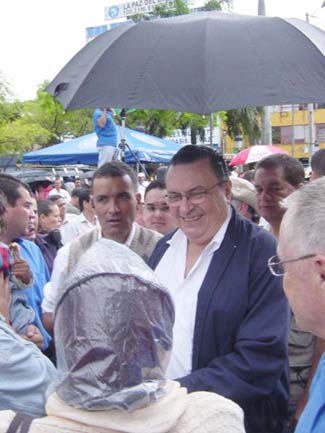
President Able Pacheco shows he really can smile while he talks to citizens
along the parade route during a light rain. |

The ox carts hobby frequently is a family affair. |
|

Saint Joseph, the patron of the city which bears his name in Spanish, was one of the saints in evidence. Here near the grandstand on Avenida 2 he holds the hand of young Jesus. |
By the A.M. Costa Rica staff Occasional periods of light rain did nothing to hamper the parade of the boyeros Sunday through downtown San José. The event was titled formally the VII Desfile de Santos y Boyeros. The event is called that because ox cart drivers (boyeros) brought statues of saints from their home communities all over Costa Rica. The Municipalidad de San José, one of the sponsors, estimated that some 350 ox cart drivers would take part along with their brightly painted carretas and their oxen. The entry of the saints into San José is the traditional kickoff to the Christmas season. This year the event was particularly colorful because the line of march was headed up by a half dozen folkloric groups. No many oxen really are used for agricultural work in Costa Rica these days, but the hobby of raising a matched pair of animals is a hobby that maintains the tradition. At once time the ox carts were the principal means of transport, and Central Valley coffee was carried bag by bag in such carts over the mountain passes to boats in Puntarenas. The traditional colors, particularly the wooden wheels, are a craft identified with Costa Rica all over the world. The tradition began not with the 19th century coffee transporters but in the early 20th Century. |

Youngsters pulling tiny ox carts are always photogenic, expecially when a mustache is painted on their upper lip. |

Who is doing the pulling? From here it looks like the lad is doing all the pulling |
|
|
|
|
|
|
|
|
| What we published this week: | Monday | Tuesday | Wednesday | Thursday | Friday | Earlier |
|
|