mmmm
|
colon exchange rate HERE! |
Your daily English-language
news source
Monday through Friday

|
mmmm
|
Your daily English-language
|
|
|
|
|
|
|
|
|
|
|
|
|
|
||||||||||||||||||||
|
|
||||||||||||||||||||
|
Second news page |
 |
 |
| Costa Rica Expertise Ltd http://crexpertise.com E-mail info@crexpertise.com Tel:506-256-8585 Fax:506-256-9393 |
 |

La Costanera, Quepos, Parrita, Manuel Antonio |
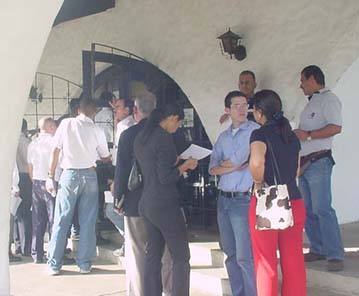
A.M. Costa Rica photo
Visiting news people line up in vain seeking credentials at the Hotel
Herradura.
Computer woes hamper
By the A.M. Costa Rica staff The nation’s efforts to stage a smooth summit of Latin American leaders got off to a bad start Wednesday when aides were unable to process credentials for visiting news people. The glitch caused some hot tempers to flare at the Hotel Herradura, which will be the administrative site for the summit. The Ministerio de Relaciones Exteriores y Culto is in charge of the event. But the computer used to store data for visitors and their credentials just would not work. Some 800 visiting news people are expected. The XIV Cumbre or summit of the Iberoamerican nations has a formal opening Friday, but diplomats and support personnel already are arriving in the Central Valley. All those associated with the summit had been asked to provide extensive information in order to obtain credentials. Ministry officials promised that those for news people would be ready today. In addition to the press, radio and television technicians, some 3,000 diplomats and employees of international agencies are expected. The event kickoff Friday night at the Teatro Nacional will prompt the closing of Paseo Colón and Avenida 2 that day and evening, officials said. Preventative detention
By the A.M. Costa Rica staff The president of the failed Banco Elca and two key employees have lost their appeal to be let out of jail. The trio have been in jail since Oct. 22 when preventative detention was ordered by a judge. Now the Tribunal de Juicio del II Circuito Judicial de San José has confirmed the order, according to a spokesperson for the Poder Judicial. The three are Carlos Alvarado, the bank president, and Javier Filloy and Hernán González. Regulators took over the institution, correctly called Corporación Elca S.A., in June when the bank’s reserve margins fell below legal requirements. Smaller depositors have received their money back, but those with more than $10,000 on the bank’s books have not. A U.S. bank is believed to be interested in purchasing the company. Students in Chile protest
By the A.M. Costa Rica wire services SANTIAGO, Chile — Police here have fired tear gas and water cannon at hundreds of students protesting the arrival of President George Bush later this week at an economic summit in this, the Chilean capital. Street clashes erupted Wednesday, just before foreign and trade ministers from the 21-member Asia-Pacific Economic Cooperation opened two days of talks on free trade and other issues. Police arrested dozens of demonstrators protesting the U.S.-led war in Iraq and globalization, which they say widens the gap between rich and poor nations. No injuries were reported. In addition to President Bush, outgoing U.S. Secretary of State Colin Powell, Chinese President Hu Jintao and Japanese Prime Minister Junichiro Koizumi will attend the talks, which take place this Saturday and Sunday. Washington sources say that Bush plans to focus on security and trade issues during the session. The president also plans to hold several meetings with Asian and Latin American heads of state while in Chile and Colombia to discuss a wide range of issues of mutual concern. A senior Bush administration official said the primary security objective at the meeting is to get "concrete implementation" of commitments made at the 2003 meeting in Bangkok, Thailand. According to the official, these commitments primarily focused on eliminating the weapons of mass destruction, eliminating transnational terrorist groups, and addressing other terrorist threats. The meeting in Chile is one reason some heads of state, including Chilean President Ricardo Lagos, will not be in Costa Rica for the Iberoamerican summit this weekend. |
|
 |
|
with the observations of Dr. Lenny Karpman Click HERE! |
 |
Call our ad department
or e-mail us |
|
with the observations of Dr. Lenny Karpman Click HERE! |
|
|
|
|
Author Beatrice Blake will present the latest edition of her travel guidebook, "The New Key to Costa Rica," and a slide show at 11 a.m. Dec. 4, at the third Feria de Turismo Rural at InBio in Santo Domingo de Heredia, 20 minutes from downtown San Jose. The 17th edition of the book focuses on destinations owned and operated by grassroots community conservation groups. It also includes, as always, the ecolodges that have made Costa Rica famous, plus 500 pages of practical travel information, chapters on history and ecology, and over 20 maps, said the author. According to Andy Drumm, director of The Nature Conservancy’s Ecotourism Program, 'The latest edition of the "New Key to Costa Rica" sets the standard for environmentally and socially responsible tourism guides.' Ron Mader, host of planeta.com, the award- winning Web site dedicated to ecotourism in the Americas, calls it "one of Planeta's all-time favorite books." "The community-based travel experience is a taste of how Costa Rica used to be. You can hike in a community’s nature reserve and learn about the plants and animals from the campesinos who live there," said Ms. Blake, whose talk is entitled "Campesinos, Conservation and Your Vacation." "It is very inspiring to see how farmers are now able to follow their natural impulse to conserve forests and watersheds, to find meaningful work close to home, to pursue alternative energy sources and organic agriculture." The guidebook highlights the adventures you can have at these rustic country lodges: riding horses to a valley hidden in the mountains of the Karen Mogensen |
Reserve, part of the Nicoya Peninsula
Biological Corridor; watching sea turtles lay their eggs on the beach at
Ostional Wildlife Refuge in Guanacaste; setting out across a hanging bridge
to get close to a 175-foot waterfall at Los Campesinos Reserve near Quepos;
and traveling down jungle rivers in a dugout canoe to Yorkin village in
the Bribri Indigenous Territories on the Panama border, where a women's
organization raises organic cacao.
Ms. Blake’s talk will feature slides of these destinations, which have the added advantage of being easier on the pocketbook than many other forms of ecotourism, she said, adding that most community-based lodges cost $25 to $35 per person including three hearty meals. The Global Environmental Facility, which works to reduce poverty and global warming, largely funds this new aspect of the Costa Rica’s famous ecotourism trade, Ms. Blake said. The facility is administered by the U.N. Development Program. Ms. Blake lived in Costa Rica for more than 13 years and returns once or twice a year. Her company, CONSERVacations, leads tours to community-based lodges in conjunction with the respected ecotourism company, Horizontes Nature Tours. Ms. Blake lives with her family in East Blue Hill, Maine. The original "New Key to Costa Rica" was published by Ms. Blake’s late mother, Jean Wallace, in 1978. Ms. Blake re-wrote the book in 1986 with colleague Anne Becher, and has updated it every other year since then. The 17th edition is being published this month. For more information, write beatrice@keytocostarica.com or visit www.keytocostarica.com. |
|
|
|
|
Despite concerns raised by the attacks of Sept. 11, 2001, American college students are studying abroad in greater numbers and in a greater diversity of nations than ever before, according to Open Doors 2004, an annual report on international education exchange. In 2002-2003, the first full academic year after the terrorist attacks, a record number of 174,629 U.S. college students received credit for studying in other countries, an 8.5 percent increase from the 2001-2002 academic year, the report found. The findings were released Monday in conjunction with the nationwide observance of International Education Week, which is sponsored jointly by the U.S. Department of State and the U.S. Department of Education. The growing popularity of study abroad is "a sign that our students continue to recognize the importance of international study for their future careers and are eager to learn more about a world that is increasingly more interdependent," said Patricia S. Harrison, State Department assistant secretary, of the report. |
Although the United Kingdom, Italy,
Spain, and France remain the most popular sites for Americans studying
abroad, 11 of the leading 20 destinations were outside Western Europe,
the report states. Australia and New Zealand, Chile, Russia and the Czech
Republic proved especially popular. And although the numbers of Americans
going to the Middle East declined sharply, the number of Americans studying
in Turkey, Egypt and Morocco increased dramatically.
The study also found that even though more Americans are studying abroad, they are doing so for shorter periods, with about half of all students selecting summer, winter break, and other study periods of less than one semester. This growth in short-term programs has opened study abroad to community-college students and four-year students whose limited finances or demanding majors would not otherwise allow them to take advantage of international education, the report notes. According to Open Doors 2004, 572,509 students from other countries attended U.S. colleges and universities during the 2003-2004 academic year, a 2.4 decrease from the previous academic year and the first decline in international student enrollments since 1971. |
|
|
|
with the observations of Dr. Lenny Karpman Click HERE! |
|
|
|
|
A sea turtle conservation and education program based in the Osa Peninsula is looking for new funding. The group, Salvamento Internacional de la Tortuga del Mar, has operated out of the Osa Peninsula for the past three years and receives money from the National Save the Sea Turtles Foundation of Ft. Lauderdale, Florida. That agreement ends next year. Since the organization’s start three years ago, employees have worked to educate the public and to care for an 8 km. stretch of beach in Osa Peninsula: Carate, Rio Oro and Pejeperro. Normally, the end of November would mean the end of their season, but this year, employees will be working through the new year, hoping to locate new sponsors. The organization is hoping to contact several U.S. non-profit corporations that have interests in the peninsula. Between these contacts and local help, the organization hopes to find sufficient funding for the 2005 season and beyond. Rachel Silverman, the president of the organization, is hopeful about next season and expects to find adequate funding before the season starts. She has spent the last three years helping the organization and hopes to improve the level of education surrounding the turtles and their importance in Costa Rica. Three sea turtle species lay their eggs in Costa Rica. "The turtles are a key part of the coastal system in Costa Rica," Ms. Silverman said. "They bring nutrients from the ocean onto the beach. Those nutrients are important for many other species in the environment." The group’s main two goals are protecting turtles on their beach and educating the public. Silverman said, "Sea turtles are like little tanks. They were around before the dinosaurs, but now they are starting to die off." The group hopes that by relating the turtle’s importance to Costa Rica to the public, they will be able help the turtle population rebound. |
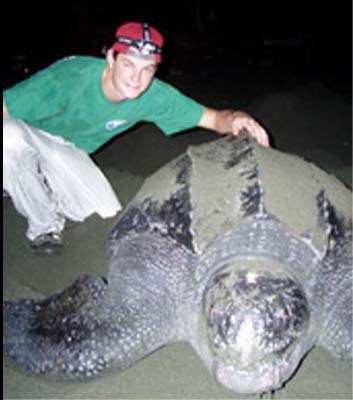
Salvamento Internacional de la Tortuga
del Mar photo
Jason Murray, a Canadian naturalist associated with the foundation,
poses with a sea turtle to give an indication of its size.
xx During the groups time at the peninsula they have been able to make large improvements and they hope to continue with those improvements, Ms. Silverman said, adding that when she arrived "Dogs were everywhere, digging up the turtle nests." Since that time, volunteers and employees have managed to clean up the beach, find homes for the dogs, and save hundreds of turtles." The group's extensive Web site in Spanish and English is HERE! |
|
|
|
|
BANGKOK, Thailand — The world's largest conservation group opened a week-long meeting here Wednesday and warned that nearly 16,000 species face extinction. The group is the World Conservation Union. Members kicked off the congress Wednesday by releasing its so-called Red List of Endangered Species. It has nearly 16,000 plants and animals listed. Indonesia, China and Brazil have the most threatened species. The report says one in every four mammals and one in every eight birds are facing a high risk of extinction in the near future. While one in three amphibians and almost half of all tortoises and fresh water turtles are threatened. In the last 500 years some 844 species have died out. Conservationists are sounding the alarm as the current rate of extinction far exceeds that. Achim Steiner is director general of World Conservation Union. "The evidence presented in this Red List should make people worried about the future viability of many of the eco systems on which we depend," he said. "The |
loss of biodiversity means a great
deal to those who understand the implications of that loss."
Experts attribute the problem to climate change and destruction of natural habitats by human encroachment. The union's report says half of the world's wetlands have been destroyed over the last 100 years and more than a quarter of the world's coral reefs have been destroyed. This congress — which brings together scientists, activists and government officials from 181 countries — is debating how best to address these problems over the next fours years. The union's Steiner says governments need to start paying attention to conservationist ideas. "The world's conservation community has been ignored for far too long by those who are taking fundamental decisions in the economic and political sphere," he said. Conservationists say their efforts are working. On the good news front one quarter of the world's threatened birds have benefited from conservation efforts, and several species have started to recover. The eight-day congress will close on Nov. 25. |
|
|
|
|
|
|
|
|
| What we published this week: | Monday | Tuesday | Wednesday | Thursday | Friday | Earlier |
|
|