|
 |
Costa Rica Your daily |
 |
|
|
 |
 |
|||||||||||||||||
|
|
||||||||||||||||
 |
|||||||||||||||||
 |
|||||||||||||||||
|
|
||||||||||||||||
 |
 |
 |
| What we published this week: | Monday | Tuesday | Wednesday | Thursday | Friday | Earlier |
|
|
|
|
|
|
|
Food |
|
Jo
Stuart |
|
|
 |
| A.M. Costa Rica's Second news page | |||||||||
| San José, Costa Rica, Monday, Nov. 7, 2011, Vol. 11, No. 220 | |||||||||
|
|
|
|
|
|
|
Food |
|
Jo
Stuart |
 |
 |
 |
|
Our readers' opinions
World needs opportunityto vote on warming claims Dear A.M. Costa Rica: You really hit one out of the park . The article on global warming in Friday's A. M. Costa Rica is one of the best I have ever read on the subject. Congratulations. Maybe, with information like this from the press, people will wake up to the fact that while warming may be a problem, we simply don't know yet . We have not been getting the truth about global warming for a long time . In the press, we have only heard from the so-called experts that tell us we have stop putting co2 into the atmosphere . They don't seem to care that this will kill our economies . That it will costs gazillions of dollars, maybe for nothing. Anybody who disagrees with them is denigrated and called names .They are told to shut up and go away . This is not science . This is not the way science has always been practiced for centuries. There is more and more evidence that data has been manipulated for some time by the these so-called experts . I believe that if the earth is warming, it would be better than cooling . Co2 is plant food. In the past, the earth seemed to do quite well with a lot more co2 than we have now . The plants really thrived and animals as well . We will just have to adapt to the warming as human beings have been doing for thousands of years thru much warmer periods and much colder periods than we have now. Who gets to say that the average temperature we have now is ideal. Does Al Gore get to declare that we must spend and spend to keep the temperature the same . Why ? Can't we at least vote on it ? Thanks again for a great article . You are very brave . Bill
E Pitts
Fort Worth, Texas EDITOR'S NOTE: The piece referenced in the letter was an opinion column. Scars remain for Cubans who lost real estate there Dear A.M. Costa Rica: I'm reading in the AM news that Cuba is going to give a new freedom to its citizens the right to own the very home that they live in, considering since the revolution in the late 50s Fidel has nationalized every piece of real estate in Cuba. My friends and neighbors in Florida have always vowed to return to Cuba some day and reclaim the properties that were in their family for generations. This new revelation is going to create havoc with the expats. Many Cubans in Florida and elsewhere in the world have worked hard and have experienced success and are in a position to finance a legal maneuver if need be, All have traveled back to Cuba or had loved ones do so to take pictures and document the existence of the properties they lost. Castro and his brother may be making some citizens happy, but the families who had to flee for their lives will be back and they are going to still want their farms and their grocery stores and their homes returned to them. Despite the fact that the revolution has been over for 50 years, there still are scars and many many unsolved issues. Bruce
Simpson
Hone Creek/Miami
|
|||||||||||||||||||||||||||||||||||||||||||||||
 |
||||||||||||||||||||||||||||||||||||||||||||||||
|
|
|
|
|
|
|
Food |
|
Jo
Stuart |
| What we published this week: | Monday | Tuesday | Wednesday | Thursday | Friday | Earlier |
| The contents of this page and this Web site are copyrighted by Consultantes Río Colorado 2011 and may not be reproduced anywhere without permission. Abstracts and fair use are permitted. Check HERE for details | ||||||
| A.M. Costa
Rica's Third newspage |
 |
||||||||
| San José, Costa Rica, Monday, Nov. 7, 2011, Vol. 11, No. 220 | |||||||||
|
|
|
|
|
|
|
Food |
|
Jo
Stuart |
| Archaeologist Hoopes skeptical of Mayan
doomsday myth |
|||
|
By the University of Kansas News
Service
John Hoopes, the University of Kansas anthropologist and Maya scholar, and his students are watching predicted doomsday dates such as 11/11/11 and Dec. 21, 2012, with considerable skepticism. Hoopes is regarded as one of the major go-to guys to separate fact from fiction about the Maya calendar and a
This fall, Hoopes and his students have watched two predicted cataclysmic dates — Oct. 21 and 28 — come and go with little fanfare. Oct. 21 was a date selected by California evangelist Harold Camping after his original May 21, 2011, prediction passed without calamity. Swedish pharmacologist, self-help advocate and self-taught Maya cosmologist Carl Johan Calleman was among those predicting that Oct. 28 would usher in a worldwide unified consciousness. The next big date to consider is 11/11/11, when many in the New Age movement plan celebrations to receive emerging energies in preparation for a transformation of consciousness on Dec. 21, 2012. The date is next Friday. Whether these dates mark a time for transformation of consciousness or a catastrophic end, they are part of a 2012 myth that originated with Christopher Columbus and Franciscan missionaries, not the ancient Maya calendar, Hoopes emphasizes. In a paper presented in January at the Oxford IX International Symposium on Archaeoastronomy in Lima, Peru, Hoopes tracks the 2012 Maya myth origins through various revivals into the 21st century. The myth is rooted in an early 16th-century European combination of astrological and biblical prophecies to explain the new millennium. Columbus believed that his discovery of the world’s “most remote land” would lead to Spain’s re-conquest of Jerusalem and fulfill world-end events described in the Book of Revelation. To validate his convictions, Columbus wrote his own book of Prophecies that included an account of his interview with a “Maia” leader in 1502. The reference inspired early speculation by explorers and missionaries, indirectly influencing crackpots as well as scholars to link ancient Maya — before any contact with Europeans — with the astrological and religious beliefs popular in Europe in the 1500s. Misinterpretations and distortions flowed with each revival of interest in Maya culture. In the 1960s, the myth re-flowered as the dawning of the Age of Aquarius, enjoyed a resurgence in Y2K and thrives today. Hoopes adds that the Occupy Wall Street movement clearly reflects a nostalgia for the progressive culture of the 1960s. More than 1,000 books have been published on the 2012 myth, not to mention a plethora of Web sites on the topic. Hoopes expects the hype won't hit its peak until well into 2012. Fear and fantasy both sell well, especially in uncertain times, he notes. End-of-the-world and transformative beliefs are found in |
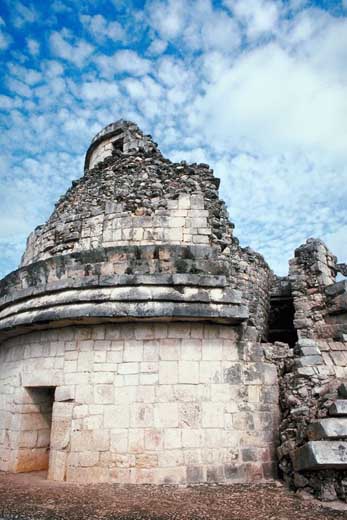 A.M. Costa Rica archives
This is the observatory at the
Mayan Chichen-Itza site. In most cases, astronomy was in the hands of
the priestly class.many ancient cultures but have been a fundamental part of modern times since 1499, Hoopes points out. They are also fundamentally American, he adds. “The United States has always embraced religious freedom. Peculiar religious sects, including occult beliefs, have always been part of America,” he says. Astrology, Ouija boards, séances, channeling, spiritualists, extraterrestrial life and a host of pseudosciences all have had acceptance in parts of America, he adds. Mary Todd Lincoln used séances to contact her son. Nancy Reagan consulted astrologists. Wishful or magical thinking help perpetuate myths and beliefs that have no basis in science. Hoopes uses the 2012 myth and others to teach students to think critically and learn to distinguish science and myth. “If a narrative has a moral message, then it probably is not a scientific story. Stories based in science ideally should be objective, not subjective,” Hoopes says. The persistence of the 2012 myth may reflect a fear of mortality that has nagged ancient and modern civilizations. “It’s much easier to discuss mortality when we’re all in the same boat,” Hoopes said. “Creating a concerned community allays people’s fears and allows us to project individual morality onto the world.” Hoopes' interest in the 2012 phenomenon began as an academic hobby and has evolved into an anthropological study of contemporary American culture. At the very least, he says, the 2012 phenomenon “has made a huge audience aware of Maya calendrics and the winter solstice.” Hoopes earned his doctorate from Harvard University with a study of ceramics from pottery from sites in Costa Rica dating from 2000 BC to AD 500. He worked at the Museo Nacional in San José several times in technical positions. He directed the university's Golfito project in the early 1990s. The project focused on prehistoric human ecology and used archaeological survey, excavation, and laboratory analysis. He worked on excavations in Arenal and also worked at Costa Rica's Museo Nacional in several technical capacities. He also directed the successful doctoral effort in 2000 by Francisco Corrales, who is again the director of the Museo Nacional. |
||
| Language schools are not immune to
economic impact |
|
|
By Zack McDonald
of the A.M. Costa Rica staff Many of Costa Rica´s markets have had a tough run recently. Industry, agriculture and trade have been down since last July. The deceleration of tourism this year has not helped and seems to be hurting small, niche businesses. Some educators of Spanish, whose customer base consists of tourists and expats, have felt a pinch in their numbers. Katie Horch of the Centro de Idiomas Intercultura in Heredia said the enrollment number for students at the language school was significantly lower from last year. ¨It´s the low season as is,¨ she said. ¨But our enrollment is usually 30 to 45 a week. It´s more like 15 to 20.¨ She said that despite the stagnation in numbers she had optimism for next year judging from the school´s scheduled enrollment. Centro de Idiomas Intercultura uses a variety of marketing approaches from Facebook to Twitter to having |
arrangements with universities in
the U.S. However, their enrollment has faltered this year, according to
Ms. Horch. Lorenzo Abarca, an administrator at the Costa Rica Language Academy in San Pedro, seconded Horch in saying that there is a noticeable difference even though he didn´t know the exact numbers. ¨I know, in fact,¨ he said, ¨from conversations with our competitors, that there are less students.¨ But some language schools in Costa Rica haven´t felt the brunt. The Centro de Idiomas Logos in San José uses the same marketing techniques, such as affiliations with U.S. universities, and has not seen an increase or a decline in enrollment, according to Jose Martínez, the general program director. He said the school has only been around a couple of years but operators have not noticed a deviation in comparisons of this year and the last. He attributed the stability to the school´s partnerships with U.S. universities. |
 |
| You need to see Costa Rican tourism information HERE! |
|
|
|
|
|
|
|
Food |
|
Jo
Stuart |
| What we published this week: | Monday | Tuesday | Wednesday | Thursday | Friday | Earlier |
| The contents of this page and this Web site are copyrighted by Consultantes Río Colorado 2011 and may not be reproduced anywhere without permission. Abstracts and fair use are permitted. Check HERE for details | ||||||
| A.M.
Costa Rica's Fourth news page |
 |
||||||||
| San José, Costa Rica, Monday, Nov. 7, 2011, Vol. 11, No. 220 | |||||||||
|
|
|
|
|
|
|
Food |
|
Jo
Stuart |
| French institute reports advances in
monitoring Niño, Niña |
|
|
By
the Institut de Recherche pour le
Développement news staff El Niño and La Niña, the climate’s two enfants terribles, arise with the onset of eastward migration of the tropical western Pacific’s immense warm-water reservoir, the “warm pool.” Institut de Recherche pour le Développement researchers and their partners recently found two parameters useful for observing the way this pool moves: water salinity and color. The salinity gives information on the barrier layer which plays a major role in vertical heat transfer. It proves to be a driving factor in global climate dynamics. However, scientists do not yet have access to sufficiently frequent observations on salinity to conduct close monitoring of the warm-water mass. In contrast, ocean color can already be monitored weekly by using satellite images. A team of institute scientists and their partners recently showed the color to be an indicator of the eastern edge of the warm pool, whose extension, to a distance |
of up to 5,000 kilometers
(about 3,100 miles), triggers the El Niño events. Scientists
will now
be able to predict related climate anomalies and warn of the
consequences, they concluded. The immense warm-water reservoir in the western tropical Pacific – with sea surface temperatures above 28°C and an area as large as Europe, is the principal heat pump of the Earth. This warm pool, as climatologists call it, feeds the heat and humidity fluxes at global scale, exerting a direct effect on the global climate. Particularly important is its role as generator of the El Niño and La Niña events, the climate’s two enfants terribles. Every two to seven years they cause havoc – cyclones, drought in Africa and floods in Latin America. Keeping watch of changes taking place in this water mass is therefore crucial for devising prediction measures for these events and giving warnings on the socio-economic and environmental consequences, the research institute said. |
| Pacific Rim countries will test responses
to tsunami threats |
|
|
Special
to A.M. Costa Rica
Some 30 Pacific Rim countries are to take part next week in a United Nations-backed tsunami warning exercise to improve their ability to respond to an alert and enhance regional coordination in the event of a disaster. Most tsunamis occur in the Pacific Ocean and connected seas, according to the U.N. Educational, Scientific and Cultural Organization. Three tsunamis have struck that region recently – Samoa in 2009, Chile in 2010 and Japan in 2011. The test scheduled for Wednesday and Thursday, known as PacWave11, is organized under the aegis of the U.N. Intergovernmental Oceanographic Commission and will be carried out in two phases. In its first phase, the exercise will consist of nine different scenarios to allow each participating country to respond to a regional or local source tsunami based on powerful earthquake events generated off the shores of the Philippines, Vanuatu, Tonga, Ecuador, Central America or Japan’s Ryukyu Islands. |
Countries engaged in the test will
choose one of these scenarios and
opt for a region or local event to which they would have to react. In the second phase, which will be carried out simultaneously after receipt of warning messages, the authorities will test all the necessary steps to respond to a warning prior to alerting the public. Simulated warnings will be sent out to national focal points by the Northwest Pacific Tsunami Advisory Centre in Japan and the Pacific Tsunami Warning Center and the West Coast/Alaska Tsunami Warning Center, both in the United States. The Commission set up the International Coordination Group for the Tsunami Warning System in the Pacific in 1965, following the major tsunami of 1960 that hit the coast of Chile and claimed close to 5,000 lives. The purpose of the group is to coordinate the development of the Pacific tsunami warning systems and to promote the establishment of national risk assessments, alert and response programs, said the U.N. |
|
|
|
|
|
|
|
Food |
|
Jo
Stuart |
| What we published this week: | Monday | Tuesday | Wednesday | Thursday | Friday | Earlier |
| The contents of this page and this Web site are copyrighted by Consultantes Río Colorado 2011 and may not be reproduced anywhere without permission. Abstracts and fair use are permitted. Check HERE for details | ||||||
| A.M.
Costa Rica's Fifth news page |
|
|||||||||
| San José, Costa Rica, Monday, Nov. 7, 2011, Vol. 11, No. 220 | ||||||||||
|
|
|
|
|
|
|
Food |
|
Jo
Stuart |
 |
Death of top rebel leader greeted with hope for peace By
the A.M. Costa Rica wire services
Colombians are expressing a mix of relief and optimism now that the leader of the country's top terror group is dead. Some Colombians took to the streets to celebrate after President Juan Manuel Santos went on television to announce Colombian forces had killed Alfonso Cano during a raid in the country's southwestern Cauca region Friday. Santos called Cano's death the "biggest blow" against the Fuerzas Armadas Revolucionarias de Colombia, known as the FARC, in the group's history. He urged the leftist rebels to "demobilize" now that their leader is dead. The president said "violence is not the way." Images from government television showed the body of Cano without his signature glasses and heavy beard. But officials say fingerprints proved it was Cano. His real name was Guillermo León Sáenz Vargas and he was the son of Bogota intellectuals. The United States had up to a $5 million reward for his capture. Military officials said troops also recovered several computers, memory sticks and cash. Rebels have been at war with the Colombian government since the 1960s. While the number of rebels has dwindled over the years, analysts estimate the group retains as many as 9,000 fighters. Newspapers quickly carried word of Cano's death. Some residents in the capital of Bogota said the rebel leader's death gave them a sense of security. Others said it was a sign that the country was on the path to a true peace. Cano became the leader of the rebel group in 2008 after the death of its founder, Manuel Marulanda Velez. He is believed to have joined rebels in the 1970s after studying anthropology at Bogota's national university. Most of the group's funding comes from cocaine trafficking and extortion, but the leftist rebels are believed to be holding an unknown number of people for ransom or political leverage. The rebel group has been designated as a terrorist organization by Colombia, the United States and the European Union. U.N. official says relief from floods requires money Special
to A.M. Costa Rica
The humanitarian emergency caused by last month's devastating floods in Central America is only just beginning, a top United Nations relief official said as he, warned that the situation could get worse for the estimated 1.2 million people affected without urgent international support. "The people affected by this crisis have lost everything, and their difficulties are only just beginning," said Catherine Bragg. She is assistant secretary general for humanitarian affairs at the U.N. She spoke as she wrapped up a four-day visit to Nicaragua and El Salvador, two countries badly hit by the disaster. "Hundreds of thousands of people face a struggle for survival over the next six months. We must act now. We cannot let the people of El Salvador and Nicaragua down." Up to 300,000 people fled the floods in El Salvador during the peak of the rains in October, and the homes and livelihoods of 143,000 people have been affected by heavy rains in Nicaragua, the U.N. said. Thousands of homes have been damaged, possessions destroyed and hundreds of schools, roads and health facilities are closed. The governments and peoples of Nicaragua and El Salvador mobilized emergency responders immediately after the floods, and have succeeded in minimizing the loss of lives, according to the U.N. Office for the Coordination of Humanitarian Affairs "But the cumulative effect of annual catastrophic events has pushed national capacities to their limit," the office said. The U.N. is mobilizing international assistance to assist the efforts of the governments and last week launched emergency appeals for both countries. However, the $14 million appeal for Nicaragua is currently only 22 per cent funded, while the $15 million appeal for El Salvador is only 23 per cent funded. Canada agrees to provide $2 million via aid agencies Special
to A.M. Costa Rica
Canada has agreed to provide humanitarian assistance for the Central American countries that suffered extensive damage from flooding. Beverley J. Oda, minister of International Cooperation, announced that in Ottawa late last week. "The devastating floods in Central America continue to threaten the health and safety of those affected," said Minister Oda. "The people of Central America face a serious humanitarian crisis and Canada is contributing to help those in need." Canada, through the Canadian International Development Agency, will provide up to $2 million to international and Canadian organizations responding to this crisis, the government said. The government noted that Honduras and Guatemala also had been affected. |
|
|
|
|
|
|
|
|
Food |
|
Jo
Stuart |
| What we published this week: | Monday | Tuesday | Wednesday | Thursday | Friday | Earlier |
| The contents of this page and this Web site are copyrighted by Consultantes Río Colorado 2011 and may not be reproduced anywhere without permission. Abstracts and fair use are permitted. Check HERE for details | ||||||
| A.M.
Costa
Rica's sixth news page |
|
|||||||||
| San José, Costa Rica, Monday, Nov. 7, 2011, Vol. 11, No. 220 | ||||||||||
|
|
|
|
|
|
|
Food |
|
Jo
Stuart |
 |
Latin America news |
for electoral landslide By
the A.M. Costa Rica staff
with wire service reports Costa Rican officials reported no flood of Nicaraguans headed home to vote. The security ministry said that only 223 persons had traveled north at Los Chiles by Sunday afternoon. The election was turning out to be a landslide with Daniel Ortega expected to get a majority of votes. The Washington Post already declared him a winner in its Monday headline. The Consejo Supremo Electoral in Nicaragua said early Monday that Ortega had 63.95 percent of the vote. The Sandinista leader's principal opponents are radio broadcaster Fabio Gadea of the Partido Liberal Independiente and former president Arnoldo Aleman of the Partido Liberal Constitucionalista. Gadea had 29.09 percent, according to the Consejo, and Aleman had just 6.27 percent. That report was based on about 400,000 votes, it said. Ortega is poised to become the first Nicaraguan president to serve back-to-back terms since the end of the Somoza dictatorship in 1979. Ortega first came to power in 1984 after earlier leading a movement to overthrow the country's dictator Anastasio Somoza. President Ortega lost his re-election bid in 1990, but regained power in 2006. His popularity has been buoyed by his support for a free-market economy and assistance to the poor, who make up almost half of Nicaragua's nearly 6 million residents. The country is among the poorest in the Western Hemisphere. The United States. has raised concerns ahead of Sunday's poll, because people have complained of not getting voting cards. Ex-general is winner in Guatemalan elections By
the A.M. Costa Rica wire services
A retired general promising to crack down on crime has won Guatemala's presidential runoff election. Otto Pérez Molina won Sunday's election with 55 percent of the votes with almost all votes counted, defeating businessman Manuel Baldizon. Pérez, of the right-wing Patriotic Party, won more votes than Baldizon of the Democratic Freedom Rival Party in the September election, but not the required majority to avoid a runoff. Pérez will take office in mid-January, replacing current President Alvaro Colom. Pérez will be the first military man to lead the country since its return to democracy in 1986. The former military general commanded troops during Guatemala's civil war, which lasted from 1960 through 1996. More than 200,000 people disappeared or were killed during that time. Pérez has denied that there were massacres or genocide during that time. |
|
Latin
American news feeds are disabled on archived pages.
|
|
| Costa Rican News |
AMCostaRicaArchives.com |
Retire NOW in Costa Rica |
CostaRicaReport.com |
|
|
|
|
|
|
|
Food |
|
Jo
Stuart |
| What we published this week: | Monday | Tuesday | Wednesday | Thursday | Friday | Earlier |
| The contents of this page and this Web site are copyrighted by Consultantes Río Colorado 2011 and may not be reproduced anywhere without permission. Abstracts and fair use are permitted. Check HERE for details | ||||||
 |
A.M. Costa Rica opinion |
Looking
for a story from a past edition? See our search page or http://www.amcostaricaarchives.com |
||||||||
| San José, Costa Rica, Monday, Nov. 7, 2011, Vol. 11, No. 220 | ||||||||||
|
|
|
|
|
|
|
Food |
|
Jo
Stuart |
| An
A.M. Costa Rica editorial How about some belt-tightening before demanding new taxes? |
|
| The Laura Chinchilla Miranda
administration has done little to stop the increase in the national
deficit and the country's budget. The Ministerio de Hacienda defends the lack of action by saying that the national budget is rigid. The administration has reduced the growth of the budget from 24 percent a year to 13 percent in 2011, the ministry reports. Next year, the proposed budget only increases less than 10 percent, it said. The administration is putting all its hopes on passage of a new tax law that will suck more money from the productive sector to grow the budget. Prior to any major tax proposal, Ms. Chinchilla should have taken some strong steps to increase current government income and reduce expenses. Of course, there has been an effort to increase collection and crack down on evasion. But that amounts to peanuts in the overall scheme. With any tax increase, expats and those in the tourism business will see a negative effect. The country already sees a decrease in tourism, and not all of that is due to economic conditions elsewhere. Part of the problem is increases in taxes and increases in tourism industry pricing, in part because of government demands from employers. Here are some suggestions for the president: • Any pension higher than $2,500 a month should be cut to that amount. There are plenty of public employees who have received very generous retirements from the government. Some are perhaps too generous. Ms. Chinchilla says she seeks to take from those who have and give to those who do not. This is a start. Fully 40 percent of the national budget is salaries and pensions, said Hacienda. • The practice of giving public employees an aguinaldo every Christmas should be stopped. Making employers pay bonuses without regard for production is silly. Distributing such bonuses for work not done in the public sector is, as Ebenezer Scrooge would say, “a poor excuse from picking a man's pocket every 25th of December.” Perhaps there should be a show of solidarity by public employees who would surrender this year's bonus in the interest of fiscal stability. Fat chance. • The administration should start selling off some of the large buildings that are under utilized. Do officials even know what they own? The landscape shows that the Costa Rican economy is dominated by banks and public entities. Some of the finest buildings are public. Does the Contraloría de la República really need that gigantic tower in Sabana Sur? How much of |
the La Uruca building of the
Instituto Costarricense de Turismo really is in use? • The administration should immediately seek a buyer for the Refinadora Costarricense de Petróleo S.A., the fuel monopoly. Some big oil company or perhaps the Chinese probably would be interested in the facilities but probably not the luxury building in Barrio Tournon. That could be sold separately. • Dare we suggest that the country should sell off the national stadium that the Chinese were nice enough to construct? If you can't keep a country out of the red, how can you be expected to make a profit from a stadium? • Some Costa Rican laws that involve payments to the government specify where the cash should go. The Patronato Nacional de la Infancia, for example, gets a piece of the traffic speeding fines. There is no rationale for this except that some lawmaker sought to reward the children's agency. Hardly any of the speeding fines go to the central government. This law and others like it should be changed so that all money goes to the central treasury and is allocated by the central government based on needs and budget. The slush funds at the various agencies should be eliminated. A $15 entry tax on tourists may have generated $4.7 million this year based on the arrival of 312,659 tourists by air, but that cash goes to the tourism institute which does what with it? • This newspaper already has suggested that the government inventory the land it holds and consider marketing excess. • The government should consider a management plan for its vast holdings of public lands. Instead of treating trees as sacred, the valuable hardwood should be harvested to provide room for growth of younger trees. Concessions to do that would give a boost to the public income. Otherwise, trees just get old, die and fall down. • This newspaper already has suggested that the Chinchilla administration get fully behind plans by a Canadian firm to mine gold in northern Costa Rica and plans by a Denver firm to explore for oil and gas. The severance tax and commissions on both commodities could be ample. This newspaper's opinion is that the Chinchilla administration should take immediate steps to lower its expenses and seek funds from resources before it seeks a single colon more from the working public. And Ms. Chinchilla has been around in public life far too long to complain that the financial problems are something she inherited. The problems are what she helped create in her years of public offices. —
Nov. 7, 2011
|
| An
A.M. Costa Rica editorial Getting soft on drug possession is a serious error by Chavarría |
|
| The fiscal general has made public
what has been practiced for nearly a year by the nation's prosecutors.
Possession of small amounts of drugs will not result in criminal
prosecution. The fiscal general, Jorge Chavarría, said this was a financial decision to keep an estimated 125,000 cases a year out of the court system. He said that in the past, a case was opened and then there was additional paperwork in getting a judge to close the case. Now prosecutors will just not open the case in the first place. The revelation was hailed by those who seek legalization of what are now considered illegal substances. Others said that the fiscal general's position amounts to legalization of all sorts of drugs in Costa Rica. The policy does not just include marijuana, but all types of drugs, as long as the quantity does not suggest the potential for resale. Fiscal General Chavarría may be content to live in a drugocracy, but A.M. Costa Rica is not. It would be helpful if prosecutors and judges would do their job instead of looking for loopholes. The purpose of drug laws is to reduce consumption. The result of the fiscal general's policy is encouragement. |
If one is photographed speeding on
the highway, the potential fine, although being litigated now, is
gigantic, some $600. Costa Rican law also provides for stiff fines for
drug possession. That
was rarely enforced. Now the law will not be enforced at all. Some expats who consider Costa Rica as their own personal adult disneyland may hail the position of the fiscal general. That is short-sighted. The proliferation of drugs means the continued proliferation of robberies, thefts, burglaries and all the other situations that affect foreigners. One cannot believe that police officers will continue to risk their life to stem the drug trade if many of those they detain walk. And one cannot have drugs unless there has been a sale at some point in the chain of possession. That is a delito or felony here. In addition, the idea that a chief prosecutor can overturn the nation's laws on a whim is troubling. What next? A little bit of bribery will be OK? How about whacking the wife around a bit but not enough for a felony? Maybe a pass for stealing just older cars? Or maybe these are the fiscal general's rules now. Who knows? —
Oct. 24, 2011
|
| Costa Rica is not an innocent when it
comes to drug trafficking |
|
| President Laura Chinchilla sees
Costa Rica as an innocent party between South American drug producers
and the United States, which she characterizes as the major consumer. This was a diplomatic way to tell the U.N. General Assembly “It's not our fault.” That could be Costa Rica's national slogan, and what Ms. Chinchilla wants is money. Not that the United States is not already pouring money into this country to fight the drug trade. Witness the multi-million dollar police mansion planned for the Interamericana highway in south Costa Rica or the two aluminum patrol boats recently given the Guardacostas. Perhaps the president has lost touch with what is going on in the country, but many Costa Ricans have actively and gladly joined in the drug trade. And they are not just serving the United States. The arrests Thursday involved a cocaine shipment to Spain. Drug mules frequently are picked up at Juan Santamaría airport headed to Europe with a hidden stash. Many more get through. The last big haul in the Pacific involved a boat that was part of the Puntarenas fishing fleet. Some of the crew were Costa Rican. |
Time after time, drug investigators
make arrests involving the shipment
by land of drugs to the north. But they also make large hauls of crack
cocaine. Children as young as 8 have been visible for years in south
San José smoking crack pipes. At certain corners in San
José one can
find a drug supermarket. The point is that Costa Rica is not just a victim but that many citizens here are active participants in the drug trade. And there are many drug users in Costa Rica, perhaps some not very distant from Ms. Chinchilla. This newspaper has urged a serious and consistent program of preventative drug testing not just of the police, but also of other members of the public administration. In the past we have seen politicians and others go down as drug traffickers. So this is not just a problem of fishermen in Puntarenas. Ms. Chinchilla has spent many years in public administration here. She has been a security minister, a minister of justice, a first vice president and now a president. One would hope that she devised some plan to stifle the drug traffic. But we have yet to hear it other than asking for money. —
Sept. 26, 2011
|
| An
A.M. Costa Rica editorial Tax-loving president and lawmakers off on the wrong track |
|
| President Laura Chinchilla's push
for more taxes stems from her belief that government has to be the
nanny. In her independence day speech she said that Costa Rica's level
of taxes is below its level of development. The idea that is current in liberal circles is that developed countries should have high taxes. Sweden, for example, takes 47.9 percent of its gross domestic product in taxes. Denmark takes 49 percent. Both numbers come from annual indexes compiled by the Heritage Foundation. Costa Rica is listed as taking 15.6 percent of the domestic product. Ms. Chinchilla would like to take 20 percent. Juan Carlos Mendoza Garcia, president of the Asamblea Legislativa, also is a member of Acción Ciudadana, He is fond of saying that a tax plan should take from those who have for those who do not. Ms. Chinchilla's administration appears to have reached an accord with the opposition parties that control the legislature to push through revised tax legislation. Presumably Carlos Ricardo Benavides, the minister of the Presidencia, had a large role in this agreement. He's the guy who created the new tourist tax for the benefit of the Instituto Costarricense de Turismo. We can see the impact of that. None of these individuals appreciates the fact that you get less of whatever it is that you tax. Two of the most robust economies in the world defy Ms. Chinchilla's point of view. Hong Kong takes 13 percent of its |
gross domestic product. Singapore
takes 14.2 percent. Both figures are again from the Heritage index.
Meanwhile, Danish
professionals are on record for not wanting to work in their own
country
due to the high taxation. Costa Rica's problem is not the level of taxation. It is the sprawling, inefficient bureaucracy that seems to be designed to provide jobs for the politically favored instead of doing anything for the country. Ms. Chinchilla has done little to reduce the expenses of the central government. What is needed is a complete overhaul of how Costa Rica is run. There are far too many government employees communicating on Facebook and Twitter all day and not doing any thing. We would ask minsters to take a look at the computer server reports from machines under their jurisdictions. These tell the tale. The Caja Costarricense de Seguro Social is shaking up its employees after officials read in La Nación that the number of staffers calling in sick rose dramatically during major soccer games. Then there were the teachers who got two days off to attend a professional union convention, but few showed up. We strongly object to Ms. Chinchilla's idea that the role of government is to use its redistributive function to insure the welfare and security of citizens in the future. The role of government is to get out of the way as much as possible to let the economy function. Mr. Mendoza wants to take from those who are working and earning money and give it to those who are not. Class warfare may be good for votes, but it is not good for the economy. —
Sept. 19, 2011
|
| An
A.M. Costa Rica editorial How about just making public records available to the public? |
|
| There was a crowd at the Registro
Nacional in Zapote Monday. Documents that are supposed to be available
online are not because the Registro shut down its system. The Registro did so because the Sala IV constitutional court forbade it from charging for documents while an appeal is pending. A lawyer objects to paying for the online documents. There is a lot of sense behind this appeal, although the lawyer involved probably has mostly money on his mind. Public documents should be available freely to the public. That is a basic foundation of a democracy. Costa Rica has an elaborate system of documentation, notaries and certifications, all designed to make lawyers money. Someone who runs a company is powerless unless he or she holds a current personaría juridica. This document, which may be good for 15 days or 30 days, depending on the source, assures anyone in business that the individual named in the document has the right to act for the company. Never mind that this information should be available on the Internet. Costa Rica custom usually requires a lawyer with notary credentials to draw up the document to guarantee it is correct. And where does the information originate? In a lawyer's section of the Registro Web site. It's copy-and-paste time that generates 10,000 colons or about $20 for the lawyer. For awhile, a company manager simply had to purchase a copy online from the Registro for nearly 3,000 colons, about $6. This is the system that has been frozen. The Registro server allowed interested parties to double check the validity of the |
document by just
entering a few numbers. We wonder why the entire data base is just not made public so that inquiring minds can find out who has the power to act for a company simply by checking the Registro data base. No paper documents. No lawyers. No notaries. We say the same about court cases. Most are private affairs from which the public is excluded. When someone is arrested, the bulk of the information is strained through judicial public relations professionals. Many arrests simply are not reported. Reporters do not have the right to look at case files in the courts. That right is reserved for lawyers. Consequently, many people are labeled crooks in the press and are later released. There is one case of a man held out as a crook in a press conference by high judicial officials. He later was acquitted. There was no press conference then. He can only salvage his reputation by calling on newspapers to take the initiative and report his acquittal. The Internet lives forever, and so do news stories. The system would be far more equitable here if reporters had more access to preliminary court hearings and case filings. But not just reporters. Any citizen should be able to leaf through court files and search court documents online. Article 30 of the Costa Rican Constitution seems to establish this right. But in practice, that's just so much smoke. Of course, prosecutors, crooks and others would prefer that all be handled in the dark. —
Sept. 6, 2011
|
| An A.M. Costa Rica editorial President Chinchilla delivers a troubling speech in Nicoya |
|
| President Laura Chinchilla really
led with her chin Monday when she told an audience in Nicoya that if
they wanted something done they should talk to legislators. Ms. Chinchilla's point was that opposition party members control the Asamblea Legislativa and her plans for major tax increases, an annual tax on corporations and approval of multi-million-dollar international loans are moving too slowly through the process. The president forgot to mention that her party controlled the legislature the previous year. The problem is not who is in control. The problem is the lack of viable proposals coming from Casa Presidencial. Her initial tax plan was so greedy that even members of her own party winced. But that is only part of the problem as polls show support for the president is low. Ms. Chinchilla ran on a platform of firmness, and voters expected her to take strong action against crime and some other maladies. Instead, she turned the job of making a plan over to a United Nations agency. The result was not unexpected. The agency, the Programa de las Naciones Unidas para el Desarrollo, produced an abstract document that resembled a college term paper on crime. Even a leading television reporter characterized the document as "Blah, blah, blah." Basically what Ms. Chinchilla said Monday was a variation on the common Costa Rican slogan: "It's not my fault." |
Ms. Chinchilla has held many high
offices before becoming president.
She was a minister of security, a minister of Justicia and a vice
president. That's pretty good training for a president, particularly in
times when a crime wave is sweeping the nation. The most decisive action she has taken against crime recently was to instruct government agencies to put a slogan on all their press releases: Constuimos un país seguro. "We are building a secure country." Opposition lawmakers were uniform Tuesday is saying that the president was ducking her responsibility and trying to put the blame on them. But perhaps the most unsettling comment the president made in her speech in Nicoya was when she told the crowd that they would pay none of the taxes she proposes. Only those with a lot of money would pay, she said. But the president's own tax plan levies taxes on individuals who earn more than 2,890,000 colons a year, although there are other deductions and loopholes. That is just $5,780. Even someone working at the mid range of the minimum salary would reach that level in a year. Any money after 241,000 colons a year is taxable. And in Nicoya there were plenty of well-heeled ranchers and farmers in the audience. But even more troubling was the president's effort to generate class envy. July 28, 2011
|
| An A.M. Costa Rica editorial Property transfer scam needs a little presidential attention |
|
| President Laura Chinchilla told
Guanacaste residents Monday to take their demands to legislators
because opposition lawmakers now control the Asamblea Legislativa. The president showed some frustration during her speech at the annual Anexión del Partido de Nicoya celebration, in part because she was met by about 400 protesters with various complaints. In addition to a stalled proposal for a national park, the president cited the tax reform plan that is being considered in the legislature. The plan would generate about $1 billion in new income for the government. But there is one action the president could take right now to raise funds. The president's plan would increase the property transfer tax from 1.5 percent to 3 percent, but the government has been ineffective in collecting the current levy. There exists a tradition among lawyers and and property purchasers to establish a sales price for fiscal purposes. This |
amount is much lower
than the actual sales price. This really amount to false statements to
tax authorities. The transfer tax is paid on the lower amount even
though the seller gets the real purchase price. This is tax evasion of the most bold sort because a little investigation can usually determine the real sales price. After all, a lot of the properties have been advertised and the amount clearly stated. In some cases this fiscal price is a really total effort at evasion. The stated price may be just 10 percent of the actual sale. So on a $200,000 sales, the government collects $300 instead of $3,000. The lawyers, however, collect their fee on the actual sales price. Some of them produce two invoices for their clients, one with the fake price and the second with their full fee based on the actual price. This clearly is fraud. And it would not take a lot of effort to review all the property transactions for the last five years. July 27, 2011
|
| An A.M. Costa Rica editorial Preventative detention misused badly and inconsistently |
|
| For a country that prides itself on
respect for human rights, the concept of innocent until proven guilty
is frequently overlooked. Depending on the crime, a suspect may be tossed into the general prison population for months, even years, without the chance to present a defense. On the other hand, the flagrancia courts convict and sentence without the suspect having sufficient time to mount a defense. The issue of excessive preventative detention, came to light when Kathya Jiménez Fernández, a criminal judge, ordered that two Mexican drug suspects be placed in home detention and liberated from prison. The decision created a firestorm among police officials and potential neighbors. The judge correctly reasoned that the men had spent seven months in prison without significant action by prosecutors. Costa Rica does not have a speedy trial law, and some of these cases drag on for years only to have the jailed suspect found innocent. Sometimes police and prosecutors are happy that suspects are confined for lengthy periods pre-trial. They figure that the fickle Costa Rican courts might find the suspect innocent, but he or she will at least have served some time. Pre-trial detention should be reserved for cases where there is a possibility of danger to the public from the suspect. A case in point is the hotel guard with the last name of Guevara, who is accused of murder for shooting a 16-year-old U.S. tourist by accident in La Fortuna last week. Prosecutors at first sought a year of preventative detention. A judge ordered six months. This case is not rocket science. The man is guilty of having an unlicensed gun and working without residency. But he is not guilty of murder, as prosecutors allege. A trial could easily be held in a month or two. Instead the man will languish in prison for months while prosecutors handle other cases. Out of sight is out of mind. Another human rights violation is mixing the pre-trial prison population with the convicted felons. Pre-trial inmates deserve special treatment if one assumes they are innocent until proved guilty. We are reminded of the case of Roger Crouse, the Playa del Coco bar owner who was charged with murder for shooting a man who attacked him with a knife. He was not a paragon of virtue, but the case appeared cut and dried. The local bad guy |
created a scene, and police had to
detain and confine him. A few hours
later they inexplicably released the man, who told them he was going to
return to the bar and kill Crouse. He tried. He found another knife.
Crouse had a gun. So investigators arrested Crouse, who spent a year in jail before there was a trial. His bar was sacked by locals. His limo business was vandalized into junk. He periodically would call reporters to talk about his latest robbery by fellow inmates. We think that Crouse would have been convicted without the continual carping by A.M. Costa Rica reporters. Why? There would have been a significant civil settlement in favor of the family of the dead man. Prosecutors were trying to wear him down. Another case in point is the man, Carlos Pascall, who was detained in Limón last week in a money laundering investigation. In a made-for-television raid, police broke down his front door and smashed through an interior door while Pascall, dressed only in underpants, calmly watched from a second-floor balcony. They threw him to the floor to cuff him. He was ordered jailed for investigation. This is a case prosecutors have been following since 2004. Is there any reason to put Pascall in jail before a trial? He has millions in investments here as well as being the president of a first division soccer team. Luis Milanes, who admits his investors lost some $200 million when he fled in 2002, returned to Costa Rican in 2009 and spent just one day in jail. He has been free to run his casino businesses for two years. Why is there such a difference in the treatment of these men? We think Pascal should be freed before trial, and so should Milanes. But we think the trial should be completed in a couple of months, not a couple of years. On the other hand, once someone is convicted, there should be strong consideration of prison even though appeals have been filed in the case. Monday the Judicial Investigating Organization released the photos of 12 men who have been convicted of such crimes as murder, aggravated robbery and rape. They were convicted and allowed to wander off while an appeal was heard. This is wacky. June 7, 2011
|
| Here is a career-ending case for the sob sisters in the
judiciary |
|
| There is another custody battle
brewing, and Costa Rican judicial officials who like to meddle in such
U.S. cases could face the decision of their lives. The judicial officials unerringly seem to favor the women in a custody battle and have disregarded international treaties that say the court of initial jurisdiction is the place where custody should be decided. Usually the court of initial jurisdiction is in the United States. But Tico judges and judicial officials are quick to protect a fleeing mother from the U.S. justice system and award her refugee status here, usually without making any investigation. But now comes a case with two mothers. And one is lesbian and the other is a former lesbian. At the center of the case is a 9-year-old girl, who was born via artificial insemination. |
The biological mother is Lisa Miller
who fled the United States to
avoid turning over custody to her former lover, Vermont homosexual
rights activist Janet Jenkins. Ms. Miller fled to Central
America two
years ago, and has been reported to be in Nicaragua. There is a
possibility that she has entered Costa Rica. A judge gave custody to Ms. Jenkins because Ms. Miller moved from Vermont and denied Ms. Jenkins visitations. The case is further wrapped up in evangelical Christianity, gay rights and a host of sub-issues. If some ladies in the judiciary want to be world arbitrators of parental rights, we would be happy to provide Ms. Miller telephone money, Such a case would remind the ladies of the judiciary why laws and treaties were designed to trump emotions. — April 25, 2011
|
| An A.M. Costa Rica editorial True freedom includes having the right to gamble online |
|
| Government-sponsored gambling is
centuries old. Still, politicians cannot come to grips with the
industry. When New York authorized a state lottery in 1967, cautious
lawmakers required lottery players to purchase their tickets at a local
bank. Eventually that dumb rule vanished, and in many states lottery
tickets are available at many retail outlets. Online gambling seems to be following that same erratic course. Revelations of a U.S. government crackdown on the online poker industry came Friday. Meanwhile, the U.S. District of Columbia, the seat of the federal government, has authorized online gambling for its residents this year. Specifics are in the works. Three other states, Nevada, Iowa and New Jersey, also are flirting with online gambling. Yet in 2006 the U.S. federal government passed a law that has been used to punish Costa Rican gambling sites and those executives here who publicly supported unrestricted online gambling. There are many good reasons not to allow gambling, just as there are good reasons to forbid cigarettes, alcohol and Big Macs. Frankly this newspaper would welcome a well-regulated online gambling industry based in the United States where participants probably would get a fair shake. We have not received any complaints about Absolute Poker, the |
Pavas-based firm that figured
in the federal indictments announced
Friday. But we have fielded international complaints about other online
gambling sites here who seem to fail to pay big winners. Costa Rica,
being what it is, international gamblers have no recourse to collect
their funds. District of Columbia officials expect its local online activities to bring in more than $10 million a year. That is peanuts compared to the billions at play in the world. And if United States officials were consistent, they would see large financial benefits for uniform, reasonable online legislation. The online gambling industry already is big business there. Those in the Land of the Free should recognize that true freedom includes the right to lose one's shirt in an online poker game. Those detained Friday in the current U.S. investigation face the most serious charges because they sought to circumvent the prohibition on U.S. gamblers posting money to their poker accounts. They face money laundering, bank fraud and conspiracy allegations. These charges stem from the roadblocks U.S. federal officials erected in opposition to what is a legal business here and in the other jurisdictions where the other two poker sites are located. April 18, 2011
|
|
An A.M. Costa Rica
editorial
The time has come to crack down on juvenile criminals |
|
| A wave of juvenile crime is seeping
the country, and the existing laws are insufficient to handle the
problem. The entire Costa Rican penal code is base on redemption, but some criminals cannot be redeemed. That goes for young criminals. Someone under the age of 18 who commits premeditated murder probably will not serve more than five or six years in prison. They should be put away for a long, long time. The Costa Rican juvenile code should be changed to make 14 years the limit for a juvenile criminal. Those older than that go to adult court and face adult penalties. The adult penalties are weak enough. We would prefer to see imprisonment without possibility of parole in some cases. But that is too much to expect with the current touchie feelie administration and legislature. But subjecting persons 14 years to adult penalties would be a start. We have had three youngsters detained in the last few days for the murder of a taxi driver. That was in Tejarcillos de Alajuelita Sunday night, and they were trying to rob the man, identified by the last names of Ramírez Gutiérrez. Another youngster of 16 is accused of shooting down a mother |
earlier in
the week as she walked with her two daughters. Why? Because the woman
filed a complaint against the suspect's mother. Then there are the pair of robbery suspects who are charged with putting a foot-long slash in the stomach of a schoolboy Wednesday. We think society would be well served if none of these youngsters who are between 15 and 17 years of age do not see liberty for 30 years each. We may never know what happens to these suspects. The juvenile court is closed, and the only reports are filtered through the Poder Judicial press office. Even after conviction, a young criminal may not serve the time a judge has specified. That's true of adult criminals, too. Youngsters are being encouraged to really bad behavior by the television cop shows. But we also think that adult criminals are using youngsters for bloody jobs because they correctly feel the kids are immune to prosecution. If they are killing people at 16, what will they be doing at 25? We urge that they be so treated that they continue to contemplate their crime from behind bars at 25 and for many years later. — March 17, 2011
|
|
|
||
|
We
invite your comments Reader letters are first placed on a daily news page. Later they are archived and listed here for future reading. Readers may send their opinions to editor@amcostarica.com Please keep the letter at a reasonable length and with focus on the main theme. |
| An A.M. Costa Rica editorial Apparently, international treaties are just suggestions, too |
|
| How do Costa Rican officials justify
ignoring the Hague Convention on Child Abduction? Time after time runaway moms from the United States come here with a child and try to get the courts here to block U.S. arrest warrants and judicial orders to return the child. The latest case is that of Trina Atwell and her 2-plus-year-old daughter Emily. Ms. Atwell is wanted for child abduction, and a court in Green County, Missouri, has awarded the biological father full custody. She claims she fled violence and drug abuse. He denies that. A.M. Costa Rica is in no position to determine who is telling the truth. But neither are Costa Rican officials. The international treaty says that jurisdiction rests with the Green County judge. There the evidence exists to adjudicate the case and confirm or award custody. A complicating factor is that Ms. Atwell was married to a Costa Rican when she had the child. One would think that Ms. Atwell would want to go back there and reopen the case, at least to be with the other daughter she left behind. |
One would think that Costa Rican
judicial officials would want to take
immediate and decisive action to comply with the Hague Convention if
only to avoid another long court case in an overwhelmed judicial system. Ms. Atwell is seeking refugee status for herself and her child. Of course, this is a strategic play because no right-minded individual would compare the lumbering, flawed judicial system here to the one in the United States. But we also wonder if she does not have legal custody how can she apply for refugee status on behalf of her daughter? Of course, in Costa Rica mothers are sacred. Whenever there is an international custody dispute, women gather at the judicial complex to support uncritically the mother of the hour. Some supporters of Roy Koyama, Emily's father, have suggested that the United States freeze international aid from Costa Rica. A.M. Costa Rica will not go that far, but the lack of response and action by the U.S. Embassy make one wonder. — Feb. 14, 2011 |
| An A.M. Costa Rica editorial Two judicial flaws create grossly unfair situations |
|
| Wednesday a news story about a
Florida court case illustrated some deficiencies in Costa Rican law. We have no way of knowing who will prevail in the Florida case. A former businessman here alleged in his suit that Costa Rican lawyers conspired with some of his investors to bring false criminal charges against him and that these continuing efforts destroyed the company he ran here. However, in bringing the case, the lawyer, Craig A. Brand, pointed out some serious problems with Costa Rican law. Anyone is vulnerable to private court cases because any lawyer can file such a case, including criminal cases. Frequently lawyers will file a private criminal case even while they know the case is a tissue of lies. The purpose is strategic. Brand said lawyers did so to him in an effort to extort money. Perhaps they did. But we know of other situations when such cases have been filed to stop civil cases when it appears one side would lose. This is a typical and reprehensible technique used here. The real problem is that there is no mechanism in place for judges |
to throw out
weak or fake cases at an early stage. Such actions usually have to go
to a full trial, causing great expense to the victimized individuals
and frequently delaying justice. The second aspect illustrated by the Brand case is that a judge can issue a prohibition against someone leaving the country and the subject of the order does not find out until he or she is at the airport. No one should be the subject of a secret judicial order. Each person should have the right to contest the order quickly before a judge. That means the the judiciary should notify the person who is the subject of the impedimento de salida order. Such orders should not languish in secret in the immigration computer system for months or years until someone has invested money in air tickets and travel. Again, these orders can be used strategically to bring pressure on an individual whether for legal or private reasons. The orders frequently are placed against foreign expats because opposing lawyers can argue that the individual might flee. Both of these issues are grossly unfair. The sad part is that everyone in the judiciary and in government knows it and they do nothing to remedy the unfairness. — Feb. 10, 2011
|
| An A.M. Costa Rica editorial Time has come to end disgusting practice of shark finning |
|
| Costa Rica needs to live up to its
environmentalist reputation by banning the practice of shark finning in
its waters and to forbid the shipment of shark fins. So far the country has bobbed and weaved but failed to take decisive steps to crack down on this despicable practice. A lower-court judge once again has stifled efforts to bring some kind of oversight to this practice. The judge, Rosa Cortes Morales, acted at the request of Mariscos Wang S.A., Porta Portese S.A. and Transportes el Pescador S.A. to annul an agreement that would make shark finners dump their cargo at a public dock in Puntarenas. For obvious reasons, these ravagers of the seas prefer to hide their cargo by unloading at friendly private docks. The court decision was reported by the Programa de Restauración de las Tortugas Marinas, an environmental group that has been fighting shark finning for years. The agreement was between the Instituto Costarricense de Pesca y Acuacultura and the Ministerio de Obras Pública y Transportes. The effect of the agreement was to require shark fishermen to obey the law. Judge Cortez took the unusual step of throwing out the agreement without hearing from the other side because the shark finners and their wholesalers claimed irreparable damage, according to the decision. They would be damaged by abiding by the law. There is more to come in this legal process, but Round One goes to the shark finners. They say that people cannot comprehend large numbers. To say that 200,000 persons died in the Haitian earthquake does not have the emotional impact of seeing the damaged body of a single Haitian baby. That may be true with shark finning. In 2006 the first quantitative study of sharks harvested for their fins estimates that as many as 73 million sharks are killed each year worldwide. This number is three times higher than was reported originally by the United Nations, said the study. |
 Programa de Restauración de
Tortugas Marinas photo
Shark fins drying on a Puntarenas rooftop
That number is hard to fathom. But the adjacent photo shows a number of shark fins, and each represents an animal dumped back in the ocean to die. The photo came from the Programa de Restauración de Tortugas Marinas, which reported that the photo shows a Puntarenas rooftop being used to dry shark fins. The photographer had to flee. From time to time government officials take note of shark finning. When the film "Sharkwater" played in San José, then-legislator Ofelia Taitelbaum, a former biology professor, said she would introduce a bill to ban the practice. Nothing ever came of it. Ms. Taitelbaum is now the defensora de los habitantes and would seem to be in a position to follow through if she were not just posturing in 2007. The general belief is that Costa Rican officials have not cracked down on shark finning because Asian governments that provide aid to the country have an interest in the practice continuing. Shark fins are used in Asia cooking, although nutritionally they are less adequate than many other meals. Perhaps the new stadium, a gift from China, should be called the Arena of Dead Sharks. — Feb. 7, 2011
|
| An A.M. Costa Rica editorial At some point there must be a reason to discard pacifism |
|
|
By Jay Brodell
editor of A.M. Costa Rica Costa Rica does not seem to be having much success finding international support to counter Nicaragua's invasion of a small patch of national soil. A Costa Rican letter writer Monday said this: "I am certain that if you asked civilized, average Costa Ricans and Nicaraguans if they believe that that patch of God-forsaken land is worth the life of one single person on either side, they would respond with a resounding NO! Costa Ricans don’t go to war at the drop of a hat, not because we are 'cowards with no backbone,' but because we are smart and educated." Much has been made of this country's tradition of existing without an army. Also highly valued is the tradition of neutrality. Both are pragmatic positions what have morphed into myth. José Figueres Ferrer abolished the army after he won the country's civil war. He had good, pragmatic reasons. The army in many countries is the likely source of rebellion. Later in life he said that his decision had a sound philosophical basis, too. Costa Rican school children are encouraged to believe that Costa Rica is special because it does not have an army. The money they would have spent on military has been spent on education, social services and infrastructure, so the theory goes. Clearly it has not been spent on roads and bridges. |
President Luis Alberto Monge
declared the country to be neutral when it
appeared that Costa Rica would be swept into the Nicaraguan civil war.
There was a recent ceremony praising that pragmatic decision. Can Costa Rica be neutral in all things? We know it is neutral with regard to the Taliban suppression of women in Afghanistan. Other nations and the United Nations have taken up that fight. But where does Costa Rica draw the line? Perhaps the letter writer is correct and that a small chunk of national territory is not worth fighting for. After all, the Isla Calero appears to be mostly a home for large mosquitoes. But if Nicaraguan forces move down the Río Colorado deep into Costa Rica, is that worth fighting for? How about Guanacaste? If Nicaraguan Daniel Ortega wants that land back after 186 years, is that worth fighting for? President Laura Chinchilla seems to think that there should be a line drawn. She has beefed up the northern border with heavily armed police. Myths of neutrality and the effectiveness of international law often clash with realities. Clearly no one can be neutral in the face of Nazi aggression and concentration camps. Nor can one be neutral when one country calls for the elimination of another country. At least the citizens cannot remain neutral and claim any pretensions to moral superiority. |
|
|
|
|
|
|
|
Food |
|
Jo
Stuart |
| What we published this week: | Monday | Tuesday | Wednesday | Thursday | Friday | Earlier |
| The contents of this page and this Web site are copyrighted by Consultantes Río Colorado 2001, 2002, 2003, 2004, 2005, 2006, 2007 and 2008 and may not be reproduced anywhere without permission. Abstracts and fair use are permitted. Check HERE for details | ||||||
 |
 |
| A.M.
Costa Rica: Food and good eating More recipes are HERE |
|
| San José, Costa Rica, Monday, Nov. 7, 2011, Vol. 11, No. 220 |
| There is something magical about the union of rice and milk |
|
|
By
the A.M. Costa Rica food staff
Each Costa Rican consumes on average more than 100 pounds of rice each year, according to the country's rice commission, the Corporación Arrocera Nacional. One reason could be yummy arroz con leche. With arroz con leche, there is no reason to have rice leftovers because the first step is to cook some rice. Some sources suggest cooking the rice with water and milk. Others say the milk can be added later. Once there is a large pot of cooked rice, the grain begins the transformation from dietary staple to famous dessert. The Oryza News, which covers the rice market in the United States and the world suggests using short-grain rice as this gives the result a creamier texture. Oryza News suggests cooking the rice with milk, a cinnamon stick, an orange or lemon peel and a dash of salt at medium heat with frequent stirring. Once the rice is cooked and the mixture is removed from the heat, butter and vanilla are added with sugar to taste. Other cooks just dump the milk, vanilla, cinnamon, butter |
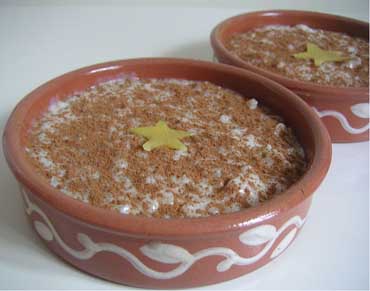 Photo by Oryza News http://oryza.com
The finished product garnished with cinnamon
and even raisins into the cooked
rice and sugar to taste. Then they cook the mixture on low heat for 30
to 45 minutes.
Arroz con leche can be served warm or after being chilled in the refrigerator. |
| Effort
launched to define a unique Costa
Rican cuisine |
|
|
By the A.M. Costa Rica staff
The French probably have nothing to worry about yet, but Costa Rica is launching its national plan of healthy and sustainable cuisine. The effort is a joint one among the Cámara Costarricense de Restaurantes y Afines, the Instituto Costarricense de Turismo, the Instituto Nacional de Biodiversidad and the Club de la Gastronomía Epicúrea. The organizations announced the plan Wednesday as part of the World Tourism Day celebration. The idea is to create a unique cuisine to strengthen the national identity and perhaps even create new businesses. Costa Rica basically is defined by gallo pinto, rice and beans. But the announcement suggested that there were a lot of food products here that could create a unique dish, such as risotto with flor de itabo or malanga chips. The Costa Rican embassy in France promotes the Costa Rican cuisine as based on corn, beans, pejibaye and palmito. The embassy Web page includes a little poem to guaro, the national alcoholic drink. But the proposal Wednesday is more complex and more creative. The organizations cited the work of Carlos Castrillo, executive chef of the Hotel Ramada Plaza Herradura. He |
put together a full
menu based on local products such as
the pejibaye palm nut and the níspero
or sapodilla fruit. The proposal is to rescue traditional foods and perhaps protect the flora and fauna of areas in risk of deforestation by suggesting alternate foods. In fact, the Ministerio de Cultura and Juventud has conducted regional contests seeking the best of the local cuisine. These dishes have been put into booklets. So the research already exists. The proposal also marks the 30th anniversary of the restaurant chamber. Manuel Burgos, president of the chamber, said that to put such a plan into action would require coordination with educational institutions. He said it was an ambitious, long-term project. Expats can experiment with products usually found at the local ferias. For example, malanga is a root crop. And flor de itabo is very seasonal. The white flowers of this yucca plant are collected each year, mostly by those in the country, to provide zest for their meals. One use is in scrambled eggs. But it also can be used in a salad. Although guaro is well known as a local version of sugar cane alcohol, the country also produces several types of coffee liquor as well as rum. So crepes de flor de itabo flambé would not be out of the question. |
| Scientists show how New World yeast created lager beer |
|
|
By
the University of Wisconsin-Madison news service
In the 15th century, when Europeans first began moving people and goods across the Atlantic, a microscopic stowaway somehow made its way to the caves and monasteries of Bavaria. The stowaway, a yeast that may have been transported from a distant shore on a piece of wood or in the stomach of a fruit fly, was destined for great things. In the dank caves and monastery cellars where 15th century brewmeisters stored their product, the newly arrived yeast fused with a distant relative, the domesticated yeast used for millennia to make leavened bread and ferment wine and ale. The resulting hybrid — representing a marriage of species as evolutionarily separated as humans and chickens — would give the world lager, the clear, cold-fermented beer first brewed by 15th century Bavarians and that today is among the most popular — if not the most popular — alcoholic beverage in the world. And while scientists and brewers have long known that the yeast that gives beer the capacity to ferment at cold temperatures was a hybrid, only one player was known: Saccharomyces cerevisiae, the yeast used to make leavened bread and ferment wine and ale. Its partner, which conferred on beer the ability to ferment in the cold, remained a puzzle, as scientists were unable to find it among the 1,000 or so species of yeast known to science. Now, an international team of researchers believes it has identified the wild yeast that, in the age of sail, apparently traveled more than 7,000 miles to those Bavarian caves to make a fortuitous microbial match that today underpins the $250 billion a year lager beer industry. Writing in the Proceedings of the National Academy of Sciences, researchers from Portugal, Argentina and the United States describe the discovery of a wild yeast in the beech forests of Patagonia, the alpine region at the tip of South America, that apparently solves the age-old mystery of the origin of the yeast that made cold-temperature fermentation and lager beer possible. “People have been hunting for this thing for decades,” explains Chris Todd Hittinger, a University of Wisconsin-Madison genetics professor and a co-author of the new study. “And now we’ve found it. It is clearly the missing species. The only thing we can’t say is if it also exists elsewhere (in the wild) and hasn’t been found.” Expanding the search to other parts of the world, however, finally paid dividends when collaborator Diego Libkind of the Institute for Biodiversity and Environment Research in Bariloche, Argentina, found in galls that infect beech trees a candidate species whose genetic material seemed to be a close match to the missing half of the lager yeast. “Beech galls are very rich in simple sugars. It’s a sugar rich habitat that yeast seem to love,” notes Hittinger. The yeast is so active in the galls, according to Libkind, that they spontaneously ferment. “When overmature, they fall all together to the floor where they often form a thick carpet that has an intense ethanol odor, most probably due to the hard work of our new Saccharomyces eubayanus.” The new yeast was hustled off to the University of Colorado School of Medicine, where a team that included |
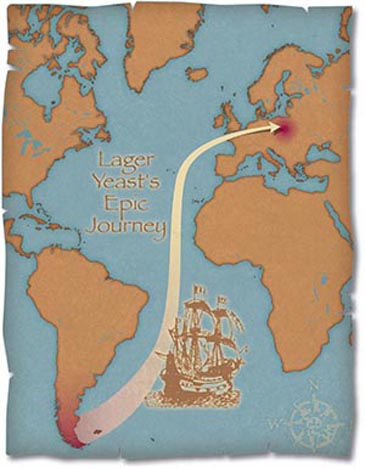 University of Wisconsin-Madison/Barry
Carlsen
This
is route yeast is believed to have taken
 Institute for Biodiversity and Environment
Research,/ Diego Libkind
Orange-colored galls on a
Patagonian tree.Hittinger, Jim Dover and Mark Johnston sequenced its genome. “It proved to be distinct from every known wild species of yeast, but was 99.5 percent identical to the non-ale yeast portion of the lager genome,” says Hittinger. The Colorado team also identified genetic mutations in the lager yeast hybrid distinctive from the genome of the wild lager yeast. Those changes — taking place in a brewing environment where evolution can be amped up by the abundance of yeast — accumulated since those first immigrant yeasts melded with their ale cousins 500 years ago and have refined the lager yeast’s ability to metabolize sugar and malt and to produce sulfites, transforming an organism that evolved on beech trees into a lean, mean beer-making machine. “Our discovery suggests that hybridization instantaneously formed an imperfect proto-lager yeast that was more cold-tolerant than ale yeast and ideal for the cool Bavarian lagering process,” Hittinger said. “After adding some new variation for brewers to exploit, its sugar metabolism probably became more like ale yeast and better at producing beer.” |
| What we published this week: | Monday | Tuesday | Wednesday | Thursday | Friday | Earlier |
| The contents of this page and this Web site are copyrighted by Consultantes Río Colorado 2001, 2002, 2003, 2004, 2005, 2006, 2007 and 2008 and may not be reproduced anywhere without permission. Abstracts and fair use are permitted. Check HERE for details | ||||||
|
|
|
| A.M.
Costa Rica: Lifestyle Festivals, arts, entertainment |
|
| San José, Costa Rica, Monday, Nov. 7, 2011, Vol. 11, No. 220 |
With local stations going on the Internet, a news junkie can watch all the stations at once without flipping channels, something that also is possible with some television sets but a lot easier with a Web browser like Firefox. These stations are Channel 6, Repretel, Channel 42 from El Diario Extra and the upper half of Channel 7 Teletica. |
 A.M.
Costa Rica graphic
|
| Television news shows now are as close as the Internet
browser |
|
|
By
the A.M. Costa Rica Lifestyle staff
With most Central Valley television stations now online in a limited fashion, Internet users do not have to leave their desk to catch the latest news in Spanish. Repretel with its channels 6 and 11, Teletica with its Channel 7, Sociedad Periodística Extra Limitada with its Channel 42 and the new entry, Channel 9 each have some air time through various technical means. Channel 6 and 11 are streamed through Central de Radio, a firm that operates Radio Reloj, Radio Monumental and 28 others and also provides online music via the Internet. Channel 9 and Channel 7 are available through Ustream.tv, which also contains YouTube personal videos. Channel 42, appears to produce its own Internet signal, but a special browser plugin is required to see the live shows. Most of the programming now is either news or soccer games, Channel 6 has the most ambitious schedule starting at 6 a.m. But the online version goes dark several times a day. Channel 9 does not list a schedule, although a movie was playing Sunday night. Channel 7 went dark on the Internet Sunday night in the middle of its news show. However, it was back on in time for “Pequeños Gigantes,” the children's variety show. Such variety would have been unthinkable just a few years ago, but Internet bandwidth continues to expand. The station programming is viewed easily with a normal household cable Internet hookup. Those who really are hooked on electronics can find Channel 42 on their iPad, and Central de Radio will stream music to cell telephones. Sociedad Periodística Extra also has its Radio América at 780 am streaming live via its El Diaro Extra Web page. |
Even when the
stations are not producing a live Internet signal, the various Web
pages contain snippets from earlier broadcasts, mostly of local news. Internet broadcasting for both television and radio is far more economical than using vast amounts of electricity to send a signal through the open air. Ustream, like YouTube, invites individuals to submit clips and even provides a downloadable program to create video. Although the Internet shows have limited popularity, clearly the time is coming when all programming will be shifted to the Internet, and thousands of new arrivals will be producing shows in the same way that the Internet has transformed the print media. Here are the links: Channel 7, Teletica: http://www.ustream.tv/discovery/live/all?q=teletica or via the station's Web page: http://www.teletica.com/ Channel 6 and 11, Repretel http://www.cdr.cr/player/230/BCanal%206 http://www.cdr.cr/player/233/CCanal%2011 Channel 9 http://www.ustream.tv/channel/canal9cr Channel 42 http://www.extratv42.com/c42/ Central de Radio http://www.cdr.cr/ Radio América http://www.780america.com/ra/index.php |
| What we published this week: | Monday | Tuesday | Wednesday | Thursday | Friday | Earlier |
| The contents of this page and this Web site are copyrighted by Consultantes Río Colorado 2001, 2002, 2003, 2004, 2005, 2006, 2007 and 2008 and may not be reproduced anywhere without permission. Abstracts and fair use are permitted. Check HERE for details | ||||||











 James
DeRoy
James
DeRoy