Your daily
English-language
news source
Monday through Friday

|
|
Your daily |
|
|
|
|
|
|
|
|
|
|
|
|
|
|||||||||||||||||||
|
|
|||||||||||||||||||
 |
|
Costa Rica Second news page |
 |
|
|
|
|
|
|
|
|
|
|
 |
| Costa Rica Expertise Ltd http://crexpertise.com E-mail info@crexpertise.com Tel:506-256-8585 Fax:506-256-7575 |
 Click HERE
for great
hotel discounts
|
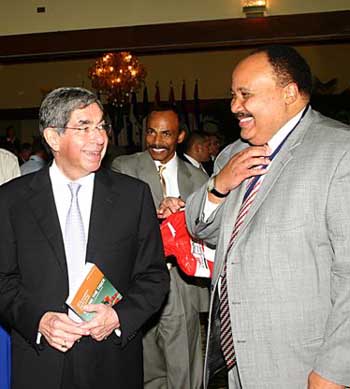 Casa Presidencial photo
Martin Luther King III, president of the King Center in
Atlanta, Georgia, chats with President Óscar Arias
Sánchez.Role of government
considered for two days By the A.M. Costa Rica staff
The role of government in the development of Central America was the main focus for two days at a seminar that ended Thursday. President Óscar Arias Sánchez told the group in closing comments that it is indisputable that the intervention by the government for more than 50 years in the economy has achieved much. He also plugged the idea of freeing private firms to do tasks that the state has done in the past, like the construction and reconstruction of Costa Rica's collapsed highway system. Martin Luther King III, son of the U.S. civil rights leader, was among the 50 researches an academics who attended at the Hotel Ramada Plaza Herradura. King called Costa Rica a world leader in non-violent education. Immigration gets posts to keep crowds in line By the A.M. Costa Rica staff
The donation may not solve the constant crush of people at the immigration offices, but at least the crushes will be orderly. The International Organization for Migration has given the Dirección General de Migración y Extranjería $6,000 worth of signs and posts to organize the crowds that descend on immigration in La Uruca each work day. The posts are the type with elastic bands like are used in banks to create orderly rows of waiting persons. The immigration offices are months behind in setting appointments for foreigners who seek residency or changes in status. The agency also dispenses passports to Costa Ricans. Our readers opinions
We are Bush-bashing soft-on-terror libs Dear A.M. Costa Rica: Way to go G. McMahon, in San José. I didn’t think there were any patriotic Americans left in Costa Rica, after listening to the constant Bush-bashing barrages that get published here. One thing you should know, the editor of this periodical, another anti-U.S.A., Bush basher, will do his best to set you up. He published your letter, but then will only publish the venomous, soft-on-terror libs that rebuke your comments. So it seems to all who read this exchange, that you are in the minority. Therefore I don’t expect this letter to make it into print. How do I know he’s an anti-American Bush basher? Just go back and read the article he inserted back in early July of this year, when we were celebrating our July 4th Independence Day. Http://www.amcostarica.com/070406.htm Dragging up every negative event he could find in the U.S.A.’s history, and rehashing them as proof that the USA is a despicable place, governed by lying, tyrannical despots. (Slick Willie and Hillary not included, of course ) Take away the aid we give out internationally, and you’d really hear these “sour grapes” whiners holler. God bless the U.S.A. And Costa Rica,..and yeah, even the Godless liberals. (smile) Joe Furlong
Cape Haze, Florida/ Dominical, CR Writer should be sorry for his misleading note Dear A.M. Costa Rica: G. McMahon was absolutely correct, if not totally self-revealing, by beginning his letter with an apology by stating that he was ‘ Sorry ‘ in the first sentence of that letter. If partial truths and misstatements were nails, a very large structure could be built with the purposely misleading statements that he used in his response. That is, in and of itself, something for which to be genuinely sorry. Interestingly enough, those are the same tactics that were used to convince our legislature to approve the funding necessary to invade, attack and occupy a sovereign nation which had neither attacked us nor posed any immediate threat to us. Since then, a non-select group of mouth breathing, living brain donor idolaters have continually attempted to promote the bizarre concept of our country serving it’s leader in lieu of that leader serving our country and preserving our Constitution, as he took an oath to do. Pat Schmit’s letter, to which G. McMahon responded, was not so much against our president as it was in favor of America and the current preferences of over 65 percent of it’s citizens. Allen McDonald
An American expatriate, not an American ex-patriot |
|
 |
 |
 |
It may seem obvious,
but people advertise here because they get the best return for their investment |
|
on our real estate page HERE! |
|
Costa Rica Third news page |
 |
|
|
|
|
|
|
|
|
| San José, Costa Rica, Friday, Oct. 13, 2006, Vol. 6, No. 204 | ||||||
 |
 |
|
Consumers
face wildly fluctuating drug prices, survey says
|
|
|
By the A.M.
Costa Rica staff
Over-the-counter and prescription drug prices fluctuate as much as 193 percent, a study by the economics ministry found. And Costa Ricans can pay as much as 1,073 percent more for common drugs than residents of Nicaragua where drug prices are controlled, the study report said. The results were released Thursday by the consumer section of the Ministerio de Economía, Industria y Comercio. The survey took place in the greater metropolitan area between Sept. 27 and Oct. 7. The Nicaraguan prices came from the regulatory agency there. Jorge Woodbridge, a vice minister, said the ministry was trying to generate more competition among drug vendors. The five best prices found for 10 over-the-counter products were in supermarkets, said the survey report. Some 78 percent of the highest prices in this category were found in pharmacies, the study said. Farmacia Fischel was singled |
out as having 38 percent of the highest prices,
that is 19 of some 50 products surveyed. Prices for certain anti-depressants fluctuated 160 percent among pharmacies. Tofranil (25 mgs.), for example, sold for prices from 165 colons to 429 colons a unit. Prices among generic products differed some 193 percent. These included your basic headache pills. Of 23 of the generic products surveyed, 99 percent had higher prices in Costa Rica when compared to the regulated prices in Nicaragua. Frosamida, a diabetes medicine, had an average price of 10.77 colons a pill in Nicaragua compared to 126.41 colons a pill here, said the report. There are about 521 colons to the U.S. dollar. However, the ministry concluded that the open market was the best way to provide quality and the best prices for the consumer. The full report in Spanish is on the ministry Web page. Even someone who did not speak Spanish would have no trouble identifying prices and locations. |
| Practical and philosophical reasons for riding the city bus |
|||
| Bill recently came to
live in
Costa Rica. Like me, he lives in the city and does not own a
car. He called me last Saturday to ask directions to the Pavas feria.
I told him where to catch the bus on Pavas Avenue and to get off one
stop past the U.S. Embassy. He was a little embarrassed as he confessed that he had not as yet ridden a bus in San José. He should not be embarrassed; not many expats do ride city buses. I am now used to that mode of transportation but remember how confused I was at first, so, for those who would like to try the bus, I am going to answer some of the questions Bill asked. Often there is a sign in the window of buses telling you the various stops and how much the current fare is (it changes with inflation). You do not need the exact change. I have seen bus drivers change 5,000-colon bills, although you might find yourself with a pocketful of menudo (small change). Within the city most trips are under 200 colons (40 cents). Don’t dally in the front of the bus once you have entered because often there is an electronic gate that records the entries. Sometimes buses are crowded with standees. If you are older and female, someone will usually give you their seat. If you don’t know where your bus stop is, the driver is usually very helpful in letting you know when to disembark. Ask him when you enter. If you do know, pull the string or push the proper button at least a block beforehand. As soon as you sit down, look for the signal apparatus. Sometimes they are hard to find. Remember, Ticos riding buses are as kind and helpful as they are in other situations. I once was struggling with a torn fingernail and the lady in the seat opposite me brought out an emery board, gave it to me and insisted that I keep it. Some buses seem to be old school buses with seats and spaces between them just right for third graders. If you are very tall, it might be easier to stand in some of these, especially if the driver is a “cowboy” as I call them or muy bravo as some Ticos say. There are signs in most buses telling you to exit via the back door but many riders near the front still use the front door. Buses are not always quiet. Sometimes the driver treats you to his music. Sometimes a vendor or supplicant gets on to give a pitch for money. A city bus is sometimes noisy and sometimes crowded, but it is never smelly. I am convinced that Costa Ricans are the most bathed people in the world. |
And then this past week I attended Al Gore’s film “An
Inconvenient
Truth” about global warming. The viewing was sponsored by the eco
travel agency Horizontes Nature Tours and was free for the many people
invited to view it. The lovely Cine Megaly was almost full.
The film
is well worth seeing and has significance for Costa Rica because this
country could, with continued and more serious concern for the
environment, for conservation, be a proud example to the rest of the
world. Global warming is reaching a critical mass and seems to be
affecting even Costa Rica (and we are lucky because the rise in
temperatures is less the closer you are to the equator). Some
friends
who live in Atenas tell me it is getting warmer there so that they are
now noticing that there are more mosquitoes – a warm weather
menace. |
||
 dddd |
 Photos by
Pablo Murillo
|
|
Photo
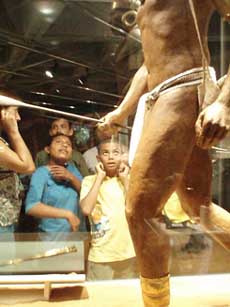
exposition at local museum is designed to offset local xenophobia
|
|
|
By the A.M.
Costa Rica staff
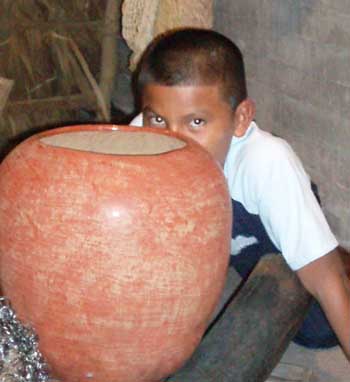
A digital photo exposition at a local museum is at least politically incorrect. The exposition theme is that Nicaragua, Panamá and Costa Rica are one region, something that many Costa Ricans, tinged with a bit of xenophobia, probably are not willing to admit. The exposition is by Pablo Murillo and titled "Una Región, la Misma Visión." The exposition specifically is designed to awaken the sensibilities of spectators despite the xenophobia that has as its origin the social and migration problems that |
provoke
ill will among the peoples, according to a summary from the Museo Dr.
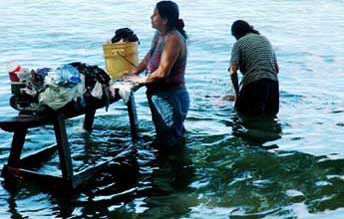
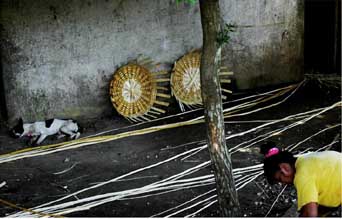
Rafael Ángel Calderón Guardia in Barrio Escalante. The exhibition, which will run until Oct. 29, was inaugurated Thursday night. The 40 color photos cover nearly all aspects of life, including religion, architecture, fiesta, handicraft and daily work. One photo shows women washing clothes in the sea. Another is of a basket artist at work. The museum, which is open from 9 a.m. to 5 p.m. Monday through Saturday, is 100 meters north and 100 meters east of the Santa Teresita Church on Calle 23 in east San José. |
 |
 |
| The principal advantage of daily newspaper advertising is. . . well. . . It's daily!* (*you DO want customers every day, right?) |
|
|
|
Fourth news page |
|
|
|
|
|
|
|
|
| San José,
Costa Rica, Friday, Oct. 13, 2006, Vol. 6, No. 204 |
||||||
|
Castro's
brother seems to be moving into his own as leader
|
|
|
By the A.M.
Costa Rica wire services
A report in Time Magazine this week that Cuban President Fidel Castro has terminal cancer has triggered new speculation about the Communist nation's future. A number of Cuba experts say that Fidel's younger brother, Rául Castro, has taken center stage in Cuba like no one else has done in the 47 years Fidel has been in power. Cuba's interim president, Rául Castro, has denied reports that his older brother is dying, saying Fidel is constantly improving, and that he will hold a special session with student delegates in December. President Fidel Castro temporarily ceded power to Rául on July 31, saying he was undergoing surgery for intestinal bleeding and would need weeks to recover. State-run media have shown photos and videos of Fidel Castro in pajamas meeting dignitaries in a private setting, but no new photographs of the 80-year-old leader have been released in three weeks. Meanwhile, Rául Castro, 75, has had a number of public appearances recently, in contrast to the first weeks after Fidel's surgery. He appeared at a youth meeting Sunday, and he delivered his first nationally televised domestic speech two weeks ago. Brian Latell is a professor at the University of Miami and has written a book about the two Castro brothers called "After Fidel." He said the brothers have a fascinating relationship and have been working together for 53 years. |
"Fidel has relied on Rául to an
extraordinary extent and Rául Castro has been underestimated for
years
by observers," he said. "He has run the military and the armed
forces
very skillfully, the world's longest-serving defense minister. He
is a
very powerful man in his own right. And he's been essential to
Fidel,
he's been indispensable. I do not think Fidel Castro could have
kept
himself in power for almost 48 years without the support of his
brother." Latell points to the lack of riots, protests or open challenges to Rául Castro since Fidel's surgery as evidence that he is a formidable political player. Professor Andy Gomez, a senior fellow at the University of Miami, agrees that Rául Castro should not be underestimated. "Let us remember Rául has always been the man behind the scenes, running the day-to-day [operations]," said Gomez. "It was Fidel's face that represented the Cuban revolution. Rául, from all the years we have studied him, we know for a fact that he is a very capable administrator." Professor Gomez says there have been no policy changes since Rául Castro took power in late July, and he does not expect any until after Fidel dies. He said that Rául Castro looks to Communist China as a role model, meaning he says, stronger global economic ties without accompanying political freedoms. Most analysts agree that, for now, Rául Castro holds a firm grip on the levers of power in Cuba. |
|
Free
wireless Internet access waking up a sleepy provincial town in Chile
|
|
|
By the A.M.
Costa Rica wire services
Salamanca used to be a sleepy Chilean provincial town tucked away in the foothills of the Andes. But, thanks to the foresight of the local mayor, Gerardo Rojas, all that has changed. Through funding from the local copper mine and help from other organizations, he has managed to ensure that the town is the first place in all of Latin America to have free high speed wireless Internet access, or WiFi, for its community. Salamanca has just finished the first stage of installing the technology, 11 antennas that enable the town to be a WiFi area with wireless access to the Internet. University students gave up their holidays to teach the townspeople how to become computer literate. One person taking full advantage of the new technology is taxi driver Pedro Saavadera. He says that, never in all his 60 years had he even switched on a computer and that now his life is changed. He says even though he is 300 kilometers (186 miles) from the capital, Santiago, he can order spare parts and check on car prices — all thanks to the computer. In a poor community like Salamanca, it is often difficult to get access to a computer, but the mayor has opened up the |
local school after classes so people can
use the 80 computers there. A retailer has also decided to sell
computers at a more competitive price. In general, it is the young who
are taking full advantage of WiFI Internet access, but they often
complain that it is difficult to get a good connection. Despite the problems, Igancio Lopez from Atina, Chile is confident that the next step is nothing short of a social revolution. He says that in Salamanca, there are no universities so people have to study elsewhere and it is expensive for their families to phone them. He says computers make it possible for everyone to have access to long distance phones over the internet. Lopez says health care is another area in which Internet access can help. He says Salamanca does not have enough medical facilities, so townspeople can use the computer to communicate with doctors or medical centers in other parts of Chile. Since he helped set up the Internet access program, Mayor Rojas has been getting a lot of telephone calls. People from all over Chile are ringing up to find out more about the project and see if they can become the next digital city in the country. |
| News from
the BBC up to the minute |
BBC sports news up to the minute |
| BBC news and sports feeds are disabled on archived pages. |
|
|
|
|
|
|
|
|
|
| What we published this week: | Monday | Tuesday | Wednesday | Thursday | Friday | Earlier |
|
|