|
 |
Costa Rica Your daily |
 |
|
|
 |
 |
|||||||||||||||||||
|
|
||||||||||||||||||
 |
|||||||||||||||||||
|
|
||||||||||||||||||
 |
 |
 |
|
|
|
|
|
|
|
|
| What we published this week: | Monday | Tuesday | Wednesday | Thursday | Friday | Earlier |
|
|
 |
| A.M. Costa Rica's Second news page | |||||||||
| Home |
Tourism |
Calendar |
Classifieds |
Entertainment |
Real
estate |
Rentals |
Sports |
About
us |
|
| San José, Costa Rica, Tuesday, Sept. 27, 2011, Vol. 11, No. 191 | |||||||||
 |
 |
 |
|
President promises land
and road for San Carlos By
the A.M. Costa Rica staff
The canton of San Carlos is celebrating its 100 years of existence, and President Laura Chinchilla visited Monday with promises of more government aid. She said that the central government will provide the resources to purchase land for a proposed university center and that a new highway that connects the area with Naranjo will be a work of quality and completed during her administration. There are about 140,000 residents of the canton, and Ms. Chinchilla praised it as being one of the more competitive in the country. The canton has a mixed economy with significant amounts of agriculture and livestock raising. Just leave plate at home to avoid speeding fines By
the A.M. Costa Rica staff
Expats who are worried about the speed trap cameras might take a hint from crooks and robbers. Typically the bad guys drive around in vehicles without plates. There was another case about 11 o'clock Sunday night in Sabanilla when four bandits in a brown Hyundai without plates pulled into a gas station and held up those present. They took just 20,000 colons and the personal belongings of the two employees and a customer they found there. Presumably the crooks will not get a speeding ticket if they exceeded the limit in their flight because the camera did not capture a number. More of same likely By
the A.M. Costa Rica staff
The weather will be more of the same today, said the Instituto Meteorológico Nacional. The forecast calls for clear skies in the morning followed by a buildup of humidity coming in from the Pacific. That means late afternoon thunderstorms on the Pacific coast, the Central Valley and the mountains of the northern zone. The Caribbean coast may see some showers but the weather will mostly be dry, said the institute. Son a suspect in man's murder By
the A.M. Costa Rica staff
The principal suspect in the killing of a 76-year old Panamanian man in southern Costa Rica is the man's son, the Judicial Investigating Organization said Monday. The victim, identified by the last name of Sanjur was found on a public roadway near Ciudad Neily. He was reported threatened and abducted a week ago, and judicial agents heard that the reason was a dispute over a debt. Our reader's opinion
Speeding fines out of line,outrageous and unfair Dear A.M. Costa Rica: I feel strongly that the fines for speeding in Costa Rica are outrageous. I just googled "average cost of a speeding ticket in the United States" and found an average range from $250 to $350 for 20 to 30 miles above the speed limit. These are the fines in a country that has superior roads and well-lit, well-divided and well-paved highways, modern infrastructure, mandatory driver education courses, defensive driving courses, and an average monthly pretax income for the Hispanic population of $3,822. Do the math! Anyone can see how completely insane and unfair by comparison the fines are in Costa Rica! I don't know of any expat who can afford a $600 speeding ticket, so how could a Tico? I am a permanent resident, have no plan of breaking any traffic rules but still feel that the local population should make this injustice known through protest. As a "guest" in the country, I don't feel I have the right to do anything more than voice my opinion in your English online editorial section. I would love to see a countrywide protest in the near future. I would love to know how these legislators justify their reasoning. Thanks for the forum for my vent! Deb
Klipper
Esparza
|
|||||||||||||||||||||||||||||||||||||||||||||||
 |
||||||||||||||||||||||||||||||||||||||||||||||||
| Home |
Tourism |
Place
classified ad |
Classifieds |
Entertainment |
Real
estate |
Rentals |
Sports |
About
us |
|
| What we published this week: | Monday | Tuesday | Wednesday | Thursday | Friday | Earlier |
| The contents of this page and this Web site are copyrighted by Consultantes Río Colorado 2011 and may not be reproduced anywhere without permission. Abstracts and fair use are permitted. Check HERE for details | ||||||
 |
| A.M. Costa
Rica's Third newspage |
Everyone should have a job! That's the philosophy behind A.M. Costa Rica's policy of providing free employment-offered and employment-wanted ads. See our jobs page HERE! |
||||||||
| Home |
Tourism |
Calendar |
Classifieds |
Entertainment |
Real
estate |
Rentals |
Sports |
About
us |
|
| San José, Costa Rica, Tuesday, Sept. 27, 2011, Vol. 11, No. 191 | |||||||||
| Lawmakers asked to OK use of ankle
locators for prisoners |
|
|
By the A.M. Costa Rica staff
The executive branch is seeking to get legislative approval for the use of ankle bracelets in part to solve the problem of crowded prisons. Hernando París, minister of Justicia y Gracia, explained the proposal at a meeting last week of the Comisión Permanente Especial de Seguridad y Narcotráfico. The bill is No. 17.665. The bracelets are those electronic devices that keep track of an individual's location. Paris noted that accommodations have increased by 1,014 prison spaces this year alone but the need is increasing more rapidly. In the last two years, the prison population increased 30 percent among adults. Juveniles in confinement increased 300 percent, he said. The use of bracelets would relieve some of the space problem, he told the committee. Judges frequently require suspects in liberty to sign in with prosecutors every 15 days. Not all do, and this system is not kept up with equal vigor in every prosecutor's office. The ankle bracelets would be monitored from a central office. Paris noted that the use of the bracelet would be helpful in cases of domestic violence where one partner, usually the man, is ordered to stay away from the home. There have been a series of killings by men who have been the object of a restraining order. The ankle bracelet would give warning when the man approached his former home. |
Police Monday just arrested a man in
Puriscal who has been set free
after being accused of beating up an infant. One of the conditions of
his freedom was that he stay out of Puriscal where the mother and baby
live. He did not, and police officers found him living there Monday.
Had he been wearing an ankle bracelet, he may have been found sooner. Costa Rica also employes various types of conditional freedom. A convicted murderer died from police bullets last week when he was fleeing from sticking up a bar. He was on conditional freedom but clearly violated the terms. There are other variations of what is called in Spanish the régimen de confianza. Sometimes prisoners are allowed to leave the institution to go to work on the condition that they return after the job. Others are released a couple of days at a time. Prison officials say that this time of reintroduction to society is valuable. The prisons are run by an agency called Adaptación Social which is part of the ministry headed by Paris. He also told lawmakers that the locator ankle bracelets would not be used on juvenile offenders. There are Internet postings by people who claim that the ankle bracelet can be defeated by various means. Some say it can be wrapped with a wet towel. Others said they can slip the device off their leg. Paris did not mention the cost of the program which would include not only the devices but the central monitoring offices and salaries for the 24-hour observers. |
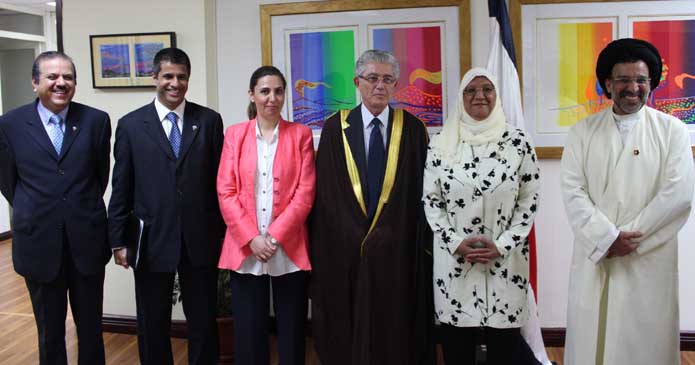 Casa Presidencial photo
Vice President Alfio Piva
Mesén dons Middle Eastern dress as he welcomes the Kuwait
delegation. |
|
| Kuwait delegation includes first woman
parliamentarian |
|
|
By the A.M. Costa Rica staff
A delegation of legislators from Kuwait are in town, including Masouma Almubarak, who is the first woman to be elected to the national governmental body. The visitors met with Alfio Piva Mesén, one of the country's two vice presidents, and then visited lawmakers in the Asamblea Legislative, mainly members of the Comisión Permanente Especial de Relaciones Internacionales y Comercio Exterior. Jeannette Ruiz Delgado, who heads the committee here, |
noted that the
visit provided an opportunity to have closer ties with the Middle
Eastern country. The lawmakers from Kuwait were seeking Costa Rica's backing so it could win a seat on the U.N. economic commission. Ms. Ruiz said that Costa Rica has a lot to learn from Kuwait in terms of education, culture and macroeconomic vision because it has a high per capita income. Some 16 lawmakers form part of a Costa Rican-Kuwait friendship committee. |
 |
| You need to see Costa Rican tourism information HERE! |
| Home |
Tourism |
Place
classified ad |
Classifieds |
Entertainment |
Real
estate |
Rentals |
Sports |
About
us |
|
| What we published this week: | Monday | Tuesday | Wednesday | Thursday | Friday | Earlier |
| The contents of this page and this Web site are copyrighted by Consultantes Río Colorado 2011 and may not be reproduced anywhere without permission. Abstracts and fair use are permitted. Check HERE for details | ||||||
| A.M.
Costa Rica's Fourth news page |
 |
||||||||
| Home |
Tourism |
Calendar |
Classifieds |
Entertainment |
Real
estate |
Rentals |
Sports |
About
us |
|
| San José, Costa Rica, Tuesday, Sept. 27, 2011, Vol. 11, No. 191 | |||||||||
| Signing set for law to protect citizens
from abusive officials |
|
|
By
the A.M. Costa Rica staff
President Laura Chinchilla is scheduled to sign into law today legal changes that threaten public employees with prison if they do not follow through with requests from the public. The Ministerio de Economía, Industria y Comercio also is taking part in the 3 p.m. ceremony at Casa Presidencial because the goal of the legislation is to increase the country's competitivity. The changes basically target public officials or employees who abuse their authority or request unnecessary paperwork to provide public services. The measure is titled Reforma a la Ley de Protección al |
Ciudadano del exceso de Requisitos y
Trámites Administrativos, meaning
“reform of the law for the protection of citizens from excessive
requirements and administrative paperwork.” The measure also punishes public employees who do not complete action on submissions in the time established by the law. The first violation may incur only a warning, but subsequent ones can lead to discharge, according to the law. Also punished are public employees who deliberately delay action on a request. The original law has been in force for nine years, but the new changes give more weapons for citizens who feel they are being victimized by abusive officials and employees. |
| Utah researchers say they created way to
frustrate AIDS virus |
|
|
By
the University of Utah news service
University of Utah researchers have discovered a new class of compounds that stick to the sugary coating of the AIDS virus and inhibit it from infecting cells — an early step toward a new treatment to prevent sexual transmission of the virus. Development and laboratory testing of the potential new microbicide to prevent human immunodeficiency virus infection is outlined in a study set for online publication by Friday in the journal Molecular Pharmaceutics. Despite years of research, there is only one effective microbicide to prevent sexual transmission of HIV, which causes AIDS, or acquired immune deficiency syndrome. Microbicide development has focused on gels and other treatments that would be applied vaginally by women, particularly in Africa and other developing regions. To establish infection, HIV must first enter the cells of a host organism and then take control of the cells’ replication machinery to make copies of itself. Those HIV copies in turn infect other cells. These two steps of the HIV life cycle, known as viral entry and viral replication, each provide a potential target for anti-AIDS medicines. “Most of the anti-HIV drugs in clinical trials target the machinery involved in viral replication,” says the study’s senior author, Patrick F. Kiser, associate professor of bioengineering at the University of Utah. “There is a gap in the HIV treatment pipeline for cost-effective and mass-producible viral entry inhibitors that can inactivate the virus before it has a chance to interact with target cells,” he says. Lectins are a group of molecules found throughout nature that interact and bind with specific sugars. HIV is coated with sugars that help to hide it from the immune system. Previous research has shown that lectins derived from plants and bacteria inhibit the entry of HIV into cells by binding to sugars found on the envelope coating the virus. However, the cost of producing and purifying natural lectins is prohibitively high. So Kiser and his colleagues developed and |
evaluated the anti-HIV activity of
synthetic lectins based on a
compound called benzoboroxole, or BzB, which sticks to sugars found on
the HIV envelope. Kiser and his colleagues found that these BzB-based lectins were capable of binding to sugar residues on HIV, but the bond was too weak to be useful. To improve binding, they developed polymers of the synthetic lectins. The polymers are larger molecules made up of repeating subunits, which contained multiple BzB binding sites. The researchers discovered that increasing the number and density of BzB binding sites on the synthetic lectins made the substances better able to bind to the AIDS virus and thus have increased antiviral activity. “The polymers we made are so active against HIV that dissolving about one sugar cube’s weight of the benzoboroxole polymer in a bath tub of water would be enough to inhibit HIV infection in cells,” says Kiser. Depending on the strain, HIV displays significant variations in its viral envelope, so it is important to evaluate the efficacy of any potential new treatment against many different HIV strains. Kiser and his colleagues found that their synthetic lectins not only showed similar activity across a broad spectrum of HIV strains, but also were specific to HIV and didn’t affect other viruses with envelopes. The scientists also tested the anti-HIV activity of the synthetic lectins in the presence of fructose, a sugar present in semen, which could potentially compromise the activity of lectin-based drugs because it presents an alternative binding site. However, the researchers found that the antiviral activity of the synthetic lectins was fully preserved in the presence of fructose. Kiser says future research will focus on evaluating the ability of synthetic lectins to prevent HIV transmission in tissues taken from the human body, with later testing in primates. Kiser and his colleagues are also developing a gel form of the polymers, which could be used as a topical treatment for preventing sexual HIV transmission. |
| Home |
Tourism |
Place
classified ad |
Classifieds |
Entertainment |
Real
estate |
Rentals |
Sports |
About
us |
|
| What we published this week: | Monday | Tuesday | Wednesday | Thursday | Friday | Earlier |
| The contents of this page and this Web site are copyrighted by Consultantes Río Colorado 2011 and may not be reproduced anywhere without permission. Abstracts and fair use are permitted. Check HERE for details | ||||||
| A.M.
Costa Rica's Fifth news page |
|
|||||||||
| Home |
Tourism |
Calendar |
Classifieds |
Entertainment |
Real
estate |
Rentals |
Sports |
About
us |
||
| San José, Costa Rica, Tuesday, Sept. 27, 2011, Vol. 11, No. 191 | ||||||||||
 |
| Jamaican leaders urge weapon control by U.N. Special
to A.M. Costa Rica
An international regime is needed to regulate the sale and transfer of small and light weapons, Jamaica’s deputy prime minister told the General Assembly’s annual general debate Monday. “Jamaica, like its Caribbean Community partners, continues to face severe threats to our long-term socio-economic development from the illicit trafficking in narcotic drugs, small arms and light weapons and ammunition,” said Kenneth Baugh, the deputy prime minister. Baugh said progress on the issue would not be possible without international regulation, and urged member states to build on existing accords to ensure further regulation is implemented. He added that although Jamaica is taking internal measures to combat organized crime, they would not be successful without international support. “We have achieved marked reductions in crime and criminal activities over the past year with our multi-faceted strategy to stem the problems, as well as through the implementation of social intervention and social transformation initiatives to stem the problem of crime and violence. “We firmly believe, however, that we will not see the full impact of these efforts without an international regime that regulates the sale and transfer of conventional weapons,” he said. Baugh said Jamaica is committed to ensuring that next year’s U.N. conference on the arms trade treaty results in a more comprehensive, transparent and legally binding agreement. Beyond the issue of organized crime, Baugh spoke of the need for U.N. member states to honor their aid commitments to developing countries and to re-engage in trade negotiations, as this is the only way to achieve sustainable economic progress for developing countries. “Developing countries like ours have undertaken painful adjustments to achieve fiscal discipline and macro-economic stability within an open economy. “Unfortunately, development aid and assistance to developing countries continue to fall short of the agreed goal of 0.7 per cent of gross national income, as some of our developed partners fail to meet their commitments,” he said. He also noted that re-engagement in the Doha Development Round trade negotiations – the World Trade Organization talks which have been stalled since 2008 – is crucial to usher in a new era of multilateral trade relations. Negotiations “must take into account the preservation of policy space for developing countries in areas which are integral to our ability to build competitiveness and trade capacity. We remain hopeful that at the 8th Ministerial Conference in December of this year we will consider a package of measures as the basis for a more balanced trade regime,” he said, referring to the next trade organization ministerial conference, which will be held in Geneva. Prime minister in Jamaica planning to step down By
the A.M. Costa Rica wire services
Jamaica's prime minister has announced that he is stepping down in the coming weeks to make way for a new leader from within the ruling Jamaica Labor Party. The prime minister, Bruce Golding, has been in office since 2007. Golding said Sunday in a statement the last four years have taken a toll. He said now is an appropriate time to make way for new leadership. Party officials say Golding will resign as soon as a new ruling leader is chosen. The transition could take place in November at party's annual conference. The opposition People's National Party has called for general elections as soon as possible to resolve what it calls the crisis of governance in Jamaica. Progress cited defending intellectuals property Special
to A.M. Costa Rica
The United Nations agency entrusted with defending intellectual property such as trademarks, patents and copyrights opened its annual meeting Monday reporting progress on issues ranging from audiovisual performances to protecting the traditional knowledge of indigenous peoples. “The atmosphere amongst member states has greatly improved,” said Francis Gurry opening the session in Geneva. “Delegations are very constructively engaged in looking for solutions. I would like to thank all member states for the extraordinary engagement that has made this possible.” He is director general of the U.N. World Intellectual Property Organization. He noted that the international intellectual property community faces three major challenges in coming years – management of demand of intellectual property applications, the migration of all cultural content to the Internet, and enhancing the capacity of least developed and developing countries to use the intellectual property system for encouraging innovation and creativity. The World Intellectual Property Organization’s top copyright negotiating body is set to call for the resumption of a conference on protecting audiovisual performances after agreement was reached in June to provide a clearer legal basis for the international use of audiovisual works, both in traditional media and in digital networks. Such an instrument would help safeguard the rights of performers such as singers, musicians, dancers and actors against the unauthorized use of their performances in audiovisual media such as television, film and video. Previous accords grant protection mainly in relation to sound recordings of performances. Gurry also reported great progress in traditional knowledge and folklore. At a meeting in June native representatives delivered a joint statement identifying their expectations and calling for their more effective participation in all negotiations and decision-making processes. Monday night the organization inaugurated its new administration building, the work of award-winning Behnisch Architekten of Stuttgart, Germany, with Barbara Hendricks, one of the world’s leading opera singers and a best-selling recording artist, performing Manuel de Falla’s “Siete Canciones Populares Españolas,” accompanied by internationally renowned pianist Love Derwinger. “This is a special occasion in the history of our organization and we are honored that it is distinguished by the presence of such an inspirational representative of the international artistic community, and one, moreover, who has demonstrated a tireless, life-long commitment to promoting development through the arts,” Gurry told some 900 guests at the inauguration. |
|
| What we published this week: | Monday | Tuesday | Wednesday | Thursday | Friday | Earlier |
| The contents of this page and this Web site are copyrighted by Consultantes Río Colorado 2011 and may not be reproduced anywhere without permission. Abstracts and fair use are permitted. Check HERE for details | ||||||
| A.M.
Costa
Rica's sixth news page |
|
|||||||||
| Home |
Tourism |
Calendar |
Classifieds |
Entertainment |
Real estate |
Rentals |
Sports |
About us |
||
| San José, Costa Rica, Tuesday, Sept. 27, 2011, Vol. 11, No. 191 | ||||||||||
 |
Latin America news |
U.N. assembly president urges action on trafficking Special
to A.M. Costa Rica
The president of the U.N. General Assembly called Monday for redoubled efforts to tackle human trafficking, which the United Nations anti-crime agency says is a multi-billion dollar industry and one that enslaves some 2.4 million people at any given time, many of whom are children. “Although human trafficking takes place in the dark margins of our societies, we must not ignore its presence,” Nassir Abdulaziz Al-Nasser said in remarks to the second ministerial meeting of the Group of Friends United Against Human Trafficking. He told the gathering, which took place on the margins of the Assembly’s 66th session, that nations must work together to end this global scourge, which ranks as the world’s third most profitable crime after illicit drug and arms trafficking. “We must prosecute and punish the criminals involved and protect and reintegrate the victims into their communities. We must spur governments and all members of society into action to reduce the vulnerability of victims, and increase the consequences for traffickers,” he said. The President noted that despite the proclamation in the Universal Declaration of Human Rights that all humans are born free and that no one shall be held in slavery or servitude, millions of people today, the majority of them children and women, are victims of human trafficking. He called for redoubling efforts to ensure that the rights and freedoms of every person are upheld. “No country is unaffected. We must do better,” said the president. He noted that a global partnership aimed at fostering good governance, debt relief and official development assistance can contribute to reducing poverty and corruption, limiting the supply and demand for trafficking. Cross-border and international cooperation are necessary to monitor and stop child trafficking, he added. Last year the Group of Friends turned the concerns of member states into concrete action by negotiating and passing by consensus a comprehensive U.N. global plan of action to combat trafficking in persons. In addition, the U.N. Voluntary Trust Fund for Victims of Human Trafficking was launched to provide humanitarian, legal and financial aid to victims of human trafficking. Administered by the U.N. Office on Drugs and Crime, it has already begun to establish a small grants facility to start distributing funds to victims. |
|
Latin
American news feeds are disabled on archived pages.
|
|
| Costa Rican News |
AMCostaRicaArchives.com |
Retire NOW in Costa Rica |
CostaRicaReport.com |
| Home |
Tourism |
Place
classified ad |
Classifieds |
Entertainment |
Real
estate |
Rentals |
Sports |
About
us |
|
| What we published this week: | Monday | Tuesday | Wednesday | Thursday | Friday | Earlier |
| The contents of this page and this Web site are copyrighted by Consultantes Río Colorado 2011 and may not be reproduced anywhere without permission. Abstracts and fair use are permitted. Check HERE for details | ||||||










 James
DeRoy
James
DeRoy