
Your daily
English-language
news source
Monday through Friday

|
|
Your daily |
|
|
|
|
|
|
|
|
|
|
|
|
|
|||||||||||||||||
|
|
|||||||||||||||||
|
Costa Rica Second news page |
|
|
|
|
|
|
|
|
|
|
|
 |
| Costa Rica Expertise Ltd http://crexpertise.com E-mail info@crexpertise.com Tel:506-256-8585 Fax:506-256-7575 |
 |
 Click HERE
for great
hotel discounts
|
|
figure in drug intercepts By the A.M. Costa Rica staff
Costa Ricans figure in two cases of boats containing what appears to be cocaine stopped at sea. The first case involved the Navegante I, which was detained in waters off Panama. Four Costa Ricans, fishermen from the Quepos area, are in custody. Saturday Guatemalan sailors caught up with a boat in that nation's waters. On board were three Costa Ricans and a Colombian. Panamanian officials said the boat there was carrying 621 kilos of cocaine and 34 kilos of heroin. Guatemala officials estimated that there had been more than 1,000 kilos on the boat they intercepted. But the crew dumped most of it at sea, they said. All that was left was 116 kilos of suspected cocaine, they said. Trio held on drug counts have a short jail stay By the A.M. Costa Rica staff
Wednesday night saw the climax of a five-month investigation in Nicoya iniciated by citizen complaints about drug dealing. The Judicial Investigating Organization agents raided a beauty shop and a bar. They made three arrests and said they confiscated marked money that came from a controlled drug buy and also a small amount of cocaine. Arrested were two men, 30 and 40, and a woman, 30. They were turned over to the Ministerio Pública, the nation's independent prosecuting agency. The Judicial Investigating Organization issued a news release and photos of the raid. Agents said both the beauty shop and the bar were being used to sell cocaine. Friday neighbors in the center of Nicoya where the two businesses are located were furious. A juez de garantías, the first stage judge in a criminal case, released the three persons, even though one of them had been convicted earlier on an unrelated drug trafficking charge, said the Judicial Investigating Organization. The agency said that the treatment of the suspects is totally under the control of the judge. Neighbors told agents that business would resume as usual at the bar and beauty shop, agents said. There was no information as to whether the judge simply dropped the charges or released the trio pending further court action. More Mideastern nations reach diplomatic accord By the A.M. Costa Rica staff
The foreign ministry announced that Costa Rica has resumed diplomatic relations with Yemen, Bahrain and Kuwait. The original announcement came from New York where Bruno Stagno, the foreign minister, is attending the opening session of the U.N. General Assembly. The foreign minister announced last week that relations had been restored with Egypt and Jordan. Arab countries broke off relations with Costa Rica in 1984 when the country decided to locate its embassy in Jerusalem The Arias administration just announced it will move the embassy to Tel Aviv from Jerusalem, a city many Arabs consider occupied territory. Sagno said from New York that he is continuing discussion with Syria with the goal of resuming relations. Russian diplomat to visit By the A.M. Costa Rica staff
Sergei Kisliak, a vice minister of the Russian Federation, will visit Costa Rica Tuesday and Wednesday. He is in the foreign ministry. Among other topics of discussion, Kisliak will discuss Costa Rica's plan for an international arms treaty. President Óscar Arias Sánchez has named Russia as one of the major arms suppliers to the world. Kisliak has been a spokesman for Moscow in defending its $3 billion arms deal with Venezuela. Costa Rica has had diplomatic relations with Russia since 1970. Our reader's opinion
U.S. military medical careis not like Medicare Dear A.M. Costa Rica: Regarding the controversy over TRICARE. Referencing the letter of Mr. Jim Young in the Sept. 21 edition, he states that “TRICARE and FMP will continue to pay on an “as billed” using basic Medicare standards.” This sentence explains why retired service members are being DENIED their just due entitlements! Mr. Young, we retired service members are not on Medicare, we are under TRICARE (a different system)! Now the question as to why TRICARE is a different system is that it is an ENTITLEMENT granted under the authority of the United States Congress. Since when does the rule regarding the requirement for a retired service member to be enrolled in Medicare part B, allow the deprivation of that entitlement by a contractor to the United States, using Medicare rules? (As I understand it, all TRICARE areas are serviced by private companies contracted to the U.S. government). It appears that the reason that retired servicemen are being denied their entitlements is that we are being treated under Medicare rules, not the rules established by legal authority regarding TRICARE and retired servicemen! Therefore, who is responsible for this outrage? This Col. Debra Franco? The TRICARE contractor for Latin America? If, as it appears, retired servicemen are being DENIED entitlements, approved under law, by the Congress of the United States, those parties responsible are possibly opening themselves to legal actions. In conclusion, let me say that the old saying that if one lives long enough, they well see anything; but this is so unbelievable, and outrageous, that I’m now due for another lifetime of “having seen it all.” P. Meister
Miramar |
|
 |
 |
|
on our real estate page HERE! |
|
Costa Rica Third news page |
 |
|
|
|
|
|
|
|
|
| San José,
Costa Rica, Monday, Sept. 25, 2006, Vol. 6, No. 190 |
||||||
 |
 |
| The double zero can be a much sought individual, too |
|||
| Más jugado
que el doble cero. “Played more often than the double zero.” In Costa Rica, like many other countries, we have a national lottery. Some people choose different numbers every time they play, usually basing their choices on this or that hunch they might have at the moment. But others always play the same number on the theory that eventually their lucky number will hit it big. Costa Ricans often play the double zero on the theory that it comes up more often than other digits, and many others simply play it because they think it’s lucky. Though based upon the frequency with which Ticos play the double zero as their pick in the national lottery, this dicho’s application has a rather interesting twist to it. For example, we often use it to refer to the fellow who has too many girlfriends. The meaning here is that he is the double zero because, like the lottery number, he receives a tremendous amount of attention. Likewise, all the women who are so hopelessly attracted to him are certain that he’s their lucky number — when, in reality, they have about as much chance of landing this guy as they do of breaking the bank at Monte Carlo. As most regular readers of this column have undoubtedly noticed, I love talking about my family. For one thing they’re a very colorful lot, and for another my job as a writer is made a lot easier because I never have to make anything up! In the case of my relatives, the truth almost always turns out to be stranger, and more interesting, than fiction. They all know that I write about them, and they don’t seem to mind. In fact, they’re rather flattered by it. When I was a child I adored my older brother Carlos. After I grew up, however, I discovered that he was something of a rogue, albeit a rather handsome and beguilingly charming one, but a rogue nonetheless. At one time he was paying court to more than a dozen women simultaneously, but never with the least intention of marrying any of them. After all, since all of his numerous lady friends took very good care of him, what need did Carlos have of a wife? Being más jugado que el doble cero, as Carlos certainly was, he considered himself to be a good deal luckier than the average hombre. But one of his lady friends once told me a story of a time when she managed to push Carlos’s luck to the limit. It seems that this particular enamorada was not quite as naïve as the others. She had a strong suspicion that Carlos was seeing another woman, so one day she decided to follow him. She tracked him to a downtown San José club where he liked to spend his afternoons shooting pool. Later that evening he left the club and sped away in his shiny new Mercedes, which, by the way, had been a birthday present from this very lady. She followed him in her own car as he drove off. But, since they lived in Barrio Lujan, she figured something was up when he turned in the direction of Guadalupe. |
Hours passed without Carlos emerging from the house. Finally
the woman
could wait no longer. She got out of her car, walked up to the door and
rang the bell. Tonio’s wife answered. |
||
|
Security
ministry staff gets new tool for tracking those with weapons permits
|
|
|
By
José Pablo Ramírez Vindas
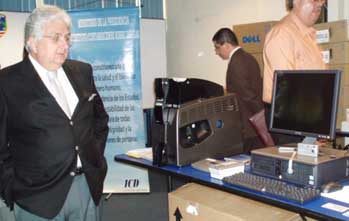
of the A.M. Costa Rica staff Costa Rican law officials have a $50,000 new system to keep track of those who have valid permits to buy or carry a gun. The system comes from the Organization of American States and is similar to a driver's license process in which unique documents in plastic are created. The system is now in the hands of the Ministerio de Gobernación Policía y Seguridad Pública, which issues the permits. In addition to purchase and carry permits, the equipment will keep track of weapons and their serial numbers. In the past, this work was done by hand with paper documents. Now carry permits will contain a photograph of the individual with the permit, fingerprints and a signature. Fernando Berrocal, the security minister, said the new system will be more secure. More Costa Ricans each day apply for permits to buy or carry firearms due to what they believe is the deteriorated security in the country. The system unveiled Friday is the first in Latin America, and there are plans to link systems installed elsewhere in the future with this one. Patricio Zuquilanda represented the hemispheric organization at a ceremony Friday. |
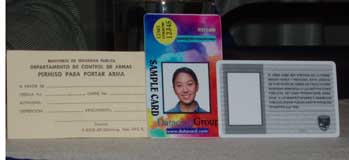 What the new
permits will look like.
 A.M.
Costa Rica photos by José Pablo Ramírez Vindas
Fernado Berrocal looks over the
new systemOfficials said that since January and through August, police have confiscated 1,209 weapons carried illegally, mostly by criminals. Fuerza Pública officers confiscate on the average about six weapons a day. |
 |
|
|
|
Fourth news page |
|
|
|
|
|
|
|
|
| San José,
Costa Rica, Monday, Sept. 25, 2006, Vol. 6, No. 190 |
||||||
|
Venezuela's foreign minister says he was threatened at JFK boarding checkpoint
|
|
|
By the A.M. Costa Rica wire services
Venezuela's foreign minister has rejected a U.S. apology for an incident at a New York airport during which he was detained by security personnel. The envoy, Nicolas Maduro, said Sunday he was detained at John F. Kennedy airport for an hour and a half after he tried to board a flight to Venezuela Saturday. He said police threatened to beat him, and he said he holds the U.S. government responsible. The U.S. State Department said the incident was regrettable and apologized to Maduro and to Venezuela. |
The Department of Homeland Security said there was no evidence that Maduro was mistreated at the airport. Officials said the incident started when Maduro began to complain after he was asked to go through a routine, secondary security screening. Ties between Washington and Venezuela's anti-American government have been strained in recent years. Wednesday Venezuelan President Hugo Chavez called U.S. President George W. Bush the devil during his speech to the United Nations. |
|
Japan and Chile reach agreement on an outline of a free trade pact
|
|
|
By the A.M. Costa Rica wire services
Japan and Chile have agreed on the framework of a free trade pact after seven months of negotiations. Japanese officials say the two countries approved the basic agreement during talks in Tokyo earlier this month. The free trade accord, once finalized, will abolish tariffs for 92 percent of trade between the two countries. Among Japanese exports to Chile are vehicles and machinery. Chile is Japan's main supplier of copper, and |
also exports salmon and wine to Japan. The pact is
expected to take effect early next year. Japanese Prime Minister Junichiro Koizumi said in a statement Friday that free trade with Chile will ensure a stable supply of natural resources for Japan, and further strengthen the two countries' relationship. Japan has been pushing for more free trade agreements around the world. Tokyo has signed such pacts with several countries, including the Philippines, Singapore, Malaysia and Mexico. |
|
Fujimori's intelligence chief, Montesinos, sentenced to 20 more years in prison
|
|
|
By the A.M. Costa Rica wire services
The former head of Peru's intelligence agency has been sentenced to 20 years in prison for his role in supplying weapons to leftist guerillas in Colombia in 1999. Vladimiro Montesinos was found guilty Thursday at a high security naval prison in Lima's port of Callao, where he is already serving a 15-year term for corruption. The court ordered Montesinos and five co-defendants to pay a fine |
of about $3 million. Prosecutors
say the men arranged to have 10,000 assault rifles delivered to
Colombia's leftist rebel group, the Revolutionary Armed Forces of
Colombia, or FARC. Montesinos still faces a possible 35-year sentence on charges that link him to a paramilitary death squad in the 1990's. Montesinos was Peru's spy chief during former President Alberto Fujimori's 10-year autocratic rule. |
| News from
the BBC up to the minute |
BBC sports news up to the minute |
| BBC news and sports feeds are disabled on archived pages. |
|
|
|
|
|
|
|
|
|
| What we published this week: | Monday | Tuesday | Wednesday | Thursday | Friday | Earlier |
|
|


