|
 |
Costa Rica Your daily |
 |
|
|
 |
 |
|||||||||||||||||
|
|
||||||||||||||||
 |
|||||||||||||||||
|
|
||||||||||||||||
 |
|
|
|
|
|
|
|
|
| What we published this week: | Monday | Tuesday | Wednesday | Thursday | Friday | Earlier |
|
|
 |
| A.M. Costa Rica's Second news page | |||||||||
| Home |
Tourism |
Calendar |
Classifieds |
Entertainment |
Real
estate |
Rentals |
Sports |
About
us |
|
| San José, Costa Rica, Tuesday, Sept. 20, 2011, Vol. 11, No. 186 | |||||||||
 |
 |
|
Souvenir shop owner
gunned down on coast By
the A.M. Costa Rica staff
A souvenir shop owner died Sunday night near Jacó, the apparent victim of an assassination outside her home. The victim was identified as 38-year-old Alejandra Erpen Fabre, a citizen of Argentina who had lived in the central Pacific town for about six years, said investigators. The Judicial Investigating Organization said that the woman died about 10 p.m. as she was about to enter her home in Playa Hermosa. She suffered a bullet in the neck. Her sister who accompanied her was wounded in the hand, agents said. There did not appear to be an effort at robbery, and the person with the gun, believed to be a man, fled on foot. Properties being auctioned via Internet Web page By
the A.M. Costa Rica staff
Banco Nacional and the Cámara Costarricense de Bienes Raíces are conducting an unusual online auction of real estate Thursday. The bank said that more than 12,000 persons already have looked at its auction Web page. The bank is prepared to offer mortgages to qualified bidders, it said. The bulk of the properties are in Guanacaste and on the Pacific coast where real estate prices are depressed. The bank promised that properties would be struck down at about 50 percent of their value. However, to really see the properties a visitor to the Web page has to register. There are fees levied. The bidding starts at 4 p.m. Thursday with properties valued at more than $250,000 being offered first. Then properties valued at from $75,000 to $250,000 will be offered. At 9:15 p.m. properties valued between @3,000 and $75,000 will be offered, the bank said. For those wishing to attend in person, the event is at Pueblo Antiguo in the Parque de Diversiones in La Uruca. Local environmental group cites Taiwanese petition By
the A.M. Costa Rica staff
An environmental group that opposes shark finning said that hundreds of Taiwanese citizens have sent a petition to President Laura Chinchilla calling for a complete ban on the importation of shark fins and other shark products. The individuals are from local government, elementary students and members of a Christian church, said the Programa de Restauración de Tortugas Marinas, the environmental group. The signatures were compiled by Shanon Lee, a lecturer at the National Chiao Tung University, said the organization that is known as Pretoma. "We, concerned citizens of Taiwan, are appalled by Taiwan government's indifference to the illegal finning activities of its fleets overseas in Nicaragua and Costa Rica" denounced the organizer. "We do not care for shark fin soup and consider it a horrid, extremely horrid practice, and the government of Costa Rica has our full support to kick the fleets out!" "With these signatures included, over 5,000 citizens of the world have asked President Chinchilla to forbid the importation of sharks to Costa Rica," said Randall Arauz, president of Pretoma. "This is the only way that Costa Rica can advance toward the effective conservation and management of shark resources, and if it doesn't do it, the foreign fleet will continue to circumvent and make a mockery of Costa Rican shark conservation and management policy, affecting our credibility in international forums", he sentenced. The environmental organization noted that the Instituto Costarricense de Pesca y Acuacultura has authorized the importation of 15 tons of shark fins from Nicaragua since Dec. 1. That is because Costa Rican law forbids landing shark fins that are not attached to a shark. But the finners unload in Nicaragua and bring the fins to Puntarenas by truck.
|
|||||||||||||||||||||||||||||||||||||||||||||||
 |
||||||||||||||||||||||||||||||||||||||||||||||||
| Home |
Tourism |
Place
classified ad |
Classifieds |
Entertainment |
Real
estate |
Rentals |
Sports |
About
us |
|
| What we published this week: | Monday | Tuesday | Wednesday | Thursday | Friday | Earlier |
| The contents of this page and this Web site are copyrighted by Consultantes Río Colorado 2011 and may not be reproduced anywhere without permission. Abstracts and fair use are permitted. Check HERE for details | ||||||
| A.M. Costa
Rica's Third newspage |
 |
||||||||
| Home |
Tourism |
Calendar |
Classifieds |
Entertainment |
Real
estate |
Rentals |
Sports |
About
us |
|
| San José, Costa Rica, Tuesday, Sept. 20, 2011, Vol. 11, No. 186 | |||||||||
 |
| Long dead Nicoyans to live again via
museum exhibit |
|
|
By the A.M. Costa Rica staff
The Museo Nacional is putting together an exhibit that will display for the first time objects from the El Silo archaeological site on the Gulf of Nicoya. The site is a cemetery of residents from 800 to 1350 A.D., the museum said. Discovery was by chance when the operators of the Finca El Pochote brought in a backhoe to begin construction of a silo to store grain. That is how the site got its name. That was in 2004. There still is excavation going on at the site because there is a dwelling area that has not been explored, said the museum. The main topic of the display, which opens Nov. 9 is the burial customs of what are being called the old Nicoyans. |
The museum said that the show
includes 85 objects, mostly ceramics. But
there also are stone, obsidian, jadeite and gold objects. These include
incense burners, platters, containers, hatchets and metals. The museum is constructing a scale replica of the site with reproductions of the bone remains and objects located by excavators. “The montage exemplifies the original circular forms of ten graves and their central ossuary, being this the first time this type of circular design is ever found,” said the museum on its Web site. “Evidence shows that in some graves several persons were buried together," it added. "On the other hand, the treatment given to the dead was diverse, possibly related to hierarchy, trade, gender, and other.” The exhibit will run until April 17. The Web page contains a number of images. |
| Independence day comes to the really
remote Costa Rica |
|
|
By the A.M. Costa Rica staff
There are plenty of remote places in Costa Rica, but Punta Burica has to rate very high on being inaccessible. This is the little tail of Costa Rica at the extreme south end of the Pacific coast. The area is so remote that a continent of police going there on an independent day mission had to obtain special permission from officials in Panamá to traverse that country's territory. The idea was to bring an independence day celebration and some health experts to the remote area. Physicians and paramedics from the Reserva de la Fuerza Pública made the trip. There they met Ruperta, a mule that has been in service to the health ministry as the areas only ambulance for 25 years. There are no roads in the area. Most travel is by mule or horseback. Until a month ago, the only communication with the outside world is by Fuerza Pública radio. Now a satellite telephone has been installed. Police officers were not able to bring their vehicles to the area. The only vehicular access is along the beach at low tide, they said. Workers with the Ministerio de Salud and from the Caja Costarricense del Seguro Social provided some basic health attention, such as vaccinations for youngsters. The police officers and others who brought independence day to the area did so on their days off, the agency said. |
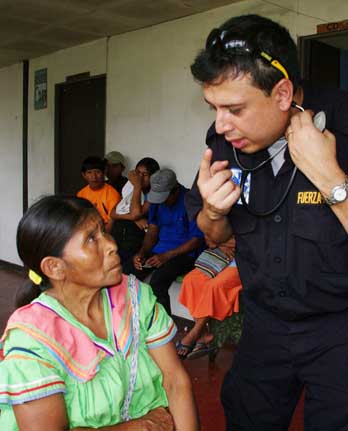 Ministerio de Gobernación,
Policía
An elderly resident receives
care from a reserve police officer.y Seguridad Pública They provided face painting for the children and joined the residents together to sing the national anthem. They said the next project will be to raise funds for a wheelchair for a local boy with cerebral palsy |
 |
| You need to see Costa Rican tourism information HERE! |
| Home |
Tourism |
Place
classified ad |
Classifieds |
Entertainment |
Real
estate |
Rentals |
Sports |
About
us |
|
| What we published this week: | Monday | Tuesday | Wednesday | Thursday | Friday | Earlier |
| The contents of this page and this Web site are copyrighted by Consultantes Río Colorado 2011 and may not be reproduced anywhere without permission. Abstracts and fair use are permitted. Check HERE for details | ||||||
| A.M.
Costa Rica's Fourth news page |
 |
||||||||
| Home |
Tourism |
Calendar |
Classifieds |
Entertainment |
Real
estate |
Rentals |
Sports |
About
us |
|
| San José, Costa Rica, Tuesday, Sept. 20, 2011, Vol. 11, No. 186 | |||||||||
| Key highway reopened, but highway
officials issue warning |
|
|
By
the A.M. Costa Rica staff
The nation's road agency said today that Ruta 32 was reopened about 7 a.m. Monday after crews cleared some 400 cubic meters of debris that fell across the road Sunday evening. However the agency, the Consejo Nacional de Vialidad, issued a warning about using the road because of the wet conditions that contribute to slides. It urged motorists to avoid the route during the nights. This is the San José-Limón route. There will be plenty of wet conditions to worry about. The |
Instituto Meteorológico
Nacional says that the nation is entering the
months with the heaviest precipitation. The institute said that today would be more of the same with warm mornings giving away to cloudy and humid afternoons with a good chance of electrical storms in the Pacific coast, the Central Valley, the northern zone and the mountains of the Caribbean. Much of the Central Valley was spared heavy rains Monday, but the mountains to the west took a beating with thunderstorms and plenty of lightning. |
| Smithsonian Tropical Research Center
looks
to its centennial |
|
|
By
the A.M. Costa Rica wire services
Every year, about 1,000 scientists from around the world visit the Smithsonian Tropical Research Institute in Panamá. The institute is one of the oldest and largest facilities of its kind in the world. Its research on flora, fauna and geology is responsible for many recent discoveries about how the Earth's tropical ecosystems work. It's 6 o'clock in the morning, and light barely filters through the canopy of this tropical rainforest on Barro Colorado Island in Panamá. But neither insects, the lack of light nor the intense humidity deter these scientists. They are looking for monkeys. Anthropologist Stephanie Ramirez studies spider monkeys. “I am interested in knowing how food affects their reproductive potential, because spider monkeys mostly consume fruit, and we noticed that when fruit is not abundant or available they can’t conceive,” she said. There are 1,800 monkeys on the island. 39 of them are spider monkeys. Eight of them have had radio collars placed around their necks. Ms. Ramirez and her assistant Lauren Mills can locate the animals by picking up their signals with a radio receiver. The two researchers are only a small contingent. About 1,000 scientists come here every year for field studies. “The Smithsonian Tropical Research Institute here in Panamá is something of a mecca for all biologists in the world who are interested in the tropics and in tropical biology,” explains Tony Coates, a scientist emeritus with the institute. The institute was established in Panama 100 years ago. Today, Barro Colorado is the most studied rain forest in the world. Abby Bruning came from South Dakota to study ants. “We manipulate their diets. Either they will be on a high carbohydrate or a high protein diet and at the end we run analyses to see how well they fight off infection, death rates |
and
things like that,” Ms. Bruning stated. She studies one of about 200
species of ants here. Pink flower trees on the forest’s canopy are Dipteryx Panamensis, better known as Almendro. The working ants love the flowers and take them home, one petal at a time. It took Azteca ant colony more than a year to build their structure. They are the favorite meal of ant eaters. Smithsonian scientists estimate there are about 100 species of mammals on this tiny island. More than half of them are bats. There are 71 species of reptiles and about 30 million insect species. “The vast majority of all species of plants and animals live in the tropics. The vast majority of all the technical knowhow, political will, education and financing are in the temperate world. How to get those two worlds together is one of the greatest issues facing global conservation,” Coates explained. The Smithsonian Tropical Research Institute is headquartered in Panama City. Its library, with 70,000 volumes on tropical biology, is regarded by scientists as one of the best in the world. “It follows the same system as the Library of Congress,” Coates added. Nearby, Culebra, a major Smithsonian educational center, is open to the public. About 100,000 people, mostly Panamanian school children, visit this center each year. “That’s our biggest educational contribution to our host country of Panamá,” Coates noted. As the Smithsonian Tropical Research Institute in Panamá prepares for its centennial, it is also getting ready to launch new research facilities in the town of Gamboa. Private donors want the institute to examine subjects of growing concern today, such as the forest's ability to control erosion and to capture carbon from the air, and ways to restore and preserve one of the richest and most important ecosystems on the planet. |
| Home |
Tourism |
Place
classified ad |
Classifieds |
Entertainment |
Real
estate |
Rentals |
Sports |
About
us |
|
| What we published this week: | Monday | Tuesday | Wednesday | Thursday | Friday | Earlier |
| The contents of this page and this Web site are copyrighted by Consultantes Río Colorado 2011 and may not be reproduced anywhere without permission. Abstracts and fair use are permitted. Check HERE for details | ||||||
| A.M.
Costa Rica's Fifth news page |
|
|||||||||
| Home |
Tourism |
Calendar |
Classifieds |
Entertainment |
Real
estate |
Rentals |
Sports |
About
us |
||
| San José, Costa Rica, Tuesday, Sept. 20, 2011, Vol. 11, No. 186 | ||||||||||
 |
| Three quakes hit Guatemala and leave three dead By
the A.M. Costa Rica wire services
Three separate earthquakes struck the Central American nation of Guatemala Monday, killing at least three people and causing buildings in the capital, Guatemala City, to shake. The largest quake, with a magnitude of 5.8, hit just after noon local time. The quake, like the other two, was centered some 52 kilometers south of the capital. The temblors occurred within a 90-minute period. One woman died when her house collapsed in the town of Cuilapa. A landslide was also reported following the quakes. The quakes caused the evacuation of buildings in the area and affected electricity and telephone services. Brothers arrested in Brazil in environmentalist killings By
the A.M. Costa Rica wire services
Brazilian police arrested two brothers Sunday in the killing of two Amazon rainforest activists in May. A third suspect remains at large. Brazilian authorities say the suspects were found hiding in a rural area of Para state. The region is known for violence related to land disputes. The rainforest activists had been vocal about illegal logging and ranching in the Para state region. Catholic Land Pastoral says it has found instances of more than 1,150 activist murders in the last 20 years. Six farmers or activists were reported murdered between May and June of this year for their efforts to defend the rainforest. Iranian academic shown as discrimination victim By
the A.M. Costa Rica wire services
The U.S. State Department has issued its annual report on religious freedom. Secretary of State Hillary Clinton said that violations of religious freedom embolden extremists, and said that Iran is among the worst offenders. An example of the abuses can be seen in the case of Mahtab Farid, whose father was arrested after he tried to circumvent a ban on university education for the Baha'i minority. "This is the picture of my Dad. This is from two years ago when he was visiting the United States," Mahtab Farid said. She explains her father, Kamran, was arrested in Iran May 22, the day she graduated from college here in the United States. The crime, according to his daughter: administering a university for young Baha'is who are not allowed to study in Iranian universities. Ms. Farid took part in a discussion in Washington on the plight of Baha'is in Iran. She says she doubts her father will get a fair trial. "We're all really, really, really worried and devastated. I mean all we can really do is pray, she said. "And really try to hold on to our faith." People of the Baha'i faith live freely in the United States and elsewhere. But the State Department's Report on Religious Freedom cites instances of imprisonment, harassment, intimidation and discrimination under Iran's Shi'ite Muslim theocracy. Secretary of State Hillary Clinton says Baha'is are among a number of persecuted minorities there. "In Iran, authorities continue to repress Sufi Muslims, evangelical Christians, Jews, Bahais, Sunnis, Ahmadis, and others who do not share the government’s religious views," Ms. Clinton stated. Non-contagious diseases take U.N. Center stage By
the A.M. Costa Rica wire services
Health starts where people live, labor, learn, play and pray, not just what happens to you in the doctor’s office, says Howard Koh, assistant secretary for health at the U.S. Department of Health and Human Services. That sentiment will take center stage this month as the U. N. General Assembly convenes in New York City and takes on the number-one killer in the world: Non-communicable diseases, including cancer, lung disease, cardiovascular disease and diabetes. The rising tide of such diseases throughout the global community has pushed public health officials to assemble a two-day high-level meeting addressing not only treatment of these illnesses, but more importantly, the outside factors that exacerbate them. Koh focuses on the common misconceptions surrounding non-communicable diseases, especially the notion that these chronic illnesses only affect wealthy countries. He outlines the devastating effects these illnesses have on all nations, rich and poor, claiming two-thirds of deaths worldwide. Interestingly, Koh notes that 80 percent of those deaths occur in middle- and low-income countries. While many health policy leaders grasp the colossal impact of non-communicable diseases, constructing a plan to prevent them is far more complicated. Koh discusses in detail tobacco use and its status as the number one global health threat. Koh expands on the complexities that accompany efforts to prevent tobacco use, namely the capital-rich tobacco industry. Koh stresses that language regarding the inherent conflict of interest between the tobacco industry and public health will be included in the upcoming declaration by the United Nations. The assistant secretary also discusses time-tested efforts to diminish tobacco use, such as raising both the price of tobacco and awareness of its harmful effects. The swift implementation of these efforts is crucial for nations in Africa and East Asia where tobacco addiction exists at alarming rates, he says, adding that there are more smokers in China than there are people in the United States, a frightening statistic that demonstrates the need for action now. In addition, the U.N. high level meeting will tackle the rise of diabetes and obesity, subjects that U.S. First Lady Michelle Obama has identified as growing threats to Americans health and well being. As in the case of tobacco use, the fight to curb unhealthy eating habits and excessive alcohol intake will inevitably clash with the powerful food and alcohol industries. The high-level meeting on non-communicable diseases will mark only the second time in history a health issue has been placed at the forefront of the U.N. General Assembly, preceded only by the 2001 confab on the HIV/AIDS pandemic and other infectious diseases. |
|
| What we published this week: | Monday | Tuesday | Wednesday | Thursday | Friday | Earlier |
| The contents of this page and this Web site are copyrighted by Consultantes Río Colorado 2011 and may not be reproduced anywhere without permission. Abstracts and fair use are permitted. Check HERE for details | ||||||
| A.M.
Costa
Rica's sixth news page |
|
|||||||||
| Home |
Tourism |
Calendar |
Classifieds |
Entertainment |
Real estate |
Rentals |
Sports |
About us |
||
| San José, Costa Rica, Tuesday, Sept. 20, 2011, Vol. 11, No. 186 | ||||||||||
 |
Latin America news |
Spanish tourism firms OK U.N. global ethics code Special
to A.M. Costa Rica
Fourteen prominent Spanish tourism businesses have signed up to follow the Global Code of Ethics for Tourism, a set of principles backed by the U.N. World Tourism Organization and designed to guide the development of the industry in ways that maximize socio-economic benefits and minimize negative impacts. “If responsible tourism is to become a tangible reality in our world, it is essential that the private sector, like their counterparts in public institutions, embrace the principles of ethical, sustainable, and universally accessible tourism,” said Taleb Rifai, according to a press release distributed by the agency today. He is secretary general of the tourism organization. “Today, these companies have underscored their dedication to corporate social responsibility, to support the protection and empowerment of vulnerable groups, consumers and humanity’s heritage, to champion gender equality, poverty reduction, accessibility, cultural and environmental sustainability, and to facilitate access to decent employment across the globe,” he said. The commitment was made last week during the first International Congress on Ethics and Tourism which brought together more than 450 high-profile tourism officials, business leaders, international organizations and experts in Madrid, Spain, to discuss how to guarantee sustainable tourism as well as its role in poverty reduction, gender equality, and fighting exploitation in both the public and private sectors, among other topics. “Today’s show of private sector commitment to the Global Code of Ethics for Tourism from some of Spain’s most important tourism companies is an important step towards a more ethical tourism sector and one other businesses will surely follow,” said Prince Felipe of Asturias, who was present at the closing ceremony of the congress. Among the companies to sign up for the code were the Spanish Federation of Tour Agents’ Associations, as well as several hotel federations for various regions in the country, such as the Balearic Islands. The majority of the companies also signed the Code of Conduct for the Protection of Children from Sexual Exploitation in Travel and Tourism, committing themselves to concrete measures to protect children. The code was founded by ECPAT International, a global network for the elimination of child prostitution, child pornography and child trafficking for sexual purposes, and is funded by the U. N. Children Fund and supported by the tourism organization This commitment comes just ahead of World Tourism Day, whose theme this year is ‘Tourism – Linking Cultures.’ Rifai had previously highlighted this as an opportunity for tourism to contribute to the aims of the U.N. Alliance of Civilizations, an initiative launched in 2005 by Spain and Turkey under U.N. auspices to promote better cross-cultural relations worldwide. World Tourism Day will be celebrated next Tuesday. |
|
Latin
American news feeds are disabled on archived pages.
|
|
| Costa Rican News |
AMCostaRicaArchives.com |
Retire NOW in Costa Rica |
CostaRicaReport.com |
| Home |
Tourism |
Place
classified ad |
Classifieds |
Entertainment |
Real
estate |
Rentals |
Sports |
About
us |
|
| What we published this week: | Monday | Tuesday | Wednesday | Thursday | Friday | Earlier |
| The contents of this page and this Web site are copyrighted by Consultantes Río Colorado 2011 and may not be reproduced anywhere without permission. Abstracts and fair use are permitted. Check HERE for details | ||||||










 James
DeRoy
James
DeRoy