
Your daily English-language
news source
Monday through Friday
our classifieds
|
|
|
Your daily English-language
|
our classifieds
|
|
|
|
|
|
|
|
|
|
|
|
|
|||||||||||

|
|
|||||||||||
 |
| Costa Rica Expertise Ltd http://crexpertise.com E-mail info@crexpertise.com Tel:506-256-8585 Fax:506-256-9393 |
 |

La Costanera, Quepos, Parrita, Manuel Antonio |
| Dalai Lama plans
Caribbean swing By the A.M. Costa Rica staff The Dalai Lama, the spiritual leader of Tibet’s Buddhist, will be visiting San José Sept. 26 to Sept. 28 and will make a series of public presentations and deliver religious messages. Since fleeing the Chinese occupation of his homeland in 1959, the Dalai Lama has been living in India, traveling extensively and authoring a number of books. The Tibetan government in exile reported Thursday that the Dalai Lama had left India on what is scheduled to be a six-nation visit to the United States, Puerto Rico and three other Latin America nations. In addition to Costa Rica, the Dalai Lama is scheduled to visit El Salvador, Guatemala and Mexico. In the United States he will visit Florida. The Dalai Lama last visited Miami in 1999, when he received an honorary doctorate in divinity from Florida International University. During his visit from Sept. 19 to Sept. 22 he will give lectures at Florida International University and University of Miami. The Dalai Lama is scheduled to speak at two public events in Costa Rica. He will then head toward El Salvador where two lectures will be held Sept. 29. On Oct. 2 the Dalai Lama will be in Guatemala. The last leg of the tour will be in México where the Dalai Lama will spend five days starting Oct. 3. New arrest made
By the A.M. Costa Rica staff The nation’s chief prosecutor took the unusual step Thursday of calling a press conference to announce another arrest in the Ivannia Mora murder case. The prosecutor or fiscal general, Francisco DallAnesse, said that a Colombian suspected of being a middleman had been picked up in Panamá. The arrest was made on the strength of a statement made by another unnamed person in Colombia, he said. Gunmen killed Ms. Mora, a magazine executive, while she drove in traffic last Dec. 23 in Curridabat. Her business associate, Eugenio Millot, has been held as the suspected intellectual author of the crime. Millot, of Uruguay, worked with Ms. Mora until she left shortly before her death to direct a competing magazine. DallAnesse said Costa Rica would seek to extradite the Colombian from Panamá. Noni fruit promoter
By the A.M. Costa Rica staff Panamanian businessman Thomas E. McMurrain has been arrested there on the strength of a U.S. district court indictment alleging he ran a fraudulent ponzi scheme from 1997 to 2000 in the United States. The indictment said that McMurrain ran a chain of pay-day loan storefronts and induced people to invest in the operation with the promise of high interest. The indictment says he spent nearly $3 million in investor money for unauthorized purposes, including personal expenses and day trading. The total loss to victims is $9 million, said the indictment. In Panama, McMurrain ran San Cristobal Land Development Inc., a company that sold land, mostly to foreigners, near Boca de Toro on the Caribbean coast. The company said expats can live there and grow teak trees and noni fruit for profit. The company has holdings not far from the southeastern border of Costa Rica. McMurrain made news when he sued the Panama News for defamation 14 months ago. Columnist to perform By the A.M. Costa Rica staff Jo Stuart, the A.M. Costa Rica columnist, will give a dramatic reading of "What About Ben" Sunday at the Julia and David Artists Colony in Ciudad Colon. The presentations begins at 10:30 a.m. with a continental breakfast. Author Lee Brady will attend. A second monologue is "Please, Mister" with Caroline Kennedy, written by Julia White. Admission is 1,500 colons ($3.36). Reservations may be made at 249-1414. |
|
FAX: (506) 223-1190 In Costa Rica: From elsewhere: A.M. Costa Rica
Consultantes Río Colo.
|
The last and choicest mountainside 35.387 m2 (8.7 acres) development property offered at wholesale price Only $28 per square meter with easy bank & owner financing! Breathtaking 270º views Central Valley, Ciudad Colón, unpolluted fresh air & climate only 8 minutes from FORUM Office Center, quick access Prospero Fernando Freeway, shopping, new hospital, 20 minutes to San José. Zoned and ready to go. Contact Captain Haines, globaltrade@racsa.co.cr Tel (506) 249-4758 Fax (506) 249-1559 |
 |
 |
1173 More info HERE! |
|
|
||
|
U.S. says goal on world coffee is to promote stability |
|
|
WASHINGTON, D.C. — The United States, as expected, has announced its intention to rejoin the International Coffee Organization after an 11-year break. The goal is to promote greater stability in the global coffee market and better conditions for coffee producers, said Tony Wayne, assistant secretary of State. At an event Wednesday hosted by the U.S. Agency for International Development, Wayne said the U.S. decision to rejoin the coffee group was motivated by the organization’s reforms establishing a more market- and development-based approach, as well as by the difficulties plaguing many coffee producers as a result of plummeting prices. According to the U.S. Agency for International Development, inflation-adjusted coffee prices fell to a 100-year low in 2002, with devastating results for coffee producers in Central America, Colombia and East Africa. Some of those producers find themselves unable to cover the costs of production, the agency said. Changes in the coffee market appear to be structural, and are influenced by shifts in production locations and technologies, the introduction of new processing technologies, the expansion of the "quality" coffee market and an overall stagnant demand for coffee, said the agency. Wayne, noting that the United States is the world's largest consumer of coffee, told reporters that the U.S. government has realized how important the commodity is to some of its close friends and allies. The coffee organization was established in 1963 under the auspices of the United Nations and is the main intergovernmental organization in which producing and consuming countries can discuss issues affecting the coffee industry. The United States pulled out of the organization in 1993 citing concerns over quota policies. "We thought they were trying to manage trade too much," Wayne said of the organization. He added, |
though, that the organization has
recently shifted focus, with a broader role and a greater emphasis on development,
environmental concerns, and the promotion of sustainable coffee production.
The organization "recognizes the need to bring both sides of the trade equation together," Wayne said. One U.S. goal as a member of the ICO will be to help small- and medium-size coffee producers around the world thrive in the world market, Wayne said. But he stressed that U.S. actions will not aim to affect prices. "We're not talking here about the prices that U.S. consumers are paying," he said. "This is not about manipulating the market." Rather, he said, the United States hopes that the forum will promote a broad look at industry needs alongside the development needs of coffee-producing countries. "We look forward to working with the producing countries and with our friends and partners in Europe and Japan on the vital issues affecting coffee," Wayne said. One of the topics the United States hopes to broach in the organization is the need to help coffee producers identify and exploit the "niche markets" for high-quality coffees that continue to grow in many developed countries, Wayne said. Wayne and other officials said that details surrounding U.S. re-entry into the coffee organization remain to be worked out, particularly the funding source for U.S. dues. One official estimated that annual dues for U.S. membership would run about $500,000, and that the Bush administration will seek funding approval from Congress, either by re-programming existing funds or through a new appropriation. An official could not predict when the United States' participation would be finalized, but added "there is a high-level commitment within the administration to get this done." |
|
Three big storms in a row just a taste of the future |
|
|
Hurricane Ivan cut a path of destruction across the Caribbean before becoming the third major hurricane to strike the United States in a month. Ivan and the other hurricanes that struck land recently are part of a trend of more and stronger hurricanes that will affect the people of the Caribbean and the United States for years to come. First there was Charley, then Frances, and now Ivan; three major hurricanes in a month that have destroyed lives, homes and property across the Caribbean and the southeastern United States. Hurricane forecasters say people who live in the region affected by hurricanes should not be surprised by the increased storm activity. Scientists who study tropical weather patterns say beginning in 1995 air and water temperatures and circulation patterns in the Atlantic Ocean changed to become more favorable to the formation of more and much stronger storms. William Gray, an atmospheric scientist at Colorado State University says this phenomenon, known as a thermohaline circulation, lasts for decades and is what determines the cycle of hurricane activity. "When this thermohaline circulation, Atlantic Ocean circulation feature goes fast we have more major storms forming in the Atlantic," he said. "When it slows we have fewer ones. Now it was going slow the first decades of the 20th century, then it was fast from about the middle 20th century to the late 60s. From the late 60s to the middle 90s it was going very slow, with many fewer major storms. Now, since '95 this is the 10th year that we feel the thermohaline has been growing stronger and eight of these last 10 years have been very busy." Gray, one of the world's leading hurricane researchers, says people who live in the region affected by hurricanes have actually been very lucky during the past 10 years not to have been hit by more storms. He says weather patterns this year have changed somewhat to push more storms ashore. "There are probably two basic reasons; one is that we have had a very active season so far, and the second is that the steering currents have been moving further west where they impact the United States and the Caribbean," he said. William Gray also says the El Niño weather pattern that helps to move storms north into the mid Atlantic was absent this year, although he says a mild El Niño pattern has begun to emerge, which should make the end of the 2004 hurricane season less active than the first half. The Hurricane season ends on Nov. 30. Scientists say they do not know how long the current thermohaline circulation pattern will continue, but Professor Gray says if the future is |
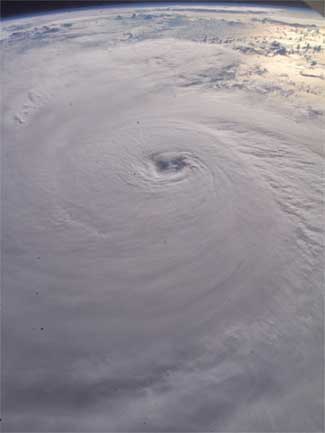
NASA photo/ Mike Fincke
Hurricane Ivan poses for this shot by Astronaut Mike Fincke, who was
on the International space Station Monday about 3:40 p.m. The storm, which
later hit the U.S. mainland, was in the Gulf of México then.
like the past, the current pattern will continue for another 20 or 30 years. He says that means not only will there be more hurricanes, but there will be more of the stronger hurricanes. With many more people living in coastal areas than there were during the last period of enhanced hurricane activity, Gray says the cost of hurricanes will be much higher. "It is inevitable that we will see damage on a scale we have never previously seen, because if we are in this more active period it is not that we will have more storms than we had from the middle 20s to the middle 60s, but that there are so many more people and property in harms way, that it is inevitable that we see hurricane spawned damage on a level we have never previously seen," he said. Professor Gray says one thing that is not causing increased hurricane activity is global warming, which some scientists have pointed to as a possible factor behind increased tropical storm activity. Gray says hurricane activity follows a measurable pattern based on temperature changes and circulation patterns of air and water in the Atlantic Ocean. What is happening now, he says, is simply that pattern repeating itself, as it has done in the past, and will likely do in the future. |
|
|
|
|
SAO PAULO, Brazil — Japanese Prime Minister Junichiro Koizumi says Tokyo and Latin America must develop stronger economic and political ties. Koizumi told Brazilian government officials here Wednesday that there is strong potential for Japanese and Latin American cooperation and trade following Japan's recovery from its stagnant |
economy of the 1990's and the end
of Latin America's economic crises of the 1980's.
Brazil is home to the largest Japanese community outside Japan. Koizumi will later travel to Mexico, where he is expected to sign a free trade agreement, and then to New York, where he will address the United Nations General Assembly. |
|
|
|
|
on the run Independence Day may be over, but William Walker, the 19th century adventurer, must continue to flee the armed women who represent the Central American nations. The scene is atop the National Monument in Parque Nacional in San José where a number of groups left wreaths during the days surrounding the Sept. 15 independence holiday. Walker, a U.S. mercenary, tried to take over all of Central American
and waged war until he was defeated for good in 1857.
|
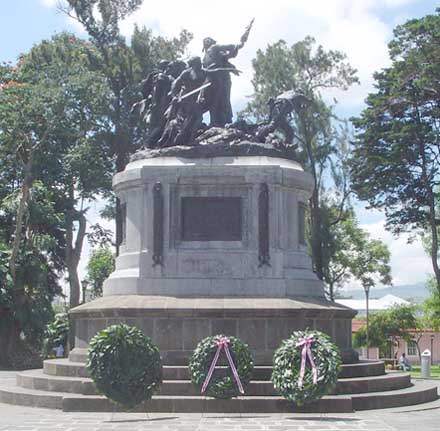
A.M. Costa Rica photo
|
|
|
|
|
WASHINGTON, D.C. — The U.S. Senate has passed a bill that would give the Federal Trade Commission authority to challenge scams against U.S. consumers by foreign entities. By voice vote Wednesday the Senate passed the bill, which would also reauthorize the FTC in 2005-2008. To become law the same version of the bill must pass the Senate and House of Representatives and the president must sign it. Sen. John McCain, Republican chairman of the Senate Commerce Committee, sponsored the bill. He said that the agency needs authority not only to share its confidential information on cross-border fraud with foreign consumer agencies but also to |
secure such information from those
agencies.
The bill would authorize the FTC, in conjunction with the Justice Department, to pursue in foreign courts cases against scams perpetrated against U.S. consumers. "The FTC's consumer protection responsibilities are essential, particularly in today's global climate of high-speed information and marketing, which know no international borders," McCain said. The bill would also allow the FTC to trace money from illegal Internet schemes transmitted through U.S. banks to offshore bank accounts. "Those who devise and carry out such schemes are too often allowed to escape the grasp of the FTC," McCain said. |
|
|
|
|
The chief sponsor of an amendment aimed at lifting U.S. travel restrictions to Cuba has withdrawn the measure from a House bill, citing election-year politics. Arizona Rep. Jeff Flake said Wednesday that with elections so close and politics so raw, the debate would not receive the thoughtful deliberation it deserves. The Republican lawmaker also said neither party can see past Florida when trying to |
decide what to do about Cuba. Florida
is a key state in the presidential race where Cuban-Americans form a crucial
voting bloc.
Next week, the House of Representatives is expected to debate a narrower measure focusing on additional restrictions the Bush administration recently imposed. The new policies limit how often Cuban-Americans can visit relatives in Cuba and the amount of money that can be sent to the island. |
|
|
|
|
|
|
|
|
| What we published this week: | Monday | Tuesday | Wednesday | Thursday | Friday | Earlier |
|
|


