|
 |
Costa Rica Your daily |
 |
|
|
 |
 |
|||||||||||||||||
|
|
||||||||||||||||
 |
|||||||||||||||||
|
|
||||||||||||||||
 |
|
|
|
|
|
|
|
|
| What we published this week: | Monday | Tuesday | Wednesday | Thursday | Friday | Earlier |
|
|
 |
| A.M. Costa Rica's Second news page | |||||||||
| Home |
Tourism |
Calendar |
Classifieds |
Entertainment |
Real
estate |
Rentals |
Sports |
About
us |
|
| San José, Costa Rica, Tuesday, Sept. 13, 2011, Vol. 11, No. 181 | |||||||||
 |
 |
|
U.S. got payback for years
on Middle East meddling Dear A.M. Costa Rica: Mr. Fred Cole's slam of Jo Stuart's rather innocuous comment about terrorists is classic American jingoism and indicative of the kind of mindset that got the Twin Towers knocked down in the first place. It doesn't matter what you call the hijackers. Arguments over who are the terrorists, who are the freedom fighters and who are the psychotics in flaming turbans only serve to deflect attention from the realities of recent political history and future choice points based on the component events of that history. Ten years on from 9/11, there is still no meaningful national conversation, let alone a debate, about why 3,000 people died that terrible day, although the reason couldn't be more obvious if it were carved into the marble alongside the names of the fallen at the Ground Zero Memorial: The United States finally got paid back for half a century of clandestine meddling and overt mayhem in the Middle East. America, (meaning the CIA, aka the gang that couldn't shoot straight), just doesn't seem to be able to get it right over there, and hundreds of thousands of innocent Muslims have been killed, imprisoned and tortured along the way. Who armed the Taliban? We did, to fight the Russians. Who armed Saddam Hussein? We did, to create a military balance to a radicalized Iran. Who radicalized Iran? We did, (with a little help from our friends), because back in 1953 we wanted to protect British petroleum profits and Allied access to Iranian oil. So we backed a coup that installed the Shah of Iran whose brutality gave rise to the Ayatollah Komeini, the capture of the American Embassy in Tehran and finally, Mahmoud Ahamadinejad, a genuine whackjob if there ever was one. There are always going to be unforeseen and destructive consequences when a powerful country imposes its will on weaker ones through force or political machinations, no matter how compelling the argument for the actions of the stronger country may be. This is especially true when the stronger country is Christian and the weaker ones are Muslim. To pretend otherwise is political naiveté in the extreme. No one wants to look at this or talk about the relationship between American foreign policy and 9/11. Instead, the conversations focus inevitably on the survivors, the pain of the families of those who were lost, and the two unwinnable but very patriotic wars which the U. S. embarked upon as a result, which have sapped the American treasury, killed thousands of brave men and women in our military and caused the deaths of tens of thousands of innocent civilians, just like the ones who died on 9/11. Mr. Cole claims that "we have made our point" via these wars. What point? From my perspective, the only point that has been made is precisely that the contemporary American military strategy of shipping massive armies to the other side of the planet to fight relatively small groups of primitively equipped opponents at a cost of one million dollars per soldier per year, (I'm not making that up, that came straight from the mouth of presidential spokesman Robert Gibbs), is so preposterously illogical, unworkable and archaic that it's virtually impossible to wrap one's brain around the level of practical and strategic dysfunction it represents! The United States is on the cusp of a massive political humbling. "We" can no longer impose our will on Islamic countries. The money isn't there, the political will isn't there, and the world in general and Islamic countries in particular will no longer tolerate it. Islam will find its own way in its own time, and it will no doubt be a very long, bloody, chaotic and frightening process. Many, many people will suffer and die. But we can't stop that! We must accept that fact, or it will lead us to national ruin. We must worry first and foremost about putting our own house in order before it falls down around us. We can no longer afford to spend trillions of dollars staging preemptive attacks on sovereign governments because they may attack us one day. End the wars. Bring the troops home now. Strengthen and clarify the War Powers Act. Protect America by creating national security on American soil. Let the Middle East deal with the Middle East, for better or for worse. Dean
Barbour
Manuel Antonio
|
|||||||||||||||||||||||||||||||||||||||||||||||
 |
||||||||||||||||||||||||||||||||||||||||||||||||
| Home |
Tourism |
Place
classified ad |
Classifieds |
Entertainment |
Real
estate |
Rentals |
Sports |
About
us |
|
| What we published this week: | Monday | Tuesday | Wednesday | Thursday | Friday | Earlier |
| The contents of this page and this Web site are copyrighted by Consultantes Río Colorado 2011 and may not be reproduced anywhere without permission. Abstracts and fair use are permitted. Check HERE for details | ||||||
| A.M. Costa
Rica's Third newspage |
|||||||||
| Home |
Tourism |
Calendar |
Classifieds |
Entertainment |
Real
estate |
Rentals |
Sports |
About
us |
|
| San José, Costa Rica, Tuesday, Sept. 13, 2011, Vol. 11, No. 181 | |||||||||
 |
| New telenovela, 'The English Teacher,'
will tickle expats |
|
|
By the A.M. Costa Rica staff
“The English Teacher” has reached Costa Rica. The telenovela is likely to generate an appreciative audience not only of Costa Ricans but also of expats, just like “Yo soy Betty, la fea” did in 2001 and 2002. This is another Colombian production that is witty, well-plotted and touches on a topic dear to the hearts of expats: Learning a foreign language. There is an evil cousin, an ungrateful spouse and the hard-working star Jesús Antonio “Kike” Peinado, played by Victor Mallarino. The show is described as a romantic comedy, but there is gunplay in some of the final episodes. Kike is running Creaciones Merceditas, a lingerie manufacturer founded by his ex-wife who dumped him for a rich Gringo. The businessman would like to expand to suppliers in the United States, but he only speaks Spanish. The show unapologetically mixes English with Spanish. The middle-aged Kike signs up for an English course only to have Pilar “Pili” Ortega, played by Carolina Gómez show up as the instructor. Kiki is captured by her charm and innocence. But most certainly in telenovelas the course of true love is challenging. That is the job of evil cousins and a host of other characters. Luis Fernando Caicedo, played by Juan Alfonso Baptista, is the U.S.-based bilingual, no good cousin who tries to steal Kike's company to settle his own narco trafficking debts. But that is in later episodes. The show is at 8 p.m. Monday through Friday on Channel 6, Repretel. The Caracol Television series started Monday. Anyone who has struggled with a foreign language cannot help but to commiserate with Kike as he tries to learn English. The Monday episode featured a dream sequence in which Kiki searches urgently for a bathroom in a Miami airline terminal and motions to a guard his needs, suggesting with his hands that his stomach will blow up if he does not find the bathroom. The guard, of course, mistakes him for a bomb-carrying terrorist with the logical outcome. |
 Carolina Gúmez and Victor Mallarino
star in the series, as pictured on the show's official Web page.
In Miami, Kike struggles to give an English-speaking taxi driver directions to a hotel. They spend the trip with each speaking in their own language with about 20 percent comprehension. At the hotel Kiki tries to order a meal. “Carne,” he tells the young, monolingual waiter. He gets a plate of corn. Of course, Pili has her own problems including a boyfriend in the United States. So naturally the U.S. consulate denies her a visa. “Yo soy Betty, la fea” became a hit in Costa Rica and then was duplicated in at least 12 other shows, including the U.S. version “Ugly Betty.” The English teacher many not receive that universal approval, but for expats in Costa Rica, the plot and language conflicts hit close to home. |
| New York expat brings 21st century golf
to La Fortuna |
|
|
By the A.M. Costa Rica staff
A former New York City real estate broker will debut a miniature golf course in the Arenal area Thursday. The course is Reno's Miniature Golf and Amusement Center in the heart of La Fortuna. Owner Frank Moreno says he worked to bring the game into the 21st century. He said he has mp3 players, motion detectors and animated exhibits to amuse players as they try to complete the challenging 18-hole course. Moreno put the entire 8,000 square feet under roof so play can continue in rain or shine. In addition, he has dedicated each hole to a different country, hence the international designation. The Venezuelan hole features Angel Falls, and the United States is, of course, represented by New York City and the Brooklyn Bridge. Players are serenaded by "New York, New York" as they work this hole. The final hole, No. 18, is dedicated to Costa Rica with Volcán Arenal, a light display and an audible "Pura Vida." He also has installed lasers for a light show. Moreno said he saw the need to diversion because he says he's from New York and needs an exciting life. Just looking at the volcanic mountain was not enough for him, he said. He is a little uncertain about how Costa Ricans will accept miniature golf. He has built a grandstand where spectators can watch the paying customers, and he hopes this will attract more local customers. If miniature golf is a success, Moreno promises other amusements such as air hockey, foosball and indoor basketball. He said he has plenty of land for expansion. The Web site for the business is HERE. |
 Photo by Wendy Holt
Frank Moreno puts the finishing
touches on his great wall supervised by a panda, which represents China
in his international miniature golf operation. |
 |
| You need to see Costa Rican tourism information HERE! |
| Home |
Tourism |
Place
classified ad |
Classifieds |
Entertainment |
Real
estate |
Rentals |
Sports |
About
us |
|
| What we published this week: | Monday | Tuesday | Wednesday | Thursday | Friday | Earlier |
| The contents of this page and this Web site are copyrighted by Consultantes Río Colorado 2011 and may not be reproduced anywhere without permission. Abstracts and fair use are permitted. Check HERE for details | ||||||
| A.M.
Costa Rica's Fourth news page |
 |
||||||||
| Home |
Tourism |
Calendar |
Classifieds |
Entertainment |
Real
estate |
Rentals |
Sports |
About
us |
|
| San José, Costa Rica, Tuesday, Sept. 13, 2011, Vol. 11, No. 181 | |||||||||
| Smithsonian Institute outlines research
on tropical reforestation |
|
|
By the Smithsonian Tropical Research
Institute
news staff A tropical forest is easy to cut down, but getting it back is another story. In a special issue of the journal Forest Ecology and Management, leading researchers at the Smithsonian in Panama and across Latin America offer new insights on reforestation based on 20 years of research. “Twenty years ago, we had almost no information about how to build a forest,” said Jefferson Hall, staff scientist at the Smithsonian and lead editor of the new special issue of Forest Ecology and Management. “People either planted one of four non-native species — teak, pine, eucalyptus or acacia — or they used a trial-and-error process with other species that was not always successful. Now we can be smart about which trees we plant at a given site, and we understand much more about what motivates land owners and rural farmers to put this know-how to work.” Forests keep water clean, control soil erosion, store carbon, shelter animals and provide plants that offer pharmacological benefits. Forests also contribute to global-scale economic activity in the form of ecosystem services. The Agua Salud project in the Panama Canal watershed, funded by the HSBC Climate Partnership and featured in the special issue, is a 700-hectare (about 1,730 acres) experiment that examines the ecosystem services forests provide: water for people and the canal, carbon storage to mitigate global warming and biodiversity protection in one of the crucial biological corridors between North and South America. “Native tropical forests are some of the richest storehouses on earth,” said Eldredge Bermingham, director of the Smithsonian Tropical Research Institute. “Now the science behind tropical forest restoration is at a level of sophistication that reforestation projects can be planned to target multiple goals — to store carbon, manage water and conserve biodiversity, buffer old-growth forests from destruction and provide a strong return on investment.” Managing forests for ecosystem services requires tradeoffs. A hectare of teak stores as much carbon as a native forest after 20 years, but will shelter far less biodiversity. In the Agua Salud experiment researchers plant mixtures of native species. Their data predict that some mixtures will surpass the carbon-storage capability of teak and the ability to support other plants and animals. Plantation soils in one experiment lost a huge amount of carbon in less than 10 years. Another experiment not far away showed soil-carbon levels under similarly aged secondary forest did not change. This juxtaposition suggests that while secondary forests may not store as much aboveground carbon as carefully tended plantations, they do a better job of maintaining soil carbon stocks. The information highlights potential tradeoffs in ecosystem services with land management and points the way to the next generation of ecosystem service research. |
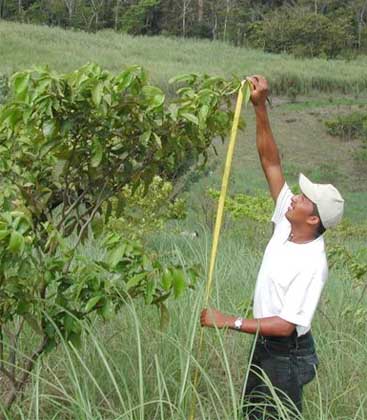 Smithsonian Tropical Research Institute
archives
Diogenes Ibarra measures the
growth of native tree saplings to see how they perform in different
environmental settings.Scientific information to guide reforestation is especially necessary in a world where half of the tropical forests are secondary forests growing on abandoned farm and pasture land. The special issue summarizes results from more than 60 tree species grown in Panamá at sites with different rainfall and soil types. Native trees often grow well in forest-restoration projects because they are adapted to local conditions. Amarillo (Terminalia amazonia), a tree species native to Panamá and neighboring countries, grows as well or better than teak on degraded agricultural soils in wet areas yet is sold for the same value as teak in timber markets. Cocobolo (Dalbergia retusa), a highly valuable wood, grows particularly well in relation to other species on dry sites with relatively infertile soils. Several articles provide guidelines for land managers as they weigh environmental and economic factors in their decision making. In Latin America there is a critical mass of information available to begin recreating forested landscapes intelligently. The Smithsonian article is “The Ecology and Ecosystem Services of Native Trees: Implications for reforestation and land restoration in Mesoamerica,” published in Forest Ecology and Management, Volume 261, Issue 10. The Smithsonian Tropical Research Institute, headquartered in Panama City, Panamá, is a unit of the Smithsonian Institution. The Institute furthers the understanding of tropical nature and its importance to human welfare, trains students to conduct research in the tropics and promotes conservation by increasing public awareness of the beauty and importance of tropical ecosystems. |
| Professional Women's Network will hear
about universities |
|
|
Special to A.M. Costa Rica
The Professional Women’s Network is presenting an insider’s view of the current public and private university systems in Costa Rica on Saturday from 10 a.m. to 1 p.m. at Hotel Torremolinos. Attendees will learn about the injustices of the current education system, how the education system plays into the development of the country and the challenges current students face, according to an advanced summary. They will also learn how they can incorporate students into places of employment to improve business and how they can contribute to improving education in Costa Rica, the summary said. The Professional Women’s Network will also announce its ‘Young Female Professional Studies Scholarship’ aimed at supporting female university students in professional skills development, which is in addition to the financial assistance the Women’s Club of Costa Rica currently provides. The speaker, Silvia Castro Montero, received her doctorate in university administration at the University of Pennsylvania and |
her
master’s in education at Harvard University. She has more than 16
years experience leading higher education institutions and is currently
director of the Universidad Latinoamericana de Ciencia y
Technología, a
private university in San José. The hotel is 300 meters north from the Banco de Costa Rica office at the west end of Paseo Colon. Full details and registration are HERE. The Professional Women’s Network is a new interest group of the Women’s Club, which has been active for 70 years serving local communities. The Professional Women’s Network has been developed specifically for women of all nationalities to encourage personal and professional development through networking with other professional women, and to develop programs to contribute to all women in Costa Rica. The Professional Women’s Network is an English speaking group and beginner level English is welcome. More information is available at pwn.wccr@gmail.com. The network also maintained a Web site, a Twitter page and a Facebook page. |
| Home |
Tourism |
Place
classified ad |
Classifieds |
Entertainment |
Real
estate |
Rentals |
Sports |
About
us |
|
| What we published this week: | Monday | Tuesday | Wednesday | Thursday | Friday | Earlier |
| The contents of this page and this Web site are copyrighted by Consultantes Río Colorado 2011 and may not be reproduced anywhere without permission. Abstracts and fair use are permitted. Check HERE for details | ||||||
| A.M.
Costa Rica's Fifth news page |
|
|||||||||
| Home |
Tourism |
Calendar |
Classifieds |
Entertainment |
Real
estate |
Rentals |
Sports |
About
us |
||
| San José, Costa Rica, Tuesday, Sept. 13, 2011, Vol. 11, No. 181 | ||||||||||
 |
| Hemispheric press group protests Panamá restriction Special
to A.M. Costa Rica
The Inter American Press Association calls a bill in Panama that seeks restore obligatory membership in a guild for journalists a retrograde action and “a backward step for press freedom and democracy in that country.” The bill, introduced last week by Rubén Fría Ortega of the governing Partido Cambio Democrático, after setting a pay scale for journalists in its Article 6 declares that such benefits would apply only to those of Panamanian nationality and holding a journalist’s credential. Gonzalo Marroquín, president of the Guatemala City, Guatemala, newspaper Siglo 21, said that this was not the first time that “we have to raise our voice against discriminatory and anti-press freedom actions that had appeared to have remained in the past in Panama.” He was referring to earlier times in which the Inter American Press Association protested another legislative bill that in 2002 restored a press council, emulating the technical press board that had been abolished in December 1999, which said who may and may not work as a journalist. Marroquin is president of the Inter American Press Association. Claudio Paolillo, co chairman of the association's Committee on Freedom of the Press and Information and editor of the Montevideo, Uruguay, weekly news magazine Búsqueda, recalled that the advisory opinion issued in 1985 by the Inter-American Human Rights Court established that obligatory membership in a journalists’ guild is incompatible with freedom of expression and press freedom, in that it restricts the right to work as a journalist merely to those who belong to a guild or are university graduates. The two assocaition officers maintained that the new bill “is clearly a retrograde step that is not compatible with the philosophy of our profession, as well as ignoring the incredible changes that the new technologies have brought so that everyone, without distinction, can seek, receive and disseminate information.” Several leaders in the Americas — presidents and legislators — have signed the Declaration of Chapultepec, by which they pledged to respect its Article 8, which declares, “The membership of journalists in guilds, their affiliation to professional and trade associations and the affiliation of the media with business groups must be strictly voluntary.” This concept is also contained in the Principles of Freedom of Expression of the Inter-American Commission on Human Rights, whose Article 6 says, “Compulsory membership or the requirements of a university degree for the practice of journalism constitute unlawful restrictions of freedom of expression.” The Inter American Press Association is a not-for-profit organization dedicated to the defense and promotion of freedom of the press and of expression in the Americas. It is made up of more than 1,300 print publications from throughout the Western Hemisphere and is based in Miami, Florida. EDITOR'S NOTE: Consultantes Río Colorado S.A., the parent company of A.M. Costa Rica and A.M. Panamå, is a member of the Inter American Press Association. Katia reaches Britain and brings bad weather By
the A.M. Costa Rica wire services
The remains of Hurricane Katia blew ashore in much of Britain and Ireland Monday, bringing some of the worst weather in the region in 15 years. Forecasters are predicting heavy rain and wind gusts of nearly 135 kilometers per hour. British officials say Wales, Scotland, Northern Ireland and northeastern England are among the regions hit by the storm. At least one storm-related death has been reported in Britain. A driver was killed when a tree fell on his car. Rescuers also had to pull an 11-year-old boy to safety when a garage roof collapsed around him. Ferry service has been cancelled and officials have issued an “Amber Alert” – the second-highest warning. Authorities are urging coastal residents to watch out for floods and other weather-related hazards. Britain's Met Office – the country's weather service – says large waves may breech coastal sea defenses. By Monday night, tens of thousands of power outages were reported across the region. Three writer groups oppose universities' digital project By
the A.M. Costa Rica wire services
Three major writers' groups are suing five U.S. universities, claiming their joint effort to digitally archive millions of books amounts to copyright violation. The U.S.-based Authors Guild, the Australian Society of Authors and Canada's Quebec Writer's Union filed a lawsuit Monday in New York against the HathiTrust digital library project. The project is led by the University of Michigan, in conjunction with the University of California, the University of Wisconsin, Indiana University and New York-based Cornell University. The plaintiffs say the five universities were planning to archive as many as seven million copyright-protected books and allow unlimited downloads by students and faculty members. The copyrighted books have been deemed “orphan works,” out-of-print books whose authors cannot be located. Angelo Loukakis, the executive director of the Australian Society of Authors, says HathiTrust's actions are “an upsetting and outrageous attempt” to dismiss authors' rights. Loukakis says the books are not “orphaned,” but “abducted books.” The Authors Guild led a similar lawsuit in 2005 against U.S.-based Internet giant Google literary archival project. A U.S. federal judge dismissed a settlement in the case between Google, and writers' and publishers' earlier this year. A new hearing in the case will be held Thursday in New York. |
|
| What we published this week: | Monday | Tuesday | Wednesday | Thursday | Friday | Earlier |
| The contents of this page and this Web site are copyrighted by Consultantes Río Colorado 2011 and may not be reproduced anywhere without permission. Abstracts and fair use are permitted. Check HERE for details | ||||||
| A.M.
Costa
Rica's sixth news page |
|
|||||||||
| Home |
Tourism |
Calendar |
Classifieds |
Entertainment |
Real estate |
Rentals |
Sports |
About us |
||
| San José, Costa Rica, Tuesday, Sept. 13, 2011, Vol. 11, No. 181 | ||||||||||
 |
Latin America news |
Backhoe breaks pipeline and diesel fuel spews out By
the A.M. Costa Rica staff
Machinery operated by a municipal employee ruptured a pipeline in Turrubares Monday morning. The Refinadora Costarricense de Petróleo S.A. said that the pipeline spewed diesel but the material did not ignite. The Cuerpo de Bomberos said that the location was in San Pablo de Turrubares near the local high school. Firemen said they got the call at 10:20 a.m. and trucks from Puriscal and Orotina responded. Firemen said their investigators determined that a backhoe was being operated by a Municipalidad de Turrubares employee in conjunction with work by the Ministerio de Obras Públicas y Transportes. The fuel spread several kilometers from the point of the rupture along a highway and gutters. In all some 1,140 square meters were contaminated. That's about 12,300 square feet. Firemen said they could not estimate the amount of diesel that flowed from the pipe. They said refinery workers applied absorptive material and also constructed dikes to contain the diesel. Road agency gets go-ahead for 28-bridge projects By
the A.M. Costa Rica staff
The Contraloría de la República has upheld the bidding process for 28 bridges for the northern zone and the Caribbean coast. The Ministerio de Obras Públicas y Transportes and its Consejo Nacional de Vialidad said that the total price tag for the jobs is about 4.6 trillion colons or about $9 million. The road agency began the bidding process in May and the firms CODOCSA and Puente Prefa emerged as the winners. However other firms challenged the bidding process, and the Contraloría studied the complaints and found that the bidding process can continue. The contract for these jobs, the next step, also have to be approved by the Contraloría, which should take about two months, the ministry said. Seven bridges will be on Ruta 247 between Campo Cinco and Puerto Lindo in Pococí. Five bridges will be on Ruta 249 between Campo Cinco and La Suerte, also in Pococí. One bridge will be in Upala at Canalete-Colonia Puntarenas on Ruta 730. Two bridges will be on Ruta 138 between Colonia Puntareanas and the Upala canton line. And 13 bridges will be on Ruta 733 between Guatuso and Chimurria, according to the ministry. The ministry now has nine bridges constructed with the bailey system. The ministry will recover that material when permanent bridges are built, it said. Miss Costa Rica reaches Miss Universe top 10 By
the A.M. Costa Rica staff
Johanna Solano of Costa Rica was one of 10 finalists in the Miss Universe pageant celebrated in Sao Paulo, Brazil, and televised here Monday night. The 20-year-old Heredia native failed to make the cut to become one of the top five finalists. The winner was Leila Lopez, 25, of Angola. Olesia Stefanko of Ukraine was first runner up. The pageant celebrated its 60th anniversary this year. |
|
Latin
American news feeds are disabled on archived pages.
|
|
| Costa Rican News |
AMCostaRicaArchives.com |
Retire NOW in Costa Rica |
CostaRicaReport.com |
| Home |
Tourism |
Place
classified ad |
Classifieds |
Entertainment |
Real
estate |
Rentals |
Sports |
About
us |
|
| What we published this week: | Monday | Tuesday | Wednesday | Thursday | Friday | Earlier |
| The contents of this page and this Web site are copyrighted by Consultantes Río Colorado 2011 and may not be reproduced anywhere without permission. Abstracts and fair use are permitted. Check HERE for details | ||||||











 James
DeRoy
James
DeRoy