|
 |
Your daily |
 |
|
|
|
|
|
|
|
|
|
|
|
|
||||||||||||||||
|
|
||||||||||||||||
 |
| A.M. Costa Rica Second newspage |
|||||||||
| Home |
Tourism |
Calendar |
Classifieds |
Entertainment |
Real
estate |
Rentals |
Sports |
About us |
|
|
|
|||||||||
 |
| Costa Rica Expertise Ltd http://crexpertise.com E-mail info@crexpertise.com Tel:506-256-8585 Fax:506-256-7575 |

Click HERE for
great
hotel discounts
|
|
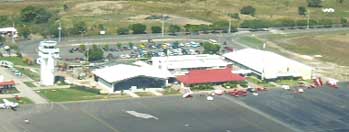 A.M. Costa Rica/José Pablo
Ramírez Vindas
Liberia's Daniel Oduber airport
Transport ministry will seek
to charge firms landing fees By José Pablo Ramírez Vindas
of the A.M. Costa Rica staff Aircraft are using the nation's 25 public airports for free because there is no landing fee. But the Ministerio de Obras Públicas y Transporte wants to change that as part of a $20 million makeover of the seven most important airstrips. At the same time, ministry officials do not think that they can find concession operators for the smaller airports because, according to Vivina Martín, a vice minister, an airport must have a volumn of 2 million passengers a year to be worthwhile for an outside company. She also is president of the Consejo Técnico de Aviación Civil within the ministry. Last Aug. 8 Houston Airport System Development Co. of Texas made an offer to design, construct, operate and maintain a new terminal building at Daniel Oduber in Liberia. Ms. Martín said that the fact that only one company bid on the job is because the Liberia airport only handles about 500,000 passengers a year. The Consejo Nacional de Concesiones and employees of the Dirección General de Aviación Civil are looking over the technical aspects of the bid. The Houston company would finish the work on the terminal by May 2010. The same firm seeks to take over operations of Juan Santamaría airport in Alajuela under an agreement with the existing concession holder. Of the 25 public airports in the country, aviation firms have suggested improving those in Barra del Tortuguero and Parismina, Nosara, Puerto Jiménez, Carate and Drake Bay. The work would involve elimination of obstacles, improving security and construction of ramps and renovation of the runways. The ministry has listed as priorities the airports at Barra de Parismina, Barra de Tortuguero, Puerto Jiménez, Nosara, and the airport in Limón, and Tobías Bolaños in Pavas as well as Daniel Oduber. The airport at Quepos, La Managua, with 32,609 passengers a year and the airport in Puerto Jiménez in the southern zone with 16,226 passengers are the most used of the smaller airports. In addition to the smaller public airports, there are about 66 private strips in Costa Rica operated by individuals or companies. Our reader's opinion
Alajuela resident agreeswith broken window theory Dear A.M. Costa Rica: Thank you for publishing the article on Street Crime in Costa Rica and the Broken Window Theory, on Aug. 19 written by Jo Stuart. I was delighted to read it and feel perhaps I am not the only expat in Costa Rica who feels that the small "petty" crime leads to much greater crimes. Most hard core drug addicts start off by smoking or drinking addictive substances that are considered by the masses to be harmless. We all know what the so called "harmless action" can ultimately lead to. So, too, is the attitude of many in Costa Rica. Petty crime is a gateway. If you are successful at it, you are tempted to do it again, and again. You begin to evolve, taking greater risks for greater rewards. Today a cellphone, tomorrow . . . ? I moved to Costa Rica with my wife just over four years ago. Although we love living here, it is also a fact that every single expat we know has been a victim of crime in one way or another. From home break-ins to a stolen cell phone, and everything in between. Costa Rica IS a dangerous place if you are not careful. It is NOT a paradise as many would have us believe. Most expats stick out. Many of us look, act and speak different. This can and does, drawn attention to us. Articles such as yours arm Costa Rica's "guest residents" and tourists alike, with information that could prevent a crime, and for that, I am grateful. One thought I would like to offer. The streets, ditches and bridges are full of litter. Non-violent criminals serving time in prison should be identified and offered the opportunity to work outside the prison walls under armed guards to help remove the trash this country is plagued with. This will have a positive impact on the country as a whole and solve more problems than it creates. Rather than sitting in their jail cells, I am sure many of them would rather be outside. Why should the country not take advantage of this opportunity? Orange jumpsuit clad inmates are easy to spot. One guard supervising every three non-violent inmate on "community work details" seems sensible, practical, and beneficial to the entire country, at least to me it does. A final thought, I would be very grateful if your paper would write an article on how the country could use non-violent inmates, in jail, serving time for what the courts have determined is "petty crime" to help the country as a whole improve itself. They represent cheap, "plentiful" labor that could be put to good use, rather than being a constant burden on the community, and the taxpayer. From planting trees, to erecting street signs, to cleaning ditches. Putting bad people to good use is better than putting bad people to bad use. A choice between staring at the walls inside a jail cell, or out in the fresh air, doing good, rather than evil for this sector of the prison population, seems a worthwhile idea to explore. I believe many inmates would choose to finally do something good for the country, rather than prey on it. Dave Lema
Alajuela
|
|||||||||||||||||||||||||||||
 |
High
season is coming. Do you know where your ad dollars are? They should be here |
 |
 |
 |
|
| A.M. Costa Rica third newspage |
|||||||||
| Home |
Tourism |
Calendar |
Classifieds |
Entertainment |
Real
estate |
Rentals |
Sports |
About us |
|
|
|
|||||||||
 |
 |
 |
|
Local response is guarded on
U.S. presidential elections
|
|||||||||
|
By Elise Sonray and Melissa Hinkley
of the A.M. Costa Rica staff Whether the U.S. presidential race is close or not, most expats and others living here are playing their votes close to their chest. A spot survey by reporters Tuesday showed that while opinions were plentiful, many persons refused to put their name with their words. Of those who would talk to reporters, a significant number said they were still undecided between the two major U.S. presidential candidates. The U. S. presidential election will be a time of firsts. It will be the first time in history that two sitting senators will be running against each other for the presidency. It will be the first time that an African American will be the presidential nominee for a major party. Finally, it will be the first billion dollar presidential election. The election between Barack Obama and John McCain is Nov. 4. CNN's national polls have Obama ahead in the race at 46 percent while McCain is at 42 percent. The poll showed that 12 percent of potential voters still were unsure. The also is true in Costa Rica. Interviews by reporters
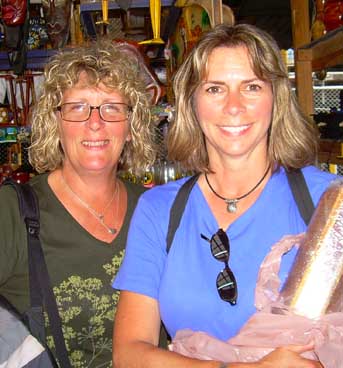
Wood said Obama continues with the theme of "change," but never said what he's going to change. That's what will destroy him in the end," said Wood. At the Mercado de Artesanía in the Plaza de Democracía Margi McCloskiy, a tourist, said she is a conservative Republican but was leaning towards Obama until the interviews with Pastor Rick Warren at the Saddle Back Church last week. Ms. McCloskiy said she originally liked Obama because he is charismatic, young, and "because of the whole change thing." People are ready for that, she added. McCain is old and more about politics — two things she doesn't like about him, she said, but the abortion issue is big for her and she agrees more with McCain on that. Sharon Rossi, a companion, said McCain is closer to President George Bush ". . . and that would be like having the same president over again. Especially because of the war. People want something different.” Back at the Nashville, one customer from England allowed: “Obama will win. People are fed up with getting ripped off.” He was one of several visitors who were not U.S. citizens but were anxious to express their opinions. One man who said his first name was Erwin and that he was Austrian threw his support to "Arnold." That's Schwarzenegger, as in the body building governor of California who was born in Austria. Some other opinions: “McCain has the same values as I do and he has a lot more experience then Obama. I don't care what color the candidate is, I just have to make sure they have the right stuff. I would vote for Condoleezza Rice if she was running.” — Anonymous
|
“Obama will probably win by a landslide because people finally realize how drastic things have become in the U.S. No one trusts Bush. It is the most corrupt and criminal administration in history. It has shattered the system of checks and balances and the world is in the most dangerous state in 30 years. Bush is the worst president in history. I have always liked McCain, but it is just too late for him now. It would be a major step to put a black guy in the presidency. The country is ready for something radical.” — Anonymous
“It's not the actual president who will make a difference but the House and the Senate. Young people don't realize the importance of electing a senator because that person stays a senator for life. For a real change to be seen, someone needs to clean out Congress and start all over again.” — Robert Dempsey,
originally from New Jersey “I am undecided. I think McCain will win because he is knowledgeable about world and foreign affairs. His views of religion are important to me.” — Anne Haught,
Pennsylvania "McCain is old and that's a strike against him, but he has integrity," said David Michalski of California. Michalski said he was on the fence between the two candidates. He said Obama has charisma and is articulate, but McCain is more for free market and capitalism which is the American way. As for trade pacts like the North American Free Trade Agreement and the Central American Free Trade Agreement, Michalski said Obama's ideas about better labor standards were good but that countries need time to develop their own infrastructures and ideas. He said his family was Polish and originally worked in the coal mines in Pennsylvania and that capitalism is a way to grow and that free trade makes better international relations between countries. Some expats said they expected McCain would win based on the fact that he is white. One man, who wished to go unnamed said the Tom Bradley election for governor in California proved that people say one thing in the polls but when it comes down to it they won't really elect a black candidate. In 1982 Bradley, a black candidate, was up in the polls but lost in the actual race. Many media outlets have tagged this as the "Bradley effect" and say it is possible with Obama. The conclusion was that some voters hid their real opinions from pollsters. |
||||||||
|
Russian businessman arrested
here after 10 years as fugitive from home country
|
|
|
By the A.M. Costa Rica staff
A Russian citizen who spent 10 years in business in San Pedro ran an investment scam in his home country, according to allegations that led to his arrest Tuesday. The man is Nikolai Korobkov, 54. according to the International Police Agency. Russian police said that Korobkov founded and directed the Investment Industrial and Commercial Co. after the fall of the Soviet Union, according to local officials. They said that Korobkov once served as treasurer of the Communist Party there. The investment operation resulted in the loss of some $2 million from some 7,000 investors, officials said. The decade of the 1990s was a time of great economic activity in Russia after the fall of the Soviet system. But there were many operations that ended up losing the investments of the public. Korobkov faces charges of fraud, theft of goods and abuse of confidence, said local law enforcement officers, citing information from Russia. Officials claim the man entered the country in 1998 on a false passport and opened up a home decorating company. |
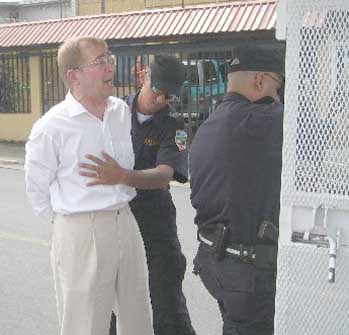 Dirección de Inteligencia y
Seguridad/INTERPOL photo
Officers lead Russian businessman to custodyHe lives here with his wife and daughter, officials said. He was detained in Barrio La Granja in San Pedro near his office. |
| You need to see Costa Rican tourism information HERE! |
 |
| A.M. Costa Rica fourth news page |
|
||||||||
| Home |
Tourism |
Calendar |
Classifieds |
Entertainment |
Real
estate |
Rentals |
Sports |
About us |
|
|
|
|||||||||
|
Social divides with
immigrants troubling to officials here
|
|
|
By Elise Sonray
of the A.M. Costa Rica staff Most North Americans in Escazú do not socialize with local Costa Ricans and this is causing problems, said a municipality representative Tuesday. The director of immigration added that there are towns in Guanacaste where Costa Ricans have disappeared and this has to be changed. A representative from the Municipalidad de Escazú, Celia Víquez, said there are three major groups of immigrants in Escazú. The first group Ms. Víquez labeled were high class foreigners, mainly Europeans and North Americans who live in Guachipelín, San Antonio, and San Rafael, she said. Other than towns by the borders, Escazú has the highest number of foreigners in Costa Rica, said Ms. Víquez. About 17 percent of the population is comprised of foreigners. Ms. Víquez said often times North Americans and Europeans do not consider themselves immigrants and therefore do not feel a need to connect with other immigrant groups. “For example, a diplomat's wife is going to say, 'I'm not an immigrant, I'm just here for a time because my husband works here,'”said Ms. Víquez. She said the municipality of Escazú has been unsuccessful in inviting North Americans to immigrant group activities. Ms. Víquez participated Tuesday in a discussion about integrating immigrants into the country. The discussion was hosted by the U.S. Embassy and included the input from other officials. The director of Migración y Extranjería, Mario Zamora Cordero, who also participated in the discussion, said there is a need to have local community projects and inter-communal activities to connect foreigners and native Costa Ricans. Zamora said isolated ghettos full of immigrants and racial misperceptions in Costa Rica are creating new forms of violence and problems for the country. In an interview after his presentation, Zamora said at times he felt like an outsider when he lived in London. A country where people are not welcome because of their nationality is not what he wants for Costa Rica, said the director. An |
ideal situation for Costa Rica
would be a country where distances between nationalities do not exist,
said Zamora. Zamora said he once lived in London working with a construction company. “Everyday I walked through a Bangladeshi neighborhood, and they always smiled and waved to greet me,” said Zamora, “I imagine they thought I was one of them. They were so welcoming.” The immigration director said one day he walked through the neighborhood with a Colombian friend who happened to be blond. “No one said hi to me, and I received a lot of serious looks, and no one responded to my greetings,” said Zamora. The director said Bangladeshi families had lived in that same neighborhood for four or five generations and still did not consider themselves British or from London. In Costa Rica there are examples of this kind of phenomenon from the lower class Nicaraguan neighborhoods to the high class areas full of Europeans and Americans, said officials at the discussion. Although there is no planned solution yet to this problem, Zamora said he has seen encouraging actions on a small scale. “Many foreigners in the beach town in Guanacaste want to interact with locals and are talking about volunteering to teach English,” said Zamora. The director said he hoped communities would start programs like this to interact with locals and integrate immigrants into society. Another problem facing immigrants are racist attitudes, said Zamora. Many times the media, judicial, and police organizations classify criminals and suspects by their nationalities and make it the main part of the story. Zamora said statistically Costa Ricans commit many more crimes than immigrants or foreigners, but that people have a misperception due to the media. Zamora said many times foreign criminals bring new techniques or “know how” to crimes which makes them stand out from the group. Peter Brennan, deputy chief of mission at the U.S. Embassy said that the United States and Costa Rica share many similar experiences with an immigrant culture. Costa Rica can learn from U.S. practices so they can convert immigrants into better informed and more active citizens, said Brennan. |
 |
|
| News from
the BBC up to the minute |
BBC sports news up to the minute |
| BBC news and sports feeds are disabled on archived pages. |
|
| A.M. Costa Rica fifth news page |
|
||||||||
| Home |
Tourism |
Calendar |
Classifieds |
Entertainment |
Real
estate |
Rentals |
Sports |
About us |
|
|
|
|||||||||
 |
 |
|
their certification course By the A.M. Costa Rica staff
Marvin Pérez, a local lifeguard from the Best Western Hotel, has established a lifeguard training program, Alfa y Omega, in Jacó. The company's first group of Jacó lifeguards was certified last week. “His group has found a niche that is needed in this area,” said Christina Truitt, co-director of the Central Pacific Chamber of Commerce. The lack of lifeguards in the area is of special importance because the Billabong 2009 World Surfing Games will take place in Playa Hermosa near Jacó. The objective of the program is to train and develop more lifeguards for the central Pacific region. “It is important to be able to have trained and professional lifeguards in our beaches, said Pérez. "It is also very important to develop young people, who have the interest and the potential of becoming future lifeguards. As a result, we will be able to offer a safe beach to our visitors, and at the same time, give a better image to Jacó and the Central Pacific region.” This is the second session of a training series organized by the Best Western Jacó Beach. The sessions have been free of charge for the participants in hopes of developing more lifeguards in the region. There will be more sessions. Election officials tell Arias to lay off backing veep By the A.M. Costa Rica staff
The Costa Rican Constitution says that public officials have to be impartial during election campaigns. The Tribunal Supremo de Elecciones has interpreted this to mean that a sitting president cannot express a personal preference. President Óscar Arias Sánchez has made no secret of his support for Vice President Laura Chinchilla. He has said that he thinks the country should have a women president and he had put forth Ms. Chinchilla as his representative in his place several times to get international exposure. In fact, the vice president will be visiting major computer companies in California this week on behalf of the country. This does not sit well with the political opponents of Arias. They filed a complaint of "political belligerence" against him with the tribunal. As a result, the tribunal said Tuesday that it asked Arias to guarantee that he and his appointees would observe the principal of neutrality and stop any display of political activism by the executive branch. |
|
|
|
|
|
|
|
|
|
| What we published this week: | Monday | Tuesday | Wednesday | Thursday | Friday | Earlier |
|
|