|
Special to A.M. Costa Rica
Nesting season is in full swing for the endangered Caribbean green turtle.
The sprawling, unkempt 22-mile beach at Tortuguero is the most important
Western Hemisphere site for this activity.
And tourism is booming because people come from all over the world to
witness the fascinating process, despite darkness and sometimes reluctant
turtles.
The Tortuguero nesting zone is the eastern side of a 1,500-meter-wide
sand spit that runs north and south in northeast Costa Rica.
The major population center is the town of Tortuguero, which was founded,
ironically, by turtle hunters in the middle of the last century. Now the
town is a center for ecotourism. Residents work as guides. There even are
life-size concrete statues of the famous turtle maintaining vigil downtown.
The statues may be the only really good look tourists get of the turtles
because all nesting activity takes place at night, and white lights are
prohibited. The local guides may carry flashlights as they lead their charges
single file through the darkened beach. But even these lights are covered
with red tape to avoid scaring the sensitive turtles.
The female green turtle (chelonia mydas) is easily 140 kgs. (more
than 300 pounds). They resemble small Volkswagens as they pull themselves
from the surf, trundle 30 or 40 meters up the dark beach and begin building
a nesting pit in the sand.
Frequently the crush of tourists is too great, and the timid turtle
turns around and flees to the ocean.
The two-hour process dovetails nicely with rules imposed by rangers
at Tortuguero National Park, which includes the beach front nesting sites.
Local guides may take up to 10 adult tourists in a single group for the
challenging beach walk in the dark.
Guides signal each other when a turtle appears, so up to 60 persons
many eventually be clustered around a laying turtle. Rules allow up to
100 tourists on the beach at one time. Two such two-hour waves are permitted
each night. Tourists pay $10 each to join a group.
A number of lodges in the area can provide access to groups, and other
guides work from the town itself.
Turtles become less nervous once they begin laying their eggs in the
tear-shaped sand pit . Most pits are about a half-meter deep (about 20
inches) and more than a meter (39 inches) wide. that's when tourists cluster
around to view the actual egg-laying. The guide's red beam illuminates
the process.
When done, the turtle covers and camouflages the nest, then makes tracks,
literally, for the sea.
Costa Rica in 1975 established Tortuguero National Park, in part to
protect the turtles. The 26,000 hectar (70,000 acre) park includes many
canals and river channels famous for diversity of wildlife.
From July through October, the main attraction is the green turtles.
Some females may repeat the egg-laying process five to seven times, each
time depositing 100 to 120 eggs. After about 60 days, the newly hatched
turtles begin their race to the sea and their slim opportunity for survival.
Turtle researchers say that only one in 1,000 to 10,000 new turtles will
return to spawn. The rest are killed by hunters, predators, shrimp nets
or pollution.
During the hatching season that runs through Christmas, tourists can
visit the beach on their own in the daytime to witness the 6 cm.-long (2
1/2-inch) turtles scurry to the surf—if they are lucky.
Researchers report that the number of nests turtles made on beaches
between 1971 and 1996 have doubled, and the numbers of green turtles are
on the upswing. They credit the creation of the park, conservation efforts
and public awareness.
Tortuguero may be reached by private bus from San José coupled
with a boat ride of more than an hour up the Tortuguero Canal. Travel agents
have the information. Travelair maintains a Tortuguero route. The tourist
rate is $100 roundtrip. Residents pay less.
Websites of interest:
The official site of the Caribbean Conservation Corp.: http://www.ccccturtle.org
Mawamba Lodge is a well-maintained resort adjacent to the beach with
a swimming pool:
http://www.grupomawamba.com
Tortuga Lodge & Gardens says it is the first hotel in the area.
http://www.tortugalodge.com/
A web search turns up many pages on Tortuguero, including those of a
number of hotels.
|
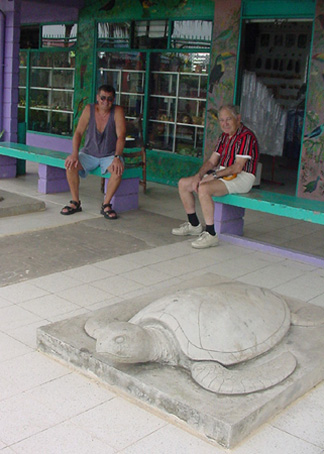
| Gary Brooking, a member, and Bob Miller, president, both of the
Association of Residents of Costa Rica, get a daylight view of a green
turtle, though concrete, during an association tour to Tortuguero last
weekend. |
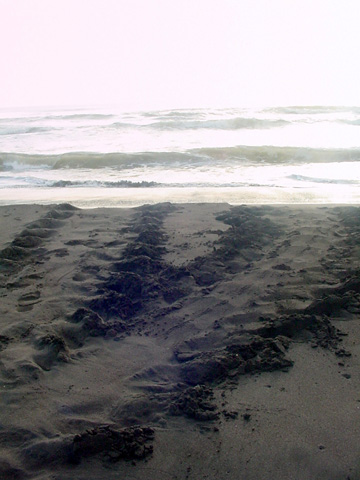
All that is left at dawn on the Tortuguero beach are tracks showing
that the turtles have come and gone. |
Cuba travel ban
may face U.S. vote
The U.S. Treasury Department, which just stepped up enforcement of the
ban on travel to Cuba, is now being urged to pull back. Congress may vote
to ease the restrictions as soon as next month, according to legislative
sources.
The ban on visiting the island has been on the books for years, to limit
the flow of tourist money to President Fidel Castro's government. But the
number of people charged with violating the law has recently risen sharply.
The enforcement has an effect in Costa Rica where many U.S expats make
vacation trips to Castro's island. In addition, some U.S. residents use
trips to Costa Rica as a disguise for trips to Cuba, although Mexico draws
many more such travelers.
Typically, the U.S. traveler buys a round-trip Cuban ticket with cash,
and Cuban immigration officials conveniently fail to stamp the passport.
In the three months from May through July the Treasury Department sent
letters to 443 U.S. citizens suspected of traveling to Cuba illegally.
That compares to just 74 such letters in the previous four months. Those
who can not prove their innocence can be fined up to $55,000, though lawyers
say the average penalty is about $7,500.
The move has angered members of Congress, who would ease rather than
tighten the 40-year economic embargo on Cuba. Democratic Sen. Byron Dorgan
urged Treasury Secretary Paul O'Neill to call off the enforcement, which
he says makes no sense.
"This new enforcement action is apparently an attempt to take a swing
at Fidel Castro," he said. "All it really does is hit American citizens
with fines that are horribly inappropriate for defying a travel ban that
has largely been unaggressively enforced in recent years."
The Treasury Department says the surge of letters is part of an effort
to clear a backlog, which began in the Clinton Administration. But President
George W. Bush said he intends to strengthen the economic blockade.
The House of Representatives, which the president's party controls,
voted last month to stop the Treasury from enforcing the ban. Mr. Dorgan
said he will propose to lift the restrictions outright when the Democratic-led
Senate reconvenes next month.
But Cuban-American lawmakers and their allies in the House leadership
have stopped such ideas several times in the past few years. And Bush could
veto any measure.
A.M. Costa Rica wires services contributed
to this report.
|
|
Shark targets include three surfers
Three shark attacks occurred Sunday in the Daytona Beach
area of Florida, not far from where sharks bit three surfers Saturday.
None of the injuries was life threatening. Most of the attacks occurred
in an inlet where sharks often gather to feed on smaller fish.
One 17-year-old victim of Sunday's shark attacks will require leg surgery.
Saturday's victims were contestants in a surfing contest.
Shark fears have been heightened across Florida after a shark bit off
the arm of an 8-year-old boy at Pensacola Beach in July. Surgeons re-attached
the boy's arm.
via wire reports
|
IRA officials nabbed in Colombia
Three men suspected of being members of the Irish Republican Army worked
with local Colombian Marxist guerrillas to perfect a devastating fire bomb
before their arrest a week ago in Colombia, according to police and intelligence
sources.
British and Irish news reports said an investigation found that the
three worked on the bomb with the Revolutionary Armed Forces of Colombia
or FARC. Police found an unidentified residue on the men's clothing after
their arrest that might be a form of Semtex, a potent explosive. Police
arrested them when they returned from a FARC-controlled area.
Peter Robinson, a Democratic Unionist politician in Northern Ireland,
claimed security sources had told him that tests were being carried out
on vaporized explosives with the potential to obliterate buildings and
kill anyone in their vicinity. The bomb used a mixture of gas and
explosives to produce a fireball similar to napalm, he said.
From A.M. Costa Rica wire services
|