|
 |
Your daily |
 |
|
|
|
|
|
|
|
|
|
|
|
|
||||||||||||||
|
|
||||||||||||||
| A.M. Costa Rica Second newspage |
 |
||||||||
| Home |
Tourism |
Calendar |
Classifieds |
Entertainment |
Real
estate |
Rentals |
Sports |
About us |
|
| San José, Costa Rica, Friday, Aug. 10, 2007, Vol. 7, No. 158 | |||||||||
 |
| Costa Rica Expertise Ltd http://crexpertise.com E-mail info@crexpertise.com Tel:506-256-8585 Fax:506-256-7575 |
 Click HERE
for great
hotel discounts
|
|
supply chain for products Special to A.M. Costa Rica
Dole Food Co., Inc. said Thursday that its Costa Rican subsidiary will work to create a carbon neutral supply chain for pineapples and bananas going to North America and Europe. Standard Fruit de Costa Rica is Dole’s operating subsidiary in Costa Rica. The Fondo Nacional de Financiamento Forestal, an agency of the Ministerio de Ambiente y Energía has signed what the company said was a ground breaking agreement to work with standard on the project. The supply chain is the route products take from production in Costa Rica to the market. Carbon neutral, as applied to the banana and pineapple product supply chains, means that the carbon dioxide emitted to produce, pack, transport and distribute the fruit will be offset by practices which increase the capture of carbon dioxide in order to achieve a neutral balance, said the company. These practices entail new, more efficient transportation methods, changes to agricultural processes to reduce carbon dioxide emissions and partnering with local farmers for preservation and reforestation programs. "The environment is a concern for all of us," said David A. DeLorenzo. He is president and chief executive officer of Dole Food Co., Inc. "Companies, consumers, governments and non-governmental organizations should endeavor to promote and adopt new production and distribution methods and consumption behavior in order to reverse harmful trends to the environment. As the world’s largest producer and distributor of fruits and vegetables, Dole is determined to take the lead in its sector. . . ." He said the agreement with the environmental ministry is a good starting point. Roberto Dobles, envirnomental minister, said that Dole is such an important company in the production of bananas and pineapples on a global level that officials are very enthusiastic that Standard Fruit made the decision to strive to become a carbon neutral company in Costa Rica and join the Arias administration efforts to become the first carbon neutral country in the world by 2021. Antidote to environment ills is will power, Arias says By the A.M. Costa Rica staff
Humans are not only witnesses to environmental deterioration but they are accomplices as well as victims, said President Óscar Arias Sánchez Thursday. He was speaking at the closing session of a conference on climate variability and change. Humans are destroying the forests and mangroves that slow the migration of mosquitoes that transmit dengue and malaria, said Arias. And humans are increasing the gap between the rich and the poor while reducing the gap between the city and the country and making more land urban, he said. He noted his administration's goal to make the country the world's first carbon neutral location by 2021. He said that the biggest antidote to whatever form of environmental destruction is will power. And he said that he hoped conference attendees had taken this antidote without any fear of an overdose. Arias has proposed a peace with nature program and is seeking to reduce the use of resources by government employees. However, he frequently welcomes investors and developers to Casa Presidencial. For example, last Friday he welcomed Steve Case, the former American Online chief, who wants to put in an $800 million development near Playas del Coco in Guanacaste. Don't mess with mothers here lawmakers finally agree By the A.M. Costa Rica staff
With the free trade legislation out of the way, thanks to a referendum Oct. 7, legislators hearts belonged to Mommy. The bill to celebrate Mother's Day on Aug. 15 instead of the following Monday had the full support of the executive branch. During August, the Arias administration sets the legislative agenda, and among the most pressing matters was the change in Mother's Day. Motherhood is one of Costa Rica's most valued institutions, right up there with soccer and sometimes blurred with worship of the Virgen de los Angeles. Wednesday is the traditional Mother's Day. But last year was the first year that the day was celebrated on the following Monday. That was designed to permit a three-day weekend. But Costa Ricans were miffed. They celebrated the day on Aug. 15 anyway and then enjoyed the holiday that followed. This year Costa Ricans will do the same thing. Wednesday is Aug. 15, and the traditional Mother's Day will be celebrated. Except the day will not be a national holiday. That will Come Monday, Aug. 20. Legislators passed the Mother's Day bill on first reading Thursday. They probably will consider the legislation for the required second time Monday or Tuesday. When passed the measure will return the Monday's Day celebration and the national holiday to Aug. 15. Free trade treaty opponent comes out with book on topic By the A.M. Costa Rica staff
Alberto Salom, a lawmaker who opposes the free trade treaty with the United States, has come out with a book on the subject. It is “Dos Polémicas sobre el TLC.” The book contains a number of documents and exchanges made by Salom about the treaty. It includes a written exchange with Esteban Agüero, one of the negotiators who helped devise the treaty in his capacity with the Ministerio de Comercio Exterior. The book also includes a discussion with Eugenio Baudrit Carillo, who is director of the Oficina Jurídica of the Universidad de Costa Rica. Baudrit Carillo opposes the mandatory arbitration contained in the treaty. According to a summary of the text Buadrit Carrillo said that mandatory arbitration is prohibited in Costa Rica. However, the free trade treaty with Canada that already has been approved seems to contain such a requirement. Victims of the Villalobos investment collapse are seeking millions from Costa Rica via an arbitration system set up by the World Bank. The idea of arbitration is to protect foreign investors who might not get a fair shake in local courts. There also is a discussion of the treaty's intellectual property rules.
|
| A.M. Costa Rica reaches 90 countries every weekday morning (You can, too!) |
 |
|
on our real estate page HERE! |
| A.M. Costa Rica third newspage |
 |
||||||||
| Home |
Tourism |
Calendar |
Classifieds |
Entertainment |
Real
estate |
Rentals |
Sports |
About us |
|
| San José, Costa Rica, Friday, Aug. 10, 2007, Vol. 7, No. 158 | |||||||||
 |
 |
| Longtime
insurance veteran sees changes with/without treaty |
|
|
By Dennis Rogers
Special to A.M. Costa Rica The opening of Costa Rica’s insurance monopoly is already under way, says Carlos Benevides, owner of a large agency in La Uruca. That’s with or without the pending free trade treaty with the United States. Benevides is a 50-year veteran of the insurance business, most of that, of course, with the Instituto Nacional de Seguros, which has had a constitutionally-mandated monopoly since the early 1950s. He now operates the UNISERSE agency. He says INS was already preparing for competition when about 10 years ago it spun off its agents as private operators. Previously all had been employees of the company. The agents had to take charge of their local operating expenses and employees. With further opening contemplated for January 2008, Benevides said that INS will expect the existing agents to be “loyal,” but “if a client wants a product they don’t offer, you have to give it to him.” No obvious new entrants to the market appear to be waiting. Benevides does not expect the government banks to get involved, but thinks the “megabanks” like Scotiabank and HSBC might. They already have insurance subsidiaries and won’t need additional infrastructure. HSBC claims it will have 100 agencies in Costa Rica within five years. Personal policies like life or medical coverage will be the easiest areas for new entrants. “There already exists a black market for personal insurance in this country,” says Benevides. Vehicle and property insurance requires more qualified personnel such as appraisers and accident investigators. It will take several years for anyone to put this infrastructure in place, he said. Benevides expects aggressive promotion of different sorts of insurance with the establishment of competitors for INS. New entrants will eventually “penetrate all the niches,” he says. Despite its mildly socialist bent, INS does not seem to market to lower-income people. Products like small life insurance policies to cover mortgages or other loans are sold in other Latin American countries by the banks themselves. Medical policies are an area with potential for innovation, especially those that can make agreements with private hospitals. INS does have policies to cover these arrangements, but none really is tailored to the needs of foreign retirees. Benevides expects a long line of new entrants in this area. Vehicle insurance is the type most in need of reform, he said. A general reduction of the accident rate, which might be helped by pending legislation to raise Costa Rica’s ludicrously low traffic fines, is the biggest need to |
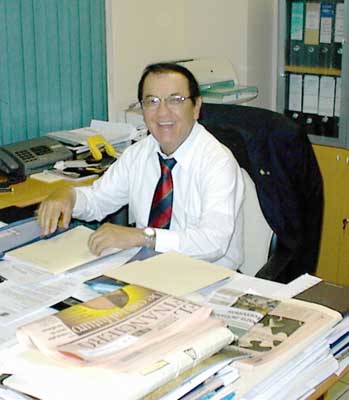 A.M. Costa Rica/Dennis
Rogers
He's seen it all: 50-year insurance pro Carlos Benevidesallow motor vehicle insurance rates to fall. A reform of the traffic courts and more police have also been touted but never put into action. As for the economic aspect, Benevides says small accidents in the metropolitan area where usually no one is hurt have as big an impact as major highway crashes caused by drunken or reckless driving. With socialized medicine and a simpler (if inefficient) legal system, the latter have less impact on insurance costs than they would in developed countries. Most of the publicity for the legal reforms has emphasized the human costs, with extra attention to spectacular accidents. Some sort of mandatory coverage to replace the tiny liability coverage which is part of the annual vehicle registration fee, will also be needed, he said. At present, it is easy for someone with limited assets to avoid civil responsibility for an accident. Benevides feels competition will bring rates down enough to allow more drivers to afford coverage, but elsewhere this has proven not to be the case. Costa Rica’s “bomberos,” the firemen and rescue units, are part of INS. Benevides said it will simply no longer be the case that INS can take on those costs. It has not been determined how the service will be funded. A tax on electric bills has been suggested, and the Asamblea Legislative is considering the issue. Cost cutting will still need to be a priority for INS. In 2006 it was revealed that some employees were promised retirement bonuses of one year’s salary for each year labored, up to 25 years. Such arrangements do exist in the private sector but are usually capped at eight years. |
| A five-hour tour around the city that our columnist loves |
|||
| I had two opportunities
to be
in the city this past week. Sunday it was a lunch with Darrylle
and Ulisis in Barrio Dent with other good friends. I am still
thinking about the strawberry rhubarb pie that Darrylle made.
Rhubarb is a rare find in the stores in Costa Rica. In the
States, when I was a kid, we used to run through the garden, pull out
the stalks and eat them raw, screwing up our faces at the sourness of
it. Then Mavis called and said that Maria, her house guest from Canada who used to live in Rohrmoser, would love to tour with me around the city to see the changes. What makes Maria special is that she also loves the city and being from Canada, where the people are very much concerned about the environment and conservation, she also is truly game to ride buses. Mavis said that although Maria was still feeling a bit shaky from a stomach upset, she wanted to go. We met on the edge of Sabana Park and caught the Sabana Cementerio bus on Paseo Colón going downtown. From the Caja we walked to the bulevar that is Avenida Central, on to Parque Morazán, and then to my favorite park, the Parque España, just opposite the INS building, I consider the park a mini rainforest in the middle of the city. Then we walked around inside the former liquor factory grounds, which I remember fondly because I was in the play, "Rumors" in the theater there. The complex is now the cultural ministry. We also admired the nearby Escuela Metalica, the imported prefab school made (of course) of metal. It looks as if it has been polished recently. From there we took another bus to the mercado central and wandered among the stalls. Our favorite stall is the one that sells herbs and spices. I bought a small bottle of oil of clove. You can buy small amounts of herbs or spices — amounts you can use up before they become stale. By now we were both tired and agreed to taxi to my favorite restaurant in the city. I talked Maria into walking three more blocks to Avenida 2 in order to catch a cab going in the right direction. (If you don't, you can go a very long way around, because there are so many one-way streets in the city.) On the way we admired the wonderful statues of the campesinos in front of the Banco Central. The restaurant, Il Ritorno is on Avenida 8 in the Casa Italia, a place I also remember fondly because I once directed two plays that were presented in the auditorium, and acted in one – that was, again, before the Little Theatre Group had its own theater in Escazú. |
Jo’s book, “Butterfly in the City: A Good Life in Costa
Rica,” is
available at the 7th Street Book Store, Lehmann’s and Liberia
Internacional. Or contact Jostuart@amcostarica.com |
||
| You need to see Costa Rican tourism information HERE! |
| A.M. Costa Rica fourth news page |
 |
||||||||
| Home |
Tourism |
Calendar |
Classifieds |
Entertainment |
Real
estate |
Rentals |
Sports |
About us |
|
| San José, Costa Rica, Friday, Aug. 10, 2007, Vol. 7, No. 158 | |||||||||
| Ortega's
courting of Iran results in millions in foreign aid |
|
|
By the A.M. Costa Rica wire services
Iran has pledged tens of millions of dollars in aid for infrastructure projects in Nicaragua in a move viewed with alarm in some quarters. Nicaraguan President Daniel Ortega, who was a Cold War nemesis for Washington in the 1980s, is seeking closer ties with countries the Bush administration considers unfriendly -- while Tehran is looking for allies in Latin America. The last time Daniel Ortega was in power, in the 1980s, Washington backed rebels fighting to depose his Marxist government. Supported by the then-Soviet Union with arms, Nicaragua under Ortega's Sandinista government became a Cold War battleground. But the world has changed, and since Ortega's inauguration in January as president, relations between Washington and Managua have been cordial. Yet the Nicaraguan leader is also working to deepen ties with Cuba, Venezuela and now Iran — all nations at odds with the United States. This alarms some, including Roger Noriega of the American Enterprise Institute. He is the former U.S. assistant secretary of State. "You really have to go out of your way to reach out to one of the four biggest rogue states in the world, Iran, which is recognized as a pariah by all the respectable countries of the world,” said Noriega. “So unfortunately, President Ortega seems to be going back to the past." President Ortega visited Tehran in June, where he was warmly welcomed by President Mahmoud Ahmadinejad. For his part, the Iranian leader is using his country's oil wealth to court allies in Latin America, according to Michael Shifter, an expert on Latin America at the Inter-American Dialogue in Washington. "They're obviously under enormous criticism from a lot of governments, not only the United States but European governments and other governments, and they want, I |
think, more respectability and to
the
extent that they can have a few governments in Latin America where they
are accepted and where they can operate. I think for them it gives them
an attempt to overcome this pariah status that they have right now,"
said Shifter. This apparently was the objective of President Ahmadinejad's trip to Latin America in January, where his first stop was Venezuela. There, he and Venezuelan leader Hugo Chavez cemented their relationship, bound together by their mutual antagonism toward Washington. Ahmadinejad also stopped in Nicaragua during that trip, a visit that laid the groundwork for Iran's assistance to the Central American nation. While the aid is expected to further deepen ties between Managua and Tehran, the announcement from Managua prompted a relatively mild reaction by U.S. State Department spokesman Sean McCormack. "Nicaragua is a sovereign, independent state. It's going to have bilateral relations with whatever states it sees fit to have relations with. We think it is in the interests of Nicaragua, as well as other states in the region, to deepen its relationships with those states which have a positive vision of the future in terms of Nicaragua's democracy, expanding that democracy, deepening that democracy," McCormack said. For Ortega, who won last November's presidential election on promises of political moderation, aid from Iran and Venezuela is a welcome boost to his government. Yet he also is well aware these ties do not please Washington, according to Shifter. "Ortega has changed somewhat but he is still somebody who ideologically, I think, does have a lot of resentment towards the United States, and I do think he wants to be empowered but at the same time, its important to remember he is not breaking with the United States." As one of the poorest countries in the Western Hemisphere, most Nicaraguans are likely to welcome the aid. |
| Chávez
is on the road seeking support to back Venezuela as Mercosur candidate |
|
|
By the A.M. Costa Rica wire services
Venezuelan President Hugo Chávez is in Uruguay as part of a regional tour aimed at helping his country's bid for admission to the South American trade bloc Mercosur. Chávez said he will guarantee Uruguay access to Venezuelan oil for decades. The Venezuelan leader also says his country will help increase the capacity of Uruguay's only oil refinery. Chávez discussed the energy plans with Uruguayan President Tabare Vazquez and other top officials late Wednesday. He planned to travel to Ecuador Thursday, then head to Bolivia. |
His previous stop on the tour was
Argentina, where he said Venezuela plans to acquire up to $1 billion in
Argentine bonds. He is offering energy and financial deals on each stop to try to ease Venezuela's entry into Mercosur. Argentina, Brazil, Paraguay and Uruguay formed Mercosur in 1991. Mercosur now accounts for $1 trillion in annual economic activity and includes 250 million people. Chávez has accused Paraguay and Brazil of blocking the ratification of Venezuela's entry to the group. |
| We can put your business announcement
here where those seeking international news will see it |
|
| News from
the BBC up to the minute |
BBC sports news up to the minute |
| BBC news and sports feeds are disabled on archived editions |
|
| A.M. Costa Rica Sports news local and from the wires |
 |
|
|
|
|
|
|
|
|
| San José, Costa Rica, Friday, Aug. 10, 2007, Vol. 7, No. 158 | ||||||
|
||||
|
|
|
|
|
|
|
|
| What we published this week: | Monday | Tuesday | Wednesday | Thursday | Friday | Earlier |
|
|