|
||
|
A.M. Costa Rica
Your daily English-language news source Monday through Friday |
||
 |
 |
 |
|
|
 |
|||||||||||||||||||
|

|
||||||||||||||||||
 |
|||||||||||||||||||
|
|
||||||||||||||||||
 |
 |
| What we published this week: | Monday | Tuesday | Wednesday | Thursday | Friday | Earlier |
|
|
|
|
|
|
|
Food |
|
Jo
Stuart |
|
|
| A.M. Costa Rica's Second news page | |||||||||
| San José, Costa Rica, Wednesday, July 11, 2012, Vol. 12, No. 137 | |||||||||
|
|
|
|
|
|
|
Food |
|
Jo
Stuart |
 |
 |
 |
|
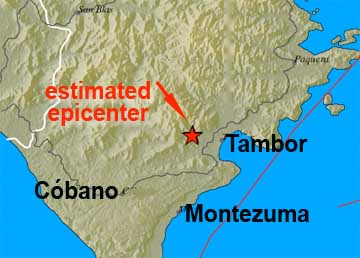 Laboratorio de Ingenieria Sismica/A,M,
Costa Rica
Map shows where an estimated 3.5
magnitude earthquaketook place at 7:14 p.m. Tuesday at the tip of the Nicoya peninsula just west of Tambor. The quake was felt the strongest in Cóbano and Paquera, said the Laboratorio de Ingenieria Sismica. Swiss find tourist's body in a glacier crevasse By
the A.M. Costa Rica staff
Rescue workers have located the body of a Costa Rican tourist who died while snowboarding in the mountains of Switzerland. The skier, Jorge Brenes Jaikel, 30, disappeared Wednesday at Zermatt. He appears to have fallen into a crevasse in a glacier. The foreign ministry here said that the Swiss mounted a rescue effort with 16 professional guides, two dogs and even a helicopter. Rescue crews had been working since Saturday. Police managed to trace the man and learned he withdrew money from an automatic teller and then rented snowboarding equipment. He was not a stranger to winter sports, his family told the foreign ministry. Osa tourism operators plan expo Thursday in San José By
the A.M. Costa Rica staff
Tourism operators in the Cantón de Osa plan their annual expo Thursday at the Hotel Crowne Corobicí in San José. This is the 15th annual expo, called the Expo Osa, said the Cámara de Turismo de Osa. The expo is open to the public from 9 a.m. to noon. The afternoon is reserved for travel agencies, said the chamber. The canton, named after a native chief, has a lot to offer. It includes the jungled Osa Peninsula as well as modern facilities up the Pacific coast to the Río Barú at Dominical. It also is home for those mysterious stone balls that were crafted from rock brought from the Río Térreba.
|
||||||||||||||||||||||||||||||||||||||||
 |
|||||||||||||||||||||||||||||||||||||||||
|
|
|
|
|
|
|
Food |
|
Jo
Stuart |
| What we published this week: | Monday | Tuesday | Wednesday | Thursday | Friday | Earlier |
| The contents of this page and this Web site are copyrighted by Consultantes Río Colorado 2012 and may not be reproduced anywhere without permission. Abstracts and fair use are permitted. Check HERE for details | ||||||
A.M. Costa Rica Third News Page |
 |
| San José, Costa Rica, Wednesday, July 11, 2012, Vol. 12, No. 137 | |
|
|
|
|
|
|
|
Food |
|
Jo Stuart |
| Nicoya residents to protest July 25 over
lack of citizen security |
|
|
By
the A.M. Costa Rica staff
Nicoya residents have launched a strong criticism of police operations in their area and say that the security of citizens in all of Guanacaste has deteriorated. A local priest, Elías Mejías, in Barrio San Martín in Nicoya sent a letter to Laura Chinchilla. He appears to have the backing of the Municipalidad de Nicoya because his letter was summarized in a news release from that office. Mayor Marcos Jiménez is said to be in full agreement. The letter said that the unhappy residents are planning some kind of pressure tactic for July 25 when, as is tradition, Ms. Chinchilla and her cabinet meet in the community of Nicoya. The date is the public holiday marking the Anexión de Guanacaste to Costa Rica in 1824. |
The priest also called for a change
in command of security forces that
are now in Guanacaste. He said he was unhappy and frustrated by lack of
replies from the security ministry. The release said that the local
chamber of commerce supports the ideas expressed in the letter. The
priest said he was sick of sitting through unproductive meetings on the
topic. There were no examples of crimes or other situations that showed a lack of police presence. The Chinchilla administration has said repeatedly that the crime situation has improved in the country. This is, in part, due to flooding the central canton of San José with Fuerza Pública officers. This also had the result of causing criminals to move into the suburbs to commit their crimes. |
| Cricket fans stake their game's future on
school children |
|
|
By
Aaron Knapp
of the A.M. Costa Rica staff Although soccer will probably always be Costa Rica's most popular sport, a group of English expats has been working for over two decades to reintroduce cricket, and in the past few years the key has become getting it into schools. To that end, the Costa Rica Cricket Federation is hosting the Inter-Schools Cricket Kick-off, a tournament for secondary-school cricket teams at the end of the month in preparation for a bigger tournament in October. By promoting the sport in schools, the federation hopes to plant the seed for more teams and more interest among young people, a small piece in the plans of the International Cricket Council, the global cricket authority that supplies roughly half the federation's funding, to spread the sport globally. “That is what the ICC wants, of course, not a bunch of old British men playing,” said Richard Illingworth, president of the federation and of Baden Corp's Croquet and Cricket Club of Costa Rica, a local team based in Heredia. Developed in Great Britain in the 17th century, cricket's heyday was during the 1800s when it became the British national sport and was subsequently spread across the nation's global empire. The sport continues to be most popular in former British colonies, particularly around the Indian Ocean, in countries such as Pakistan, Sri Lanka, Australia, New Zealand, South Africa and especially India. “Cricket in India is almost like a religion, like fútbol in Latin America,” said Illingworth. According to an article on the federation's Web site written by Illingworth, cricket grew in popularity from the late 1800s until the 1930s along the Caribbean coast, as many workers from Jamaica, a former British colony, began to settle around Limón. However, World War II put an end to cricket's growth in Costa Rica, and no one could effectively organize a movement to reintroduce the sport for 50 more years. “There was some sporadic cricket going on but not much,” said Illingworth. Often described as a bat-and-ball sport like baseball, cricket is played by two teams of 11 on a circular field about 150 meters in diameter, with a 22-yard-long sand pitch in the center. These dimensions in total are roughly twice the size of a standard soccer field and difficult to find, according to Illingworth. The game is divided in to innings, in which the batting team tries to hit the ball and run across the pitch as many times as possible to score runs. Meanwhile, the fielding team bowls or pitches the ball aiming for a target or wicket behind the batter, If the ball hits the wicker, it puts the batter out of play to be replaced by another batter until the whole team has cycled through. Batters also can also be removed if the ball is caught before it hits the ground. Born in the United Kingdom but quick to say that he is “English,” Illingworth moved to Costa Rica in 1986, and within a year he began trying to recruit and organize the small cricket movement here. He explained how during the 1990s teams grew and Costa Rica began to compete internationally, but the sport did not gain much traction until 2000, when the International Cricket Council wrote to Illingworth and invited the organization to become an affiliate member and receive donations. |
 A.M. Costa Rica file photo
A tense moment on the pitch“What the ICC was doing was increasing the number of countries and the number of people playing, and they were very successful,” he said. In addition to providing equipment, the International Cricket Council began giving the organization $4,000 and has been increasing funding up to $25,000 last year. Additionally, the organization has been able to generate matching funding from private organizations for events developing partnerships with government agencies, culminating last year when Costa Rica hosted an annual international cricket tournament played by six Latin American countries. Costa Rica took fifth place in the tournament and barely ranks in the top 100 of the council's 106 members. “It was a super achievement not only from the level of playing we had reached to part in that, but it was an achievement for us from an organizational point of view,” Illingworth said. However, despite these successes, Illingworth said that the sport has still not generated as much interest as the federation had hoped. There are only three adult teams in Costa Rica, based in Escazú, Heredia and Limón. “We've been lucky to have sponsorship. However, we still haven't managed to get hundreds or thousands of people playing,” he said. “Even with sponsorship, people haven't been showing up in droves.” In the past few years, the focus has become getting the sport into schools by offering training courses to students and physical education teachers alike, working with the Ministerio de Educación Pública and hosting tournaments for teams of middle-school, high-school, and college aged students. The sport has caught on in numerous schools in Limón, but the next step is to introduce it in more schools in the Central Valley. “We're looking to build on what we've already got, and schools are the key,” said Illingworth. Although the adult league had its championship in May, the next tournament will be a single-day event of about a dozen school teams in Siquirres July 31. The top few teams will go on to play in a bigger tournament in Limón, sometime in October. |
 |
| You need to see Costa Rican tourism information HERE! |
|
|
|
|
|
|
|
Food |
|
Jo
Stuart |
| What we published this week: | Monday | Tuesday | Wednesday | Thursday | Friday | Earlier |
| The contents of this page and this Web site are copyrighted by Consultantes Río Colorado 2012 and may not be reproduced anywhere without permission. Abstracts and fair use are permitted. Check HERE for details | ||||||
 |
|
||||
| A.M. Costa Rica's Fourth News page | |||||
| San José, Costa Rica, Wednesday, July 11, 2012, Vol. 12, No. 137 | |||||
|
|
|
|
|
|
|
Food |
|
Jo
Stuart |
The 7-foot-long painted scroll is one of the few known pictorial documents that contain text in the Zapotec language. It had been in the hands of private collectors early in the 20th century, including California mining engineer A.E. Place, who sold it to the American Geographical Society in 1917 for $350. |
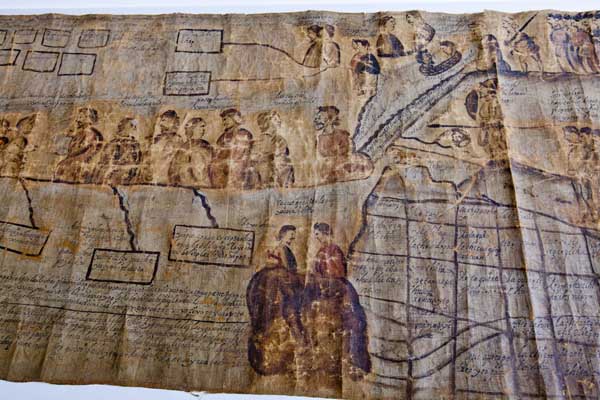 University of Wisconsin-Milwaukee photo
|
| Historical detective work solves mystery
of old Mexican scroll |
|
|
By
the University of Wisconsin-Milwaukee news service
A rare 17th-century Latin American document that was lost for nearly a century resurfaced earlier this year. The kicker: It was right where it should have been all along – in the American Geographical Society Library at the University of Wisconsin-Milwaukee. But it’s a wonder that the document, a pictorial history-map of Santa Catarina Ixtepeji, a village in Mexico, was rediscovered at all. The 7-foot-long painted scroll is one of the few known pictorial documents that contain text in the Zapotec language. It had been in the hands of private collectors early in the 20th century, including California mining engineer A.E. Place, who sold it to the American Geographical Society in 1917 for $350. In a 1917 letter to the society, Place, wrote: “Were it not for the fact that I am forging into business here, after having lost nearly all my property in Mexico, I would not sell the map at any price.” Fast forward to 1978. The society collection moved from New York to the university, where archivists have been piecing together the stories of the more than 1 million items in the collection bit by bit over the last 34 years. The contents include maps, globes, diaries and other memorabilia gathered by the society’s member-explorers, from Charles Lindbergh to Teddy Roosevelt. In 1995, society library curator Christopher Baruth came across a tattered scroll containing both writing and pictures. There were no markings on it to link it to a card in the collection’s catalog. “I had asked someone about it at that time,” he remembers, “but that person didn’t think it was anything of significance.” That could have been the end of the story. Baruth formally retired in 2011 after 31 years with the society, 16 as curator. After fielding a staff member’s question about the scroll while organizing his office, Baruth decided to get a second opinion. He called Aims McGuinness, University of Wisconsin-Milwaukee associate professor of history, who could tell that the scroll was written in both Spanish and a native language. To home in on its origin, McGuinness consulted with someone who specializes in colonial Latin America, and she was just downtown at Marquette University. Laura Matthew, an assistant professor of history, remembers being psyched to see the mystery document, which, she says, recounts the history of leadership and land ownership in a specific town in Mexico. “It continued an older tradition of documents kept by royal houses that were intended to accompany an oral presentation, like a visual aid.” The document was written in both the native and Spanish languages because it would have been used to legitimize land ownership in a bureaucratic process involving Spanish officials. Two dates inscribed on it, 1691 and 1709, were probably the dates it was used, Ms. Matthew surmises. Ms. Matthew is not an expert in Zapotec, but she knows someone who is. Michel Oudijk at the Universidad Nacional Autónoma de México knew exactly what the scroll was from looking at emailed photos, and he knew because he had been looking for it for more than a decade. “That’s when we knew we had something valuable,” says Ms. Matthew. “And luck played a part, because he had already studied this type of document and that made for a fast identification.” |
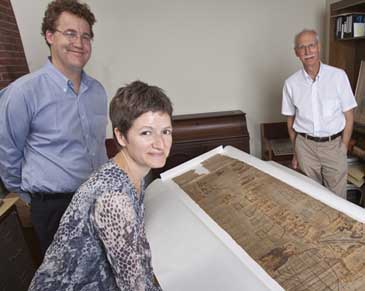 University of Wisconsin-Milwaukee /Troye Fox
Laura Matthew joins Christopher
Baruth, curator emeritus of the American Geographical Society, and Aims
McGuinness, to examine the 321-year-old Códice de Santa Catarina
Ixtepeji.Oudijk and colleague Sebastián van Doesburg had found scholarly reports from the 1960s indicating two documents from Santa Catarina Ixtepeji had been sold in the early 20th century. One was sold by a British consular official in Oaxaca named Rickards, a Mexican of Scottish descent. But the research did not reveal that mining engineer Place was the buyer or that it had ended up at the American Geographical Society. That information came some 50 years later when curator Baruth consulted the last batch of archival material – 10,000 pounds of it – that arrived in Milwaukee from New York in 2010. He unearthed a letter from Place, dated 1917, stating the price he wanted for his piece of antiquity. It provided the final piece in the puzzle of how the rare scroll had found its way from Mexico to Milwaukee. “This has been invaluable to teach students about the impact of research,” says McGuinness. “My students could see knowledge being produced and the cooperation among institutions that made it happen.” Baruth believes that Place probably secured the artifact from Rickards, as the two were both in the mining community around Oaxaca. By the time Place wanted to sell the artifact, the society was preoccupied with boundary disputes in Europe as World War I drew to a close. Baruth suspects that’s why the document entered the collection with little notice. It was mostly likely shelved without sufficient identification and forgotten. The discovery and identification of this piece illustrates the value of the work by librarians, archivists and the global community of scholars, says McGuinness. “This is more than just a curiosity,” he says. “This document tells us in the present something about Mexico that we would not otherwise have known. So UWM is part of a circuit that creates and disseminates information of worldwide significance.” Collaboration extended beyond the academic. Jim DeYoung, senior conservator at the Milwaukee Art Museum, advised that the scroll never be rolled again. He designed and constructed the frame that it is now displayed in. Through it all, McGuinness’ and Matthew’s students witnessed the mystery unfold. “This has been invaluable to teach students about the impact of research,” says McGuinness. “My students could see knowledge being produced and the cooperation among institutions that made it happen.” |
|
|
|
|
|
|
|
Food |
|
Jo
Stuart |
| What we published this week: | Monday | Tuesday | Wednesday | Thursday | Friday | Earlier |
| The contents of this page and this Web site are copyrighted by Consultantes Río Colorado 2012 and may not be reproduced anywhere without permission. Abstracts and fair use are permitted. Check HERE for details | ||||||
| A.M.
Costa Rica's Fifth news page |
 |
||||||||
| San José, Costa Rica, Wednesday, July 11, 2012, Vol. 12, No. 137 | |||||||||
|
|
|
|
|
|
|
Food |
|
Jo
Stuart |
 |
| Heat
wave jeopardizes crops and world's social stability By
the A.M. Costa Rica wire services
World food prices are likely to rise in the coming months in the wake of record-breaking temperatures and drought in the major maize and soybean producing regions of the United States, economists say. It would be the third spike in food prices in the past five years. Previous hikes during 2007 and 2008, and again in 2010 and 2011 triggered riots and social instability in dozens of countries around the world. Whether rising food prices will again trigger unrest is unclear, especially since different crops are affected. Despite early predictions of a record maize crop, estimates have plummeted after a string of record-high temperature days and dry conditions stretching across the farm states of the U.S. Midwest. “We need rain, and it doesn’t look like we’re going to get it,” says Iowa State University economist Dermot Hayes. As the world’s leading exporter of maize and a top soybean exporter, what happens in the U.S. affects global prices, according to Hayes. Mexico and Central America, where maize is a key staple, will be affected directly, but Hayes expects others to be affected indirectly as well. “Bread prices in North Africa will go up, and chicken prices in China, pork prices in China, et cetera,” he says. “And there are going to be some very unhappy people.” Bread will go up in North Africa because wheat prices follow maize prices. Pork and chicken prices will go up, as well as beef, milk and eggs, because maize and soybeans are key ingredients in animal feed. Countries that import substantial amounts of animal feed will feel the impacts the most, according to economist Maximo Torero with the International Food Policy Research Institute. “That’s China, India, and most of the Latin American countries, which are growing a lot and are starting to consume a lot more meat," Torero says. "So it could affect them substantially.” However, Torero expects the world’s poor to be hit less severely than in the previous two price spikes. “I don’t see the issue of meat and milk as a huge problem for the poorest countries,” where consumption of animal products is much lower than in industrialized nations, he says. Cornell University economist Chris Barrett agrees. “The poor who consume maize in large quantities are disproportionately in areas where they consume either a different kind of maize, or they’re in relatively remote regions where they are likewise buffered from the global markets.” In much of sub-Saharan Africa, Barrett notes, consumers prefer white maize over the yellow varieties grown in the United States. Also, the fact that the most-affected crops are primarily used as animal feed and not crops such as rice or wheat, which are consumed directly, mitigates the impact on the poor, says the institute's Torero. “If the case was rice, like what we had in 2007-2008, then the situation would be different because those commodities are really imported in most of sub-Saharan Africa. And also in the case of wheat that happened in 2010, it affected Northern Africa, Cairo and so on, because they are net importers.” But while rising prices may threaten food security for the poor, experts note they can create unrest among consumers whose standard of living had been rising. Iowa State University’s Hayes says it could be an irritant in China, a country with a growing middle class but significant social inequality. “It’s a tinderbox over there,” he says. “It’s not a real homogenous or pleasant society the way it’s structured right now. So there could be some issues.” But Cornell University’s Barrett says Beijing would keep a lid on prices for the sake of stability. “The Chinese government isn’t going to be the least bit shy about buffering its own domestic markets,” he says. And with $3 trillion in foreign currency reserves, he adds, “they have the wherewithal to do that.” But other countries without China’s fiscal wherewithal may feel the impacts more strongly. Chávez says he's ready for aggressive campaign By
the A.M. Costa Rica wire services
Venezuelan President Hugo Chávez says he has fully recovered from cancer and is ready to mount an aggressive bid for re-election. Chávez told reporters in Caracas Monday that he was "totally free" of the disease that was first discovered a year ago. The 57-year-old leader has undergone two surgeries to remove tumors from his pelvis, plus several radiation treatments in Cuba since his initial diagnosis, although the exact nature of his cancer has never been revealed. Chávez insists his treatments have not depleted his energy. "Luckily, thank God, here I am. And I am feeling in better physical condition every day," he told reporters. "And I believe, firmly, that what you just called my physical limitations won't play any role in this campaign." Chávez will face Henrique Capriles, a former state governor, in the Oct. 7 presidential vote. The president says he will increase his campaign appearances with several rallies around Venezuela later this week. If he wins, Chávez could likely serve until 2019, which will mark his 20th anniversary as president. |
|
||||
|
|
|
|
|
|
|
Food |
|
Jo
Stuart |
| What we published this week: | Monday | Tuesday | Wednesday | Thursday | Friday | Earlier |
| The contents of this page and this Web site are copyrighted by Consultantes Río Colorado 2012 and may not be reproduced anywhere without permission. Abstracts and fair use are permitted. Check HERE for details | ||||||
| A.M.
Costa
Rica's sixth news page |
|
|||||||||
| San José, Costa Rica, Wednesday, July 11, 2012, Vol. 12, No. 137 | ||||||||||
|
|
|
|
|
|
|
Food |
|
Jo
Stuart |
 |
Latin America news |
New tourism group unhappy
with classification of tourists By
the A.M. Costa Rica staff
The new tourism group, the Asociacion Para La Proteccion Del Turismo en Costa Rica, says it plans to bring a legal action against the Instituto Costarricense de Turismo because the visitor statistics released by the agency contains more than tourists. More than that, however, is the fact that some 400,000 Nicaraguans are counted as tourists, which allowed Costa Rican officials to boast of hosting more than 2 million visitors each year. A.M. Costa Rica has reported this fact repeatedly citing the tourism institutes own statistics. The tourism institute gets the data from the Dirección General de Migración y Extranjería. The tourism association that is know as ProTur, also questioned the tourism institute's latest promotion, The gift of Hapinness. that featured a talking sloth. This is the promotion that handed out free trips to North Americans. ProTur wonders why an Atlanta, Georgia, ad agency got the contract for the project without any kind of competitive bidding. The Atlanta agency, 22squared, created a campaign that used social media, such as Facebook to promote the country. The tourism institute adopted the three-toed sloth as a mascot for the $6.4 million promotional scheme that gave away 80 free trips for two with the hope that the recipients say good things about the country on the social networks. The tourism institute posted on its Facebook page photos and responses from persons the agency said made the trip. However, there are only initials instead of last names and insufficient identification information to contact the winners. ProTur also is unhappy because the winners of the free trips were housed in upscale hotels and smaller operations did not receive any benefit from the promotion. The tourism institute has not announced any benefit that came from the campaign, which ended in February. |
|
Latin
American news feeds are disabled on archived pages.
|
|
| Costa Rican News |
AMCostaRicaArchives.com |
Retire NOW in Costa Rica |
CostaRicaReport.com |
|
|
|
|
|
|
|
Food |
|
Jo
Stuart |
| What we published this week: | Monday | Tuesday | Wednesday | Thursday | Friday | Earlier |
| The contents of this page and this Web site are copyrighted by Consultantes Río Colorado 2012 and may not be reproduced anywhere without permission. Abstracts and fair use are permitted. Check HERE for details | ||||||