Your daily English-language news
source
Monday through Friday

|
Your daily English-language news
source
|
|
|
|
|
|
|
|
|
|
|
|
|
|
||||||||||

|
|
||||||||||

| Costa Rica Expertise Ltd http://crexpertise.com E-mail info@crexpertise.com Tel:506-256-8585 Fax:506-256-9393 |
|
|
|
why the road are bad Dear A.M. Costa Rica: Hello Ginger and friends. When you visit rural Costa Rica — and Lake Arenal is primarily an agricultural area — you visit the 1950s. Family life is more important to us than holes in the road, although locals do notice the holes and drive accordingly, namely slowly and carefully. In any case, a private car owner — as the editor noted in his brilliant comment at the end of your letter — would rather rent a car to avoid costly repairs. But those are big town folks. We do not have rental places with compatible prices. The reason why your rental was "rickety sounding" is that tourist usually do not drive a rental as if it was their own car. We observe daily how tourists do not slow down much and just drive as if there weren't any potholes. Although I like your idea for the government to pay for car repairs related to the bad road conditions, I would not like to see toll booths set up like it is common practice in the States and many other places around the world. We simply have not learnt how to be honest with public funds. There is plenty of tax money collected for road repairs. We still have, as it was in the 50s elsewhere, great trouble of administering funds. We have a cousin economy, meaning that money flows too easily into the pockets of relatives, even if they do not qualify for the job. We have a government agency responsible for the construction, upkeep and policing of roadways and bridges, MOPT. They allocate money to other administrative agencies, who are supposed to publish invitations of tenders. Instead, contracts are all too often given to family members and friends. You and I could also enter a very low bid. When asked if we have the machinery, we just say "yes," because we know we can always loan or rent machines. A big down payment is given for materials, but we can decide that we never repair anything. When we receive a reminder call, we simply say that we have machine problems. This is a very plausible explanation in this country, because heavy machine parts take weeks to get here. In the meantime we have put the money safe. When the administration puts up pressure, we can always declare bankruptcy, because we know and can totally rely on that the civil courts are slower than slow. We have plenty of time to reorganize and incorporate again, and do it all over again. Costaricans are very tolerant towards corruption, although a candidate for presidency should mention that (s)he will fight corruption. And corruption is visibly fought this year as we are entering slowly into the election campaign. Additionally, as it has been pointed out in these pages, the government has frozen road funds, to bring pressure on the legislature to pass a new tax packet. This packet is required to qualify for the free trade agreement with the States. So if you want to weigh this fact, you can say that the country whose tourists are complaining about our road conditions, is the very country that pushes all these little countries into trade agreements to take advantage of our low wages. In the end, all national trade gains are still earned on the backs of the working class. There are some interesting economic studies to support these facts. Come and enjoy our country, because it is changing fast to just another satellite controlled by the United States, and when you come, enjoy our friendliness and our bad roads. Just drive slowly like the rest of us. Roger Herrera
Nuevo Arenal  |
U.S. citizen sought
in waters of Arenal By the A.M. Costa Rica staff Rescue officials are seeking the body of a retired U.S. citizen in the waters of Lake Arenal. The man, identified as Palmer Ritz, 60, vanished Friday after taking his small boat onto the lake. The boat has been located but not Ritz. The search is concentrated near the northwest end of the lake at Tilarán
where the man lived.
|
In Costa Rica: From elsewhere: A.M. Costa Rica
Consultantes Río Colo.
|
reaches those folks who never even thought about your product or service.*
*That's the ones you want, right?
|
|
|
|
|
Anti-drug police here are closing down wholesale and retail cocaine operations. New search techniques at the Peñas Blancas border crossing to Nicaragua have turned up truckloads of the white powder. Police vigilance at Juan Santamaría Airport has resulted in the arrest of travelers bound for Europe and disrupted several major disribution routes. The anti-drug action continued this weekend. Agents stopped an unusual shipment of what is believed to be drugs coming into the country from Nicaragua. Usually drugs leave the country to this northern neighbor. That bust helped police round up three persons they say are connected to the drug ring. Also Friday, in the center of San José in the infamous Zona Rosa, the Policía de Control de Drogas arrested three transvestites who carried radios to avoid police. Officers also said they confiscated some 341 grams of cocaine and a pistol. In another action, a raid near the school in San Isidro de Montes de Oro, Puntarenas, led to the arrest of a woman and daughter. Police said the pair had turned a pulpería or small food store, into an outlet for crack cocaine and others drugs. Also Friday in Limón Fuerza Pública officers arrested a man with the last names of Ferguson Kolle and said he was carrying 32 crack rocks and six small boxes of cocaine. In the case of the cocaine being imported into Costa |
Rica, officials said they got a tip
from their counterparts in Nicaragua. They stopped a truck in Liberia and
found four kilos (8.8 pounds) of cocaine and about $30,400 dollars and
86,000 colons.
Detained was a 47-year-old Costa Rican with the last names of Castro Blanco. As a result of the arrest, officers were able to implicate a Nicaragua security guard who lives in Tres Ríos. His last names are Hernández Jarquín, police said. They said he was the contact man in Nicaragua. In Urbanización El Roble de Alajuela, which police said was the center of the group’s opeations, they detained a Colombian with the last names of Montano Mosquera. they said he was the leader of the group. In the arrest of the men who were dressed as women, police said the area of operation was in the vicinity of the former Cine Líbano. Three persons were identified by these last names and ages: León, 45, Acuña Valverde, 38, and Miranda Fuentes, 48. The area between Avenida 4 and Avenida 10 and Calle 6 and 2 is well known for drug activity and lower class bars and strip clubs. Police raided a nearby dwelling that was said to be a center of operations for the trio. The 39-year-old woman detained in the raid in San Isidro de Montes de Oro has the last names of Mora Agüero, said police, identifying her 19-year-old daughter by the last names of Mora Mora. In several of the cases that led to arrest, anti-drug police credited tips from the neighborhood for information that kicked off an investigation. |
|
|
|
|
CARACAS, Venezuela — President Hugo Chavez says he met with media magnate Gustavo Cisneros, one of his critics, to discuss an upcoming recall referendum that could shorten Chavez's term. In his weekly radio and television call-in show Sunday, Chavez said former U.S. President Jimmy Carter hosted Friday's meeting. On Saturday, Carter's Atlanta-based Carter Center said the meeting resulted in a mutual commitment |
to honor constitutional processes
and support further discussions between Venezuela's government and news
media.
Chavez has accused the media magnate of supporting a failed coup attempt two years ago. Venezuela's political opposition is leading the campaign to remove President Chavez, saying his policies are wrecking the economy. Opponents also accuse him of trying to model the country after communist-run Cuba. Chavez says he is working to improve the lives of Venezuela's impoverished. |
|
|
|
|
LONDON, England — British Prime Minister Tony Blair has begun a campaign to persuade British voters to approve the European Union constitution. In an interview on British television Blair said the newly approved pact would be good for Britain and that it leaves the British government with control of key areas such as taxes, defense and foreign policy. |
Opponents argue that it would rob
the United Kingdom of its sovereignity.
The E.U. constitution will be put to British voters in a referendum to be held before the deadline for ratification at the end of 2006. Polls indicate Blair has a tough battle. Meanwhile, E.U. leaders vow to continue with plans for further expansion. The E.U. is meeting in Brussels for the first time since admitting a record 10 new members last month. |
|
|
|
| Workers prepare the spaceship for its historic flight. The large rocket motor will produce 17,000 lb thrust. | 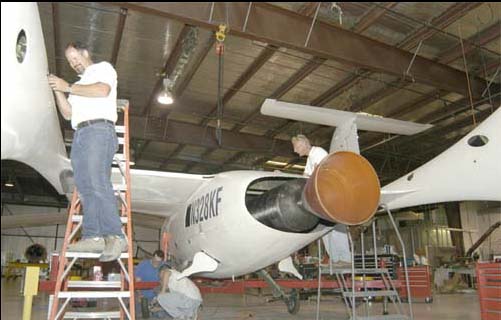
Tier One photo
|
|
|
|
|
The space race is heating up as private groups compete to put a human into space without government financing. More than two dozen teams worldwide are aiming to be the first, and claim a $10 million incentive called the X Prize. A California-based team hopes to launch its craft, called SpaceShipOne, into sub-orbital space today. The team brings together one of the world's richest people, high tech entrepreneur Paul Allen, with one of the most innovative aerospace designers, Burt Rutan. Rutan created the Voyager, the lightweight airplane that his brother, Dick Rutan, flew around the world without refueling in 1986 with copilot Jeana Yeager. This morning, if weather permits, SpaceShipOne will take off from the desert town of Mojave at 6:30. An aircraft will carry the spaceship to a height of 15 kms. (9.3 miles), then the ship's rockets will fire for 80 seconds. It will reach three times the speed of sound, and pierce the outer layer of the earth's atmosphere to briefly enter sub-orbital space. If everything goes as planned, the flight will also put Rutan and his team on the road to winning the $10 million Ansari X Prize. The award is named for Iranian-American entrepreneur Anousheh Ansari, who provided much of the funding. Twenty-seven teams from seven countries are competing for the prize, which requires two flights in the same spacecraft in a two-week period. The ships must carry a pilot and enough cargo space and weight equal to two additional passengers, who may be included on a future flight. A successful attempt Monday will likely lead to formal qualifying flights in coming months for the X Prize. Engineer and physician Peter Diamandis, chairman of the X Prize Foundation, says at least seven international teams have equipment ready for testing. As many as four have ships ready to fly this year. "And we hope that once one team does it, very much like the four-minute mile [running record], other teams will quickly follow on and repeat the feat," said Diamandis. One team ready to 'repeat the feat' is Canada's Da Vinci Project. Its founder and team leader, Brian Feeney, will pilot the WildFire spacecraft later this summer. The rocket vehicle will launch from the Western Canadian province of Saskatchewan. A helium balloon will carry the craft to a height of 24 kms. (about 15 miles), then the ship's engines will fire. "We climb to an altitude of 55 kms, where the engines burn out around just under mach four, and we continue on a steep parabolic curve into space," said Feeney. That distance is about 34 miles. His is a volunteer project with limited funding, but |
Feeney thinks his team has
a chance of winning the X Prize. He says no matter what happens over the
Mojave desert today, the contest is very much open, and competition with
Burt Rutan is friendly.
"We're cheering him on," he said. "In fact, I will be down there for it. We're somewhere in the late summer time frame for an all-out manned flight into space. And knowing something of Burt's potential X Prize flights, we feel that we're actually extremely competitive against him on that." The private race for space has inspired other ventures, that aren't focused on the X Prize, like Zero Gravity Corp., which hopes to put tourists in space. Alan Ladwig, a former official with the U.S. space agency NASA, now works for Zero Gravity, and says they'll start with the next best thing to being in space: feeling like you're in space, in an airplane. "Our first product is to provide the weightless experience for the general public, for researchers, for the film and entertainment industry, and for the government, where we will take people up in a Boeing 727, conduct a series of parabolas, and provide the weightless experience," explained Ladwig. Ladwig says those flights should begin this summer. He adds that space, once the preserve of governments, will soon be open to investors. "Now you're seeing private entrepreneurs get involved, in many ways kind of like the government started initial research 40 years ago on communications satellites, then that became something the private sector picked up," said Ladwig. "Similarly, you're seeing the whole space flight experience for individuals being something that was begun by the government and now being picked up by the private sector." X Prize Foundation Chairman Diamandis agrees, pointing to the role the commercial sector now plays in aviation and computers. "The government plays a role in getting things started, but it can't do it anywhere near as efficiently or even take the same level of risk in some cases to have breakthroughs," he said. "So private industry for space flight will eventually be operating all the travel from earth to low earth orbit, and eventually beyond." Diamandis says a spaceport to be built in Las Cruces, New Mexico, will host an annual space flight demonstration and competition beginning next year. Zero Gravity's Alan Ladwig says SpaceShipOne's flight today will have an effect on the public psyche, building enthusiasm for space travel. He says a successful flight will demonstrate that private companies like his have a future in space exploration, and that, in maybe just five years, those who can afford it will be making trips to the 'Final Frontier' for vacation. |
|
|
|
|
Mexican President Vicente Fox has wrapped up a three-day visit to the United States, calling for more economic cooperation in North America and urging U.S. officials to relax migration rules for Mexican immigrants. Speaking Friday in the midwestern state of Minnesota, Fox said Mexico, United States and Canada must work together to increase their |
productivity at home, or risk losing
more jobs to Asian economies.
He again called for easing restrictions on the flow of people between Mexico and the United States, despite security concerns after the Sept. 11, 2001 attacks, insisting that "Mexicans are not terrorists" but "honest people with dignity." At least 10 million Mexicans live in the United States. Up to half are believed to be illegal migrants. |
|
|
|
|
MONTREAL, Canada — The Olympic flame has made a stop here as it continues a global trip to all of the cities that have previously hosted the modern Summer Games. Montreal, which hosted the 1976 Olympics, is the 15th stop on a 33-city
tour on five continents. The flame began its trek on March 25 from the
games' ancient birthplace at Olympia. It will return to
|
Greece in time for the start of the
Athens Games on Aug. 13t.
Each of the 120 runners Sunday carried the flame about 400 meters along a 60-km. route. The torchbearers included 1992 Olympic swimming gold medalist Mark Tewksbury and 1996 Olympic diving bronze medalist Annie Pelletier. The Olympic flame will next visit Antwerp, Belgium today. |
|
|
|
|
|
|
|
|
| What we published this week: | Monday | Tuesday | Wednesday | Thursday | Friday | Earlier |
|
|