
Your daily English-language news
source
Monday through Friday
|
|
|
Your daily English-language news
source
|
|
|
|
|
|
|
|
|
|
|
|
|
|
|
|||||||||||
|
|
|||||||||||
|
|
|
|
A former teacher at the Costa Rican-North American Cultural Center was caught entering Chile with a pornographic video that may contain the image of an underage individual, according to Case Alianza. The child advocacy group said the person detained was a U.S. citizen, David Sussman, 42. He eventually was returned to the United States to face unrelated charges without ever returning to Costa Rica, said Casa Alianza. The organization said Sussman left Costa Rica Monday evening and was denied permission to enter Chile because he was using a Mexican passport, said Casa Alianza, quoting Chilean police. Casa Alianza said police in Chile found among |
others at least one video, made June
9, that may contain the image of an underaged female and said that Sussman
said that he thought at least one of the women videotaped was underage.
Casa Alianza did not say how old the underage female was. Although Casa Alianza said it hoped to bring Sussman back to Costa Rica, he was placed on a U.S.-bound plane in Panamá to face charges in Miami. "Casa Alianza has asked the Costa Rican authorities to request copies of the videos from the American police to determine whether the identity of the Costa Rican child in order to provide her with the necessary emotional support and to press charges against the American aggressor here in Costa Rica," said the organization. |
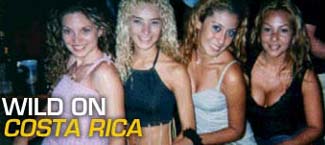
Country is featured
By the A.M. Costa Rica staff The E-entertainment show that promotes wild parties and heavy drinking will be featuring Costa Rica Tuesday with repeats Saturday and next Monday. It must be the alcohol because the show, Wild On, in its Web site, places Costa Rica in South America. But they got the isthmus part right. And they included a map. Said the Web promotion: "This South America hot spot is overflowing with dazzling volcanoes, beautiful beaches, cool clubs and miles of rain forest — this incredible isthmus is guaranteed to get you all wet." The show taped sequences at SBK and Ebony 56, both San José clubs, and El Pueblo tourist complex in north San José. Tamarindo, a hotel near Arenal and an outdoor adventure location also were included. The show premiers Tuesday at 10 p.m. with encores Saturday at midnight and 11 p.m. and June 23 at 2 a.m. and June 24 at midnight. Immigration sweeps continue By the A.M. Costa Rica staff Immigration officials were on the move over the weekend. They conducted sweeps in San José, Liberia, Limón, Jacó, Ciudad Quesada, Upala, Los Chiles and Puntarenas. Some 186 persons, including one British citizen grabbed in Liberia, were detained. There were wholesale deportations of Nicaraguans caught in the Northern Zone. In San José, immigration officials said they concentrated their efforts near the Hotel Del Rey and the pedestrian mall downtown. At least 55 persons were detained in the capital city. Saturday night fever By the A.M. Costa Rica staff A bit of shake, rattle and roll was felt Saturday night when an earthquake
hit near Quepos with enough force to be felt in the Central Valley. The
4.0 magnitude quake caused no damage.
|
|
|
As some investors hurt, the big quesiton remains |
|
|
A desperate Villalobos investor and reader, Bob Wilbert in Quepos, summarized his situation clearly in a letter Friday: "I'm stuck. I'm too old to work. I can't afford to move. . . . By the way about 6,000 other people are in the same fix. " As the Villalobos saga nears a year old, Wilbert represents a significant percentage of expats who live here and depended on their 3 percent a month interest from the Villalobos Brothers investment operation. After a police raid July 4 and the closing of the business Oct. 14,
the investors faced a number of choices.
Some like Wilbert are just hanging on. Some of these see Luis Enrique Villalobos Camacho and his brother Oswaldo as victims of a greedy government. The more pragmatic figure that government investigators will turn up evidence of money laundering and fraud. No one has been able to answer adequately what it was that the Villalobos Brothers did that generated nearly 3 percent monthly interest to their creditors. There has been no obvious dislocation in Costa Rican businesses during the year to suggest that the Villalobos Brothers were players in the commercial realm. No one has come forward to say "Hey, I used to borrow money from the Villalobos Brothers, and now the business had dried up." What they did and how they did it are key questions many investors fear to ask because they fear the answers. Investigators here found but $8 million, far less than the estimated $1 billion the Villalobos Brothers had in their care. Several defenders have cited gross percentages levied by credit card companies or banks to suggest that such a level of interest is normal in Costa Rica. Yet credit card companies have massive defaults and frauds that eat into the bottom line. The annual reports of such companies are freely available online and do not show such high net income. Some have suggested that the Villalobos Brothers made high returns by cashing U.S. checks and credit card billings here and shipping them to the United States for payment. If they did, they would not have to pay an estimated 42 percent per year to their mostly North American clientele. Any commercial bank would give them a much lower rate as a line of credit. Investors found different paths as responses to the Villalobos default. Some did nothing. They wrote off their investment and moved on. They were not the old ones. Others just left Costa Rica to an unknown future. Some from the United States and Canada just wrote off Costa Rica as a travel destination. About 600 filed criminal complaints against the company. These join with the prosecutor in alleging fraud. If the Villalobos Brothers took money and promised a high interest rate without a reasonable business plan to generate that percentage of return, they would have committed fraud. A ponzi scheme in which established investors are paid with the money from new investors is a possibility. Another group of investors, perhaps as many as 600, are supporting the United Concerned Citizens & Residents of Costa Rica. This is the informal group that hired José Miguel Villalobos Umaña for an estimated initial payment of $100,000. The lawyer Villalobos has been outspoken in saying that the Villalobos Brothers, who are not related, have done nothing criminal, but he probably is not privy to the entire case being built by the prosecutors. He never has said how the Villalobos Brothers made their money, the key fact. He probably does not know. The United Concerned Citizens generally believe that the Villalobos Brothers are honest, have been victims and that Enrique Villalobos, a fugitive, will return to pay off their creditors once government persecution is ended. A recent report by the Judicial Investigating Organization claims that Oswaldo Villaobos also was a key figure in both the Ofinter S.A. money exchange house and the adjacent informal loan business better identified with his brother. That raises the question why Oswaldo does not make payments of interest to investors, such as Bob Wilbert in Quepos. Oswaldo Villalobos is here although hospitalized and under custody. The report did not suggest how the Villalobos Brothers earned their high interest. The Judicial Investigating Organization report also did not show a flow of money that would have suggested an investment business with $1 billion |

. . . How did he make his money? on the books. The biggest transfers the audit report found were in the $2 million neighborhood. Other investors care not if the Villalobos Brothers are guilty or innocent of anything. They have joined with the Class Action Center to win the right to submit their financial claims to arbitration before an international panel. They say that Costa Rica was in the wrong allowing the Villalobos operation to continue for a number of years while it was not in compliance with Costa Rica law. Therefore, they say, Costa Rica should compensate them. They have an uphill fight. Even other investors are acting in their own behalf to find the fugitive Villalobos and try to get him to pay them their money due outside any official proceeding. These may be single investors or groups. A procession of investigators appeared after the Mall San Pedro office closed down. By January there were investigators from investor groups in Las Vegas, Atlanta and even Russia seeking information on Enrique Villalobos. Friday an Arizona private investigator announced that he is forming a group to locate Enrique Villalobos and sought funding from investors. Perhaps the strangest response came from Laura Kent of Cornerstone Investment Circle L.L.C., who hired a lawyer to threaten President Abel Pacheco with adverse publicity. The lawyer said Ms. Kent had given the Villalobos Brothers $8 million. The case of Ms. Kent raises an interesting point. The nature of Redwood City, Calif.- based business is not listed in state records. But if she had been accepting money from others for reinvestment with the Villalobos Brothers, she is under the jurisdiction of U.S. and California securities law. One person close to the investment scene but not a participant in the Villalobos operation said that at least one court case is expected in which an investor seeks compensation from the broker because of Villalobos investment advice that went sour. Despite the outcome of investigations by Costa Rica authorities, the Villalobos Brothers will still have to face possible action in the United States and perhaps Canada for unregistered securities dealings with citizens of those countries. Some U.S. investors made payments to the Villalobos operation to bank accounts located inside the United States. If Villalobos is detained in another country, the United States may enter the fray and seek his extradition to there to answer as-yet-unrevealed charges. In some letters of instruction to potential investors, payment was asked at the Whitney National Bank in New Orleans, according to one document held by A.M. Costa Rica. The U.S. securities market is tightly regulated. Meanwhile, any licensed securities salesman in North America who steered customers to Villalobos must be shaking in his boots. The Villalobos borrowing operation was not even licensed in Costa Rica, although Ofinter was licensed to exchange money. Such involvement with offshore, informal investment opportunities by a licensed securities broker is a career-ending event when the transaction turns sour. Plus the salesman leaves himself and his firm open to civil suit. Investor groups, U.S. and Canadian embassy staffers and others have been less than responsive to individuals such as Bob Wilbert in Quepos. There have been no organized efforts to help destitute North Americans who followed a dream to Costa Rica and are now stuck with the consequences. One investor said clearly when asked about possible charitable efforts: "The hell with them. I just want MY money back. I’m not going to do anything for them." |
| What we published this week: | Monday | Tuesday | Wednesday | Thursday | Friday | Earlier |
|
|


 E-mail:


