|
||
|
A.M. Costa Rica
Your daily English-language news source Monday through Friday |
||
 |
 |
 |
|
|
 |
||||||||||||||||||||||||||
|

|
|||||||||||||||||||||||||
 |
||||||||||||||||||||||||||
|
|
|||||||||||||||||||||||||
 |
 |
| What we published this week: | Monday | Tuesday | Wednesday | Thursday | Friday | Earlier |
|
|
|
|
|
|
|
Food |
|
Jo
Stuart |
|
|
| A.M. Costa Rica's Second news page | |||||||||
| San José, Costa Rica, Thursday, June 14, 2012, Vol. 12, No. 118 | |||||||||
|
|
|
|
|
|
|
Food |
|
Jo
Stuart |
 |
 |
 |
|
Rates at Juan Santamaría
are going up 6.72 percent By
the A.M. Costa Rica staff
Airline companies will have to pay more at Juan Santamaría airport. The nation's price regulating agency has approved a 6.72 percent increase in fees there. An increase was sought by the Consejo Técnico de Aviación Civil, which wanted hikes in the neighborhood of 25 percent. Rates were last increased in September. A typical passenger jet that spends 90 minutes at the airport will pay $511 for a number of services once the rates are published. The current amount is $479. That includes a landing fee, the use of the boarding lounge, lighting and use of the infrastructure, according to the published rates. That does not cover costs such as buying fuel. Airlines typically adjust their rates to cover costs at destinations. Rice farms carrying plea to government today By
the A.M. Costa Rica staff
Rice producers are meeting today with central government officials in hopes of getting more incentives for their operations. A spokesman for the producers said that rice farmers were going out of business and that many have their equipment for sale. The meeting is at 10 a.m. Costa Rica has been subsidizing its rice farmers for years, but international treaties now limit what can be done. In addition, rice from foreign producers is cheaper than the grain produced here. Rice farmers were major protesters against the Free Trade Treaty with the United States because they knew that rice from there could be sold here for less cost. Low pressure area moves away from Costa Rica By
the A.M. Costa Rica staff
The threatening clouds are passing away, according to the Instituto Meteorológico Nacional. The low pressure area that dominated the nations' weather since late Saturday has given way to typical rainy season weather. San José saw light rain Wednesday afternoon but not the thunderstorms and lightning of previous days. However, the weather institute warned that grounds are soaked in some areas creating the possibility of more landslides. One closed Ruta 32 early Wednesday.
|
||||||||||||||||||||||||||||||||||
 |
|||||||||||||||||||||||||||||||||||
|
|
|
|
|
|
|
Food |
|
Jo
Stuart |
| What we published this week: | Monday | Tuesday | Wednesday | Thursday | Friday | Earlier |
| The contents of this page and this Web site are copyrighted by Consultantes Río Colorado 2012 and may not be reproduced anywhere without permission. Abstracts and fair use are permitted. Check HERE for details | ||||||
 |
 |
| A.M. Costa Rica Third
News Page |
|
| San José, Costa Rica, Thursday, June 14, 2012, Vol. 12, No. 118 | |
|
|
|
|
|
|
|
Food |
|
Jo Stuart |
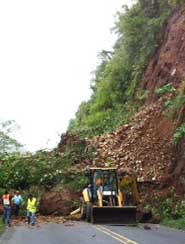
Backhoe driver begins the lengthy job of clearing the two-lane highway of the thousands of cubic yards of rock and dirt. |
 Ministerio
de Obras Públicas y Transportes photo
|
|
Braulio Carrillo
highway likely to be closed for two days
|
|
|
By
the A.M. Costa Rica staff
The highway from San José to Limón, Ruta 32, will be closed for at least two days as workers try to clear some 6,400 cubic meters (8,370 cubic yards) of dirt and rock that fell on the roadway early Wednesday. The landslide appears to have been provoked by several days of rain. This is the Braulio Carrillo highway that is a key route to the east and carried a lot of truck traffic. Now vehicles will have to travel on an alternate route through Turrialba. Spokespersons for the Ministerio de Obras Públicas y Transportes warn that the time needed might be made longer by bad weather. |
The location is 10 kilometers
(six miles) north of the Zurquí tunnel, a
spot that is not considered prone to slides even though the soil rises
up nearly vertically. Officials said that the dirt and rock dumped on the two-lane road was at least eight meters high, some 26 feet, and 100 meters long, about 330 feet. Motorists also can take a route through Vara Blanca to San Miguel de Sarapiquí and La Virgen. That is a hilly route not suitable for large trucks. Ruta 32 frequently is closed by slides during the rainy season. Officials have admitted that the entire route through the mountains needs to be rebuilt. |
| Watson has been consistent with his
description for years |
|
|
By
the A.M. Costa Rica staff
One way top lawyers can tell if a witness is lying is by comparing what is being said now with what was said in the past. Lies are a lot harder to remember than the facts. So when Paul Watson, the environmental crusader, says that shark fishermen are trying to extort money from him, the record can weigh the man's claim. Watson, of course, is the leader of Sea Shepherd Conservation Society who is on bail in Germany as Costa Rica seeks his extradition. He has been saying on YouTube videos that no one was hurt and no ship was damaged in an encounter that his “Ocean Warrior” vessel had in Guatemalan waters in 2002. Costa Rican diplomatic and judicial officials are moving quickly to put Watson into their custody. But what does the record show? When the Poder Judicial here announced a surprise trial for Watson in 2006, a reporter contacted him in the United States. His response is in an email editors uncovered Wednesday in the A.M. Costa Rica files. It dates from Aug. 21, 2006. Said Watson: “Well it appears that the charges would be dropped if I just pay the fishermen 100,000K. This is very strange because it sounds like a settlement in a civil case. If I had in fact committed a crime, I don't see how the state can drop charges in return for a payment to an aggrieved party.” Watson, of course, was unfamiliar with the Costa Rican judicial custom of criminals buying their way to freedom. “I did not damage any property,” he continued. “I did not |
threaten
anyone's life, nor did I even come close to hurting anyone. The entire
affair was videotaped by a number of cameras. The fishermen's charges
have no evidence other than their verbal claim. I have many more
witnesses than they do. The problem is that I can't be guaranteed a
fair trial. The very fact that they would jail me for up to a year
before hearing the case is unacceptable.” The Costa Rican judiciary has a long history of placing foreigners and citizens in preventative detention for long periods. “I cannot see paying illegal shark finners to withdraw an accusation that has no evidence to back it up,” he said. Watson also made this pledge: “If I am arrested, we are prepared to spend much more that $100K on a defense and an opportunity to expose this farce to the rest of the world. It will certainly be an opportunity to expose Costa Rica's continued corrupt involvement with the illegal shark fin trade.” Finally, he said: “It seems strange that after donating tens of thousands of dollars worth of equipment to the rangers of Cocos Island that this is the reward that I get from the Costa Rican government.” In a video made last week, Watson said that his case had been reviewed by judicial officials twice in 2002 and the charges were dropped. His apparent frustration can be shared by a number of foreign investors here who have experienced prolonged and indecisive legal proceedings. Perhaps coincidentally, the security ministry announced the arrest of three fishermen captured at sea this week with shark fins in their possession. Cutting fins from sharks and dumping the crippled living creature back into the sea is a crime punishable by a fine. |
 |
| You need to see Costa Rican tourism information HERE! |
|
|
|
|
|
|
|
Food |
|
Jo
Stuart |
| What we published this week: | Monday | Tuesday | Wednesday | Thursday | Friday | Earlier |
| The contents of this page and this Web site are copyrighted by Consultantes Río Colorado 2012 and may not be reproduced anywhere without permission. Abstracts and fair use are permitted. Check HERE for details | ||||||
 |
 |
||||
| A.M. Costa Rica's Fourth News page | |||||
| San José, Costa Rica, Thursday, June 14, 2012, Vol. 12, No. 118 | |||||
|
|
|
|
|
|
|
Food |
|
Jo
Stuart |
 A.M. Costa Rica file graphic
Dark line traces the
navagational options over the top of the North American continent. |
|
| Warmer temperatures open up the northern
shipping routes |
|
|
By
the A.M. Costa Rica staff
The predictions of doom that surround the slight temperature change being experienced by the earth nearly always overlooks the benefits of a warmer planet. Vast stretches of the northern hemisphere have a summer too short for most food production. Russians probably would prefer pineapples than the cabbage that is grown in many parts of that country. Nikita Krushchev, the former Soviet premier, had a long-term and ultimately unsuccessful program to develop a strain of wheat that would survive the harsh Russian winters. Farmers in Alaska and in Canada are well acquainted with early frosts and short growing seasons. A warmer planet is likely to bring some benefits to these areas. However, such topics probably will not be emphasized later this month when the United Nations holds its Conference on Sustainable Development. But there may be some surprises in the future. Panamá is building a $5 billion third lane for the canal there. In Nicaragua President Daniel Ortega is promoting a canal from the Caribbean to the Pacific that may cost up to $30 billion. But up north, the ice is receding in both the Northwest and the Northeast passages. The Northeast Passage is the route over the top of Russia. The Alfred Wegener Institute for Polar and Marine Research reported this week that this area is expected to be free from ice again in this northern summer. The route from Europe to Asia |
is shorter than the traditional
route through
the Suez Canal. The Northwest Passage is over the top of Canada and Alaska. That, too, is becoming ice free for several months of the year. This passage has been the holy grail of explorers since Europeans started probing the North American continent. The ice here also is being reduced, and some navigation is possible. More than 100 heads of state and government, along with thousands of parliamentarians, mayors, U.N. officials, chief executive officers and civil society leaders are expected to attend U.N. conference in Rio de Janeiro, from June 20 to 22. Among them will be Costa Rican president Laura Chinchilla. The U.N. says the purpose is to shape new policies to promote prosperity, reduce poverty and advance social equity and environmental protection. Representatives from various countries have been working on draft documents for the session, said the U.N. “These last three days are going to be absolutely crucial for diplomats,” said Brice Lalonde, the executive coordinator of the conference. “Delegations are going to be working day and night, dividing themselves into splintered groups to work more thoroughly on each issue, which is something that they have accepted to do only for the last few days.” He was quoted in a U.N. news release Wednesday. The talks are the third and final session of the conference's preparatory committee, which will continue deliberations until Friday. The committee’s various groups will discuss issues such as the management of water, education, health, sustainable transport, desertification and climate change, among others, said the U.N. |
 Ministerio de Gobernación,
Policía y Seguridad Pública photo
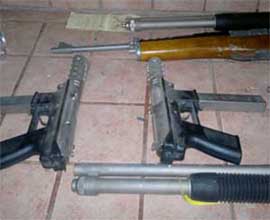
This is the assortment of
weapons police uncovered. |
|
| Eviction leads to the discovery of a
stash of weapons |
|
|
By
the A.M. Costa Rica staff
Police officers encountered an abandoned stash of weapons Wednesday when they re-entered a property that they had cleared Tuesday. Found were three 9-millimeter automatics, two rifles, and two shotguns along with appropriate ammunition. The location was a place called La Finca del Alemán in San Francisco de Cartago. The property is next to the Hotel Río |
Perlas, said the Ministerio de
Gobernación, Policía y Seguridad Pública. The ministry's Grupo de Apoyo Operacional in Cartago showed up Tuesday to perform an eviction, but no one was there. The property appears to have been lost because an owner defaulted on a loan. At that time police said they found one weapon. However, the individuals who recovered the property called police back Wednesday to show them the stash of weapons that had been encountered. |
|
|
|
|
|
|
|
Food |
|
Jo
Stuart |
| What we published this week: | Monday | Tuesday | Wednesday | Thursday | Friday | Earlier |
| The contents of this page and this Web site are copyrighted by Consultantes Río Colorado 2012 and may not be reproduced anywhere without permission. Abstracts and fair use are permitted. Check HERE for details | ||||||
| A.M.
Costa Rica's Fifth news page |
 |
||||||||
| San José, Costa Rica, Thursday, June 14, 2012, Vol. 12, No. 118 | |||||||||
|
|
|
|
|
|
|
Food |
|
Jo
Stuart |
 |
 World opinions
are mixed
on U.S. and Obama reelection By
the A.M. Costa Rica wire services
A new international opinion poll indicates that U.S. President Barack Obama and his policies are more favorably regarded in Europe than in the Muslim world. The U.S.-based Pew Research Center conducted a survey of people living in 21 nations and found that attitudes towards the U.S. are generally more positive now than in 2008, when Obama was elected. The center said the biggest improvements in America's image have occurred among Europeans, but that in a number of strategically important Muslim nations America's image has not improved. The survey found a sizable majority of Europeans remain largely confident in Obama and approve of his policies, and that has translated into sizable support for the president's re-election bid this year. The survey also discovered wide support for Obama and his re-election in Japan and Brazil. But less than 30 percent of those surveyed in Egypt, Tunisia, Turkey and Jordan express confidence in Obama, and there is little enthusiasm in the Middle East for a second term for the president, with majorities in Egypt, Jordan and Lebanon opposed to his re-election. However, Obama receives higher approval ratings than his predecessor, George W. Bush, both in Europe and in many predominantly Muslim nations. The Pew survey also found worldwide opposition to President Obama's increasing use of unmanned aircraft, known as drones, to kill suspected terrorists. In 17 of 20 nations, more than half of those responding disapprove of drone attacks in nations like Pakistan, Yemen and Somalia. But the drone attacks are approved by 62 percent of Americans. In another finding, a majority of respondents, especially in Europe, believe China has overtaken the United States as the world's top economic power. The Pew Research Center says more than 26,000 people took part in the survey, which was conducted from March 17 to April 20. U.S. defense secretary warns of cyber attacks By
the A.M. Costa Rica wires services
U.S. Defense Secretary Leon Panetta says he is very concerned about the possibility of a major cyber attack that he says could paralyze U.S. government and financial systems. The warning came as Panetta cautioned U.S. lawmakers against major cuts to the defense budget. The Pentagon has already agreed to cut $450 billion from its budget over a period of 10 years. It faces an additional $500 billion in cuts under an automatic mechanism known as sequestration after members of Congress failed to reach an agreement to reduce the nation’s deficit. Secretary Panetta and the top U.S. military officer, Gen. Martin Dempsey, went before members of the Senate to make a case against the cuts, which they said would result in job losses and funding for operations including those in Afghanistan. Panetta warned the cuts would spell disaster for U.S. defense. “It would guarantee that we hollow out our force and inflict severe damage on our national defense. I think you all recognize that sequester would be entirely unacceptable and I really urge both sides to work together to try to find the kind of comprehensive solution that would de-trigger sequester and try to do this way ahead of this potential disaster that we confront," he said. The defense secretary warned of another possible disaster: a cyberattack on the nation’s vital information systems, one with a magnitude similar to Japan’s 1941 attack on Pearl Harbor that triggered the U.S. entry into World War II. Panetta said America’s enemies are developing cyber capabilities and are attempting hundreds of attacks each day on the country’s key systems. He said the U.S. military is working to stay prepared. “I’m very concerned that the potential in cyber to be able to cripple our power grid, to be able to cripple our government systems, to be able to cripple our financial systems would virtually paralyze this country and as far as I’m concerned that represents the potential for another Pearl Harbor as far as the kind of attack that we could be the target of using cyber," he said. Defense officials also raised concerns about their ability to pay for unbudgeted items including the cost of rerouting supplies to NATO troops in Afghanistan as Pakistan’s closure of supply routes continues. Panetta said the cost of sending supplies into Afghanistan through alternate routes is about $100 million a month. |
|
||||
|
|
|
|
|
|
|
Food |
|
Jo
Stuart |
| What we published this week: | Monday | Tuesday | Wednesday | Thursday | Friday | Earlier |
| The contents of this page and this Web site are copyrighted by Consultantes Río Colorado 2012 and may not be reproduced anywhere without permission. Abstracts and fair use are permitted. Check HERE for details | ||||||
| A.M.
Costa
Rica's sixth news page |
|
|||||||||
| San José, Costa Rica, Thursday, June 14, 2012, Vol. 12, No. 118 | ||||||||||
|
|
|
|
|
|
|
Food |
|
Jo
Stuart |
 |
Latin America news |
Watchdog group
criticizes
Ecuador's Corea on media Special
to A.M. Costa Rica
The closure of another independent media outlet and numerous public comments made by President Rafael Correa attacking private media are an alarming illustration of Correa’s growing attempts to silence critical media, said a U.S. watchdog organization. Freedom House called on President Correa to retract his order preventing government officials from speaking to private media and to allow all journalists and media organizations to operate without interference. During his weekly radio address Satruday, Correa asked government ministers to stop granting interviews to private media whom he claims are corrupt. Political coordinator Betty Tola confirmed at a press conference on Tuesday that cabinet members would refuse to grant interviews to private media, because he said they received clear instructions from Correa. These actions were demonstrated when the minister of interior Jose Serrano canceled his interview with the television station Ecuvisa, said freedom House. During the 42nd Session of the General Assembly of the Organization of American States, Correa attacked the Inter-American Commission on Human Rights and its expert on freedom of expression, claiming they were working to protect private media interests. “Freedom of expression continues to be severely threatened in Ecuador,” said Daniel Calingaert, vice president of policy and external affairs at Freedom House. “What happens in Ecuador could have negative repercussions throughout the region, which has witnessed a rapid decline in press freedom. Freedom House urges the international community to keep a close watch on the climate for media in Ecuador and to raise concerns about this issue, both publicly and privately, with Correa’s administration.” President Correa’s campaign against media has included the closure of independent radio and television stations across the country. On June 6, a radio station in the city of Ambadio – Radio Net – was shut down. Radio Net was the fifth media outlet closed in Ecuador within the last two weeks. The National Communications Council used the telecommunications act to justify the closure of these media outlets. The agency claimed that Radio Net was closed due to non-compliance with the law and for failing to pay its operations fees for the last six months. Prior to Radio Net’s closure, a television station owned by the Provincial Government of Morona Santiago, and a radio station in Sucumbíos were closed on May 23. The following day, authorities closed a television and radio station in the Amazonian province of Napo. |
|
Latin
American news feeds are disabled on archived pages.
|
|
| Costa Rican News |
AMCostaRicaArchives.com |
Retire NOW in Costa Rica |
CostaRicaReport.com |
|
|
|
|
|
|
|
Food |
|
Jo
Stuart |
| What we published this week: | Monday | Tuesday | Wednesday | Thursday | Friday | Earlier |
| The contents of this page and this Web site are copyrighted by Consultantes Río Colorado 2012 and may not be reproduced anywhere without permission. Abstracts and fair use are permitted. Check HERE for details | ||||||