|
 |
Costa Rica Your daily |
 |
|
|
|
|
||||||||||||||||||||||||||||||
 |
|||||||||||||||||||||||||||||||
|
|
||||||||||||||||||||||||||||||
 |
|
|
|
|
|
|
|
|
| What we published this week: | Monday | Tuesday | Wednesday | Thursday | Friday | Earlier |
|
|
 |
| A.M. Costa Rica Second newspage |
 |
||||||||
| Home |
Tourism |
Calendar |
Classifieds |
Entertainment |
Real
estate |
Rentals |
Sports |
About
us |
|
| San José, Costa Rica, Friday, May 28, 2010, Vol. 10, No. 104 | |||||||||
 |
| Costa Rica Expertise Ltd http://crexpertise.com E-mail info@crexpertise.com Tel:506-256-8585 Fax:506-256-7575 |
 |
 Click HERE for
great
hotel discounts
|
|
Policemen who
aided murders
get 72 years each in prison By the A.M. Costa Rica staff
A court in Limón gave two Fuerza Pública officers a symbolic 72 years each for delivering two young men to their executioners. The police officers are Walter Angulo Durán and Jorge Jiménez Saldaña. Two other men were convicted and sentenced to 70 years each for the actual murders. They are Mauricio Ocampo Cordero and Johansy Mora Rojas. Under Costa Rican law prisoners can only serve 50 years, but judges frequently impose much longer sentences to stress the magnitude of the crime. Angulo and Jiménez, the policemen, used their authority to round up four young men in Cahuita. With drawn guns they confronted the four in the local park, tied them up and eventually delivered them to members of a rival drug gang in Valle de las Estrellas, also on the Caribbean coast, according to testimony. Ocampo and Mora took a knife to their hostages. Two, Roy Sotela Prendergast, 23, and Natanael Rodríguez Obregón, 17, died. Another man suffered serious injuries. A fourth man fled and survived. That happened June 14, 2008. Flu is making a comeback with two deaths reported By the A.M. Costa Rica staff
Health officials are concerned by the resurgence of swine flu in Costa Rica. At least two persons have died. Cases have been confirmed in Pavas, Oremuno de Cartago, Los Chiles and in the Talamanca mountains. A case in Los Chiles involved a Nicaraguan man who came across the border seeking medical help and then died. The second victim there was a Costa Rican man who also lived near the border. Health officials also are trying to get more information on the death of three children in the Talamancas due to respiratory problems. Many Costa Ricans already have been vaccinated against swine flu. The Caja Costarricense de Seguro Social conducted a campaign a year ago. Amnesty International sees bright spot in Latin America By the A.M. Costa Rica wire services
There is still no scarcity of poverty and human degradation around the world. But Amnesty International says in its latest annual human rights report that people are being held accountable for some of the worst violations. "We're very encouraged by the trend for example in Latin America where we had three former heads of states brought to justice from Peru, Uruguay and Argentina," said Claudio Cordone, interim secretary general. But Cordone says many countries are limiting progress in international justice by acting only when it is politically advantageous. "We still see governments who hold themselves above the law, for example by not accepting the jurisdiction of the International Criminal Court," he said. "Among those are seven of the G20 countries. And also, we see governments shielding their political allies from international scrutiny." The countries that have not signed up for the ICC include China, Russia and the United States. Cordone says the criminal court is an essential tool to fight human rights abuses. "The court is there to act when governments are unable or unwilling to bring people to justice," he said. Amnesty International criticized the United States for continuing to detain terrorist suspects at the Guantanamo Bay detention center despite President Barack Obama's commitment to close the facility by the beginning of 2010. Cordone also says repression remains a major problem around the world. He cites Iran's actions following its disputed presidential election last June. "People have been arbitrarily arrested, have been tortured," he noted. "Even the government had to acknowledge that actually women were raped in custody." Dead man was fireman By the A.M. Costa Rica staff
A U.S. citizen who died in La Fortuna de San Carlos earlier this week has been identified as 54-year-old Thomas Ruben Baylon, a retired San Francisco, California, fireman. A friend said that the man lived alone for several years and that he used a false name because of some unspecified legal problems in the United States. Investigators still do not know if the case is a suicide or a murder. The man died from a stab wound in the neck.
|
||||||||||||||||||||||||||||||||||||||||||||||
 |
|||||||||||||||||||||||||||||||||||||||||||||||
| Home |
Tourism |
Place
classified ad |
Classifieds |
Entertainment |
Real
estate |
Rentals |
Sports |
About
us |
|
| What we published this week: | Monday | Tuesday | Wednesday | Thursday | Friday | Earlier |
| The contents of this page and this Web site are copyrighted by Consultantes Río Colorado 2001, 2002, 2003, 2004, 2005, 2006, 2007 and 2008 and may not be reproduced anywhere without permission. Abstracts and fair use are permitted. Check HERE for details | ||||||
 |
| A.M. Costa Rica third newspage |
 |
||||||||
| Home |
Tourism |
Calendar |
Classifieds |
Entertainment |
Real
estate |
Rentals |
Sports |
About
us |
|
| San José, Costa Rica, Friday, May 28, 2010, Vol. 10, No. 104 | |||||||||
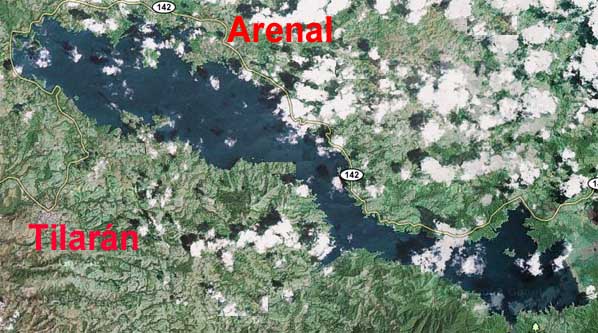
| Arenal blows top The ever-active Volcán Arenal erupted violently about 5 p.m. Thursday. The chief of the Fuerza Pública in nearby La Fortuna took this photo. He is Junier Villalta Rubí. Monday the mountain dumped part of its upper cone downhill, creating towering ash flows. |
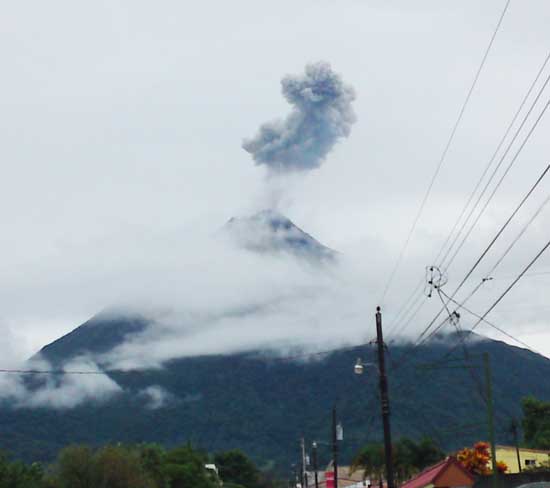 Photo by Photo by Junier Villalta
Rubí
|
| Experts begin to assess damage caused by first big storm |
|
|
By the A.M. Costa Rica staff
Engineers and technicians from the emergency commission and other agencies went to work Thursday to evaluate the damage caused by heavy rains that ravaged the Pacific coast. Rains slackened Thursday. Automatic weather stations in Guanacaste reported just an inch of rain since 7 a.m.. But the Instituto Meteorológico Nacional said that the low pressure area in the Pacific near Guatemala probably would stick around for awhile. This is the source of the atmospheric instability. The U.S. Hurricane Center in Miami said that the unstable area might soon turn into a tropical depression and that it had about a 60 percent chance of becoming a full-blown cyclone. Although some flooding victims left shelters Thursday to return to their homes, the national emergency commission estimated that there still are 160 persons in public buildings and churches waiting out the flood waters. The commission said that 80 communities were affected and 17 bridges had some damage. Some collapsed. In all, there were more than 180 reports of damage or other problems due to the rain. The flooding resulted in a meeting Thursday afternoon in Casa Presidencial directed by Alfio Piva, the first vice president. Vanessa Rosales and her staff gave reports. She is the executive president of the Comisión Nacional de Prevención de Riesgos y Atención de Emergencias. Afterwards, Piva released a statement saying that the central government so far was satisfied by the emergency response. |
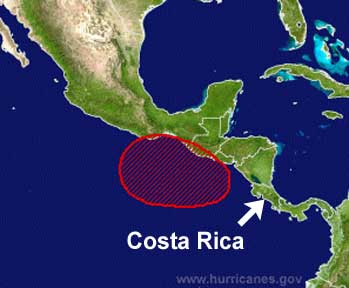 U.S. Hurricane Center/A.M. Costa
Rica graphic
Red oval shows the extent of low pressure areaAlthough there was flooding in Puntarenas Centro and problems in Golfito, Esparza and Garabito, the bulk of the emergency was on the Nicoya peninsula in the cantons of Hojancha, Nandayure, Nicoya and Santa Cruz. Communities in the central and north Pacific continue under a weather alert. The low pressure area has parked itself off the coast of Guatemala. The U.S. Hurricane Center said the system was expected to drift to the northeast and continue to bring rain and rain-related problems to the northern portion of Central America. Some areas on the northern Pacific got as much as eight inches of rain Wednesday, so rivers still are raging out of their banks. A number of communities face calf- or hip-deep water in the streets and sometimes in the homes. |
| There are the delights of slow travel and then there is the
bus |
|||
| My friend Steve
sent me an article about “slow travel.” It is a relative and
offshoot of slow food. It is about traveling by train or boat
instead of inside a speeding "aluminum sausage." Pauline Kenny and
Steve Cohen took on the subject of slow travel in 2002 and started a
blog that has gone from 400 to 13,000 followers. My second
reaction after reading the article (my first was "it’s about time.")
was "why didn’t I think of that?" I have been extolling the pleasures of the journey, not just the destination, for a long time. Now I discover (on the discovery channel known as Google) that there are blogs and chat rooms, Facebook entries, travel agencies and home exchanges devoted to the general subject of slow travel. But of course, now the time is riper for people to consider getting from point A to point B in a more leisurely fashion, and once you’re there, to spend some time versus rushing to the next destination. Many people have been thrown off the fast track of living in the past couple of years and have plenty of time (if not money) to spend on the experience of the journey. Even those who work find that they can get work done taking a more leisurely trip, either by commuting or letting someone else do the driving. I have written about the experience of becoming part of the process. At the time I was referring to those moments when you are so involved in what you are doing that you become egoless or at the least, your ego is dormant. You are totally part of the process of doing. For some it is their writing. Others it is music or perhaps working on a mathematical problem. Or as a Buddhist might like us to do, even mopping the floor. Traveling by train or bus or ship can do it — put you in the present instead of thinking about or planning the future. I imagine a long trip by car might be equally effective, (except for the driver, and I’d want to choose the driver). I have crossed the United States via land several times. One of my most pleasurable trips was by car with my husband and two small children. On the trip, we lived each day concerned only about what or where to eat and where to sleep at the end of the day. I have also enjoyed the train trips I have taken, and soon I will be embarking upon another. The last long one was over five years ago. I remember all of my train trips and very few of those by plane. One of my favorites was taking the train in Europe from Athens to Oslo. Train stations are usually elegant |
structures in the heart of the city, now many with stores and restaurants and lots of people. This time I will fly to New Mexico to visit with my children, and then go to Fort Lauderdale to see my sister and her family. I will leave Albuquerque on Amtrak, which does not travel as the crow flies so it will take a little over three days. I like that. Only a ship is more carefree than a train. My favorite part is dining on a train. The food is usually very good, the service of another, more genteel era, and I learn about other lives. Often the conversation is nostalgic as we share our previous train experiences. The last time I was in the U.S. on a train, people were reluctant to express their opinions about the current political and religious climate. I wrote that I feared there might be another civil war, one between the red states and the blue states. I should have said a war of incivility between the two. It will be very interesting this time if the subject of current politics comes up — and I am sure it will. I just hope there doesn’t come a point when they throw Josephine from the train. There is one kind of slow travel I don’t enjoy, and I am experiencing more and more each week, namely the bus rides through the city of San José. The traffic is horrendous, and drivers’ behavior does not help. When will people learn that if the traffic is backed up to the intersection, don’t drive into it, even if you have a green light. All that does is block the traffic on the cross street and really infuriate people. The other day we sat in the Cementerio Estadio bus for 10 minutes, stalled in traffic on Eighth Avenue going west. Then we moved 50 feet and stopped again for 10 minutes. Had we been anywhere near a single cross street that was free of traffic, I would have thrown myself from the bus. |
||
 |
| You need to see Costa Rican tourism information HERE! |
| Home |
Tourism |
Place
classified ad |
Classifieds |
Entertainment |
Real
estate |
Rentals |
Sports |
About
us |
|
| What we published this week: | Monday | Tuesday | Wednesday | Thursday | Friday | Earlier |
| The contents of this page and this Web site are copyrighted by Consultantes Río Colorado 2001, 2002, 2003, 2004, 2005, 2006, 2007 and 2008 and may not be reproduced anywhere without permission. Abstracts and fair use are permitted. Check HERE for details | ||||||
| A.M. Costa Rica fourth news page |
 |
||||||||
| Home |
Tourism |
Calendar |
Classifieds |
Entertainment |
Real
estate |
Rentals |
Sports |
About
us |
|
| San José, Costa Rica, Friday, May 28, 2010, Vol. 10, No. 104 | |||||||||
 |
xx |
 |
| U.S. seeks non-profit help to stem the
drug trade here |
||
|
By the A.M. Costa Rica staff
The U.S. Embassy is ready to give away from $100,000 to $550,000 to any organization that can come up with ideas to fight drugs here. The embassy sent out a notice Thursday in which it said that non-profit organizations were eligible to submit proposals to win the grant money. In addition to crime in general, the proposal seeks projects to deter the use of drugs and interaction with drug traffickers and/or increase security and safety in one or more of the three areas: at risk youth, fishing communities, and/or communities adjacent to land borders, the embassy said. The money is part of the Central America Regional Security Initiative, which used to be called the Merida Initiative. The deadline is June 25, and the embassy said it is looking for programs or projects that will continue after the 12 months of U.S. government funding ends. The application process is detailed. The embassy did not say why it was restricting participation to non-profit groups, although the requirement probably comes from Washington. Said the embassy: Proposals are being sought that will address, among other things, methods for involving youth in productive, healthy, and/or vocational activities offering alternative sources of income and social services to fishing |
communities and
communities around border areas. In other words, the
U.S. government is trying to cut down on the number of young people who
are involved in drug smuggling or providing supplies to Colombian drug
smugglers on the Pacific. The State Department's Bureau of Western Hemisphere Affairs is coordinating the security initiative. "Insecurity and violent crime is near the top of citizens’ concerns in most countries in the Americas, and the President has recommitted the United States to creating practical partnerships in the hemisphere to advance shared interests and protect our citizens," the bureau said in a related outline. "This cooperative approach is based on a deeper recognition of new and traditional threats to the safety of our citizens in the hemisphere. This strategy is grounded in our shared responsibility for addressing such challenges; the critical importance of political will, rule of law, and effective institutions of governance; and the common aspirations for secure, prosperous and inclusive societies." The bureau also said: "We believe that ongoing citizen safety initiatives in Colombia and Mexico with their well-established implementation mechanisms and robust funding can be useful catalysts for promoting the sharing of expertise and regional law enforcement cooperation, particularly among the Central American and Caribbean countries." |
|
| Mrs. Clinton expresses concern over
Brazil-Iran contact |
||
|
By the A.M. Costa Rica wire services
Secretary of State Hillary Clinton said Thursday the United States has serious disagreements with Brazil over its efforts to mediate with Iran over its nuclear program. But Clinton stressed the United States desire for good relations with the emerging South American power. U.S. officials have privately expressed irritation that Iran has used Brazilian mediation efforts to try to defuse pressure for new international nuclear sanctions. U.S. officials also are concerned about Iranian links with other Latin American governments, including Nicaragua and Venezuela. But Mrs. Clinton's comments Thursday at Washington's Brookings Institution were the most extensive by a senior Obama administration official in public on the issue. Mrs. Clinton, who outlined a new U.S. national security policy at the Washington research organization, said the United States wants enduring good relations with Brazil, which she said is a responsible and effective partner with Washington on many issues. But she said Iran used Brazilian diplomacy spearheaded by President Luis Inacio da Silva to try to stave off new U.N. Security Council sanctions. "I don't know that we agree with any nation on every issue," said Secretary of State Hillary Clinton. "And certainly we have very serious disagreements with Brazil's diplomacy vis-à-vis Iran. And we have told President Lula, and I've told my counterpart the foreign minister that we |
think buying time
for Iran, enabling Iran to avoid international unity
with respect to their nuclear program, makes the world more dangerous,
not less.'' The foreign minister is Celso Amorim. Earlier this month, Iran told visiting Brazilian and Turkish leaders that it was ready to accept a big-power proposal made last year to export more than one thousand kilograms of enriched uranium, and obtain fuel for a Tehran research reactor in return. But the fact that Iran more than doubled its uranium stockpile since the proposal was made in October lessened the significance of its export pledge. It also refused to accept a key element of the original proposal, that it suspend an enrichment program seen by the United States and key allies as weapons related. Despite the Iranian gesture, the permanent U.N. Security Council member countries announced a day later they had agreed on a new draft sanctions resolution against Iran. Mrs. Clinton said she believed President da Silva and Foreign Minister Amorim were acting in good faith but that the Iranians were not. Mrs. Clinton said the disagreement over Iran does not in any way undermine the U.S. commitment to seeing Brazil as a friend and partner in the hemisphere and beyond. She praised Brazil for among other things, its lead role in the U.N. peacekeeping effort in Haiti and earthquake relief and recovery efforts there. |
|
| Home |
Tourism |
Place
classified ad |
Classifieds |
Entertainment |
Real
estate |
Rentals |
Sports |
About
us |
|
| What we published this week: | Monday | Tuesday | Wednesday | Thursday | Friday | Earlier |
| The contents of this page and this Web site are copyrighted by Consultantes Río Colorado 2001, 2002, 2003, 2004, 2005, 2006, 2007 and 2008 and may not be reproduced anywhere without permission. Abstracts and fair use are permitted. Check HERE for details | ||||||
| A.M. Costa Rica fifth news page |
|||||||||
| Home |
Tourism |
Calendar |
Classifieds |
Entertainment |
Real
estate |
Rentals |
Sports |
About
us |
|
|
|
|||||||||
 |
 |
| Home |
Tourism |
Place
classified ad |
Classifieds |
Entertainment |
Real
estate |
Rentals |
Sports |
About
us |
|
| What we published this week: | Monday | Tuesday | Wednesday | Thursday | Friday | Earlier |
| The contents of this page and this Web site are copyrighted by Consultantes Río Colorado 2001, 2002, 2003, 2004, 2005, 2006, 2007 and 2008 and may not be reproduced anywhere without permission. Abstracts and fair use are permitted. Check HERE for details | ||||||
A.M. Costa Rica sixth news page |
|||||||||
| Home |
Tourism |
Calendar |
Classifieds |
Entertainment |
Real estate |
Rentals |
Sports |
About us |
|
|
|
|||||||||
Latin American news Please reload page if feed does not appear promptly |
back to their parents' home By the A.M. Costa Rica staff
The Sala IV constitutional court has declined to return a pair of former Siamese twins to their parents. The court rejected an appeal from the parents. who said the two girls were removed from the home because they suffered respiratory ailments and one of the parents is a smoker. The girls are in a special home for children with health problems under the supervision of the Patronato Nacional de Infancia. The girls are Fiorella and Yurelia Rocha, who were separated in California in 2007. They were removed from their home in March. The parents in the appeal to the court said that some children in the place where the twins were staying had suffered from swine flu. Colombia moved to reduce murders, U.N. expert says Special to A.M. Costa Rica
Colombia, long buffeted by armed conflict and serious human rights violations, has made efforts to reduce extrajudicial killings, but the country’s security forces have continued to be implicated in many murders, a United Nations independent human rights expert said Thursday. “My investigations found that members of Colombia’s security forces committed a significant number of unlawful killings in a pattern that was repeated around the country,” said Philip Alston, the U.N. special rapporteur on extrajudicial executions, in his report on Colombia. “Although these killings were not committed as part of an official policy, I found that many military units engaged in so-called ‘false positives’ or ‘falsos positivos’ in which victims were murdered by the military, often for soldiers’ personal benefit or profit,” he added. His report follows a fact-finding mission he made to Colombia in June last year. Alston said victims were generally lured under false pretences by a so called recruiter to a remote location and killed by soldiers who then reported the murders as “death in combat,” and took steps to manipulate and cover up the crimes. “Within the military, success was equated with kill counts of guerrillas, and promoted by an environment in which there was little or no accountability. Soldiers simply knew that they could get away with murder,” Alston added. |
| Latin American news feeds are disabled on
archived pages.
|
|
| Home |
Tourism |
Place
classified ad |
Classifieds |
Entertainment |
Real
estate |
Rentals |
Sports |
About
us |
|
| What we published this week: | Monday | Tuesday | Wednesday | Thursday | Friday | Earlier |
| The contents of this page and this Web site are copyrighted by Consultantes Río Colorado 2001, 2002, 2003, 2004, 2005, 2006, 2007 and 2008 and may not be reproduced anywhere without permission. Abstracts and fair use are permitted. Check HERE for details | ||||||