|
 |
Your daily |
 |
|
|
|
|
|
|
|
|
|
|
|
|
|||||||||||||
|
|
|||||||||||||
 |
| A.M. Costa Rica Second newspage |
 |
||||||||
| Home |
Tourism |
Calendar |
Classifieds |
Entertainment |
Real
estate |
Rentals |
Sports |
About us |
|
|
|
|||||||||
 |
| Costa Rica Expertise Ltd http://crexpertise.com E-mail info@crexpertise.com Tel:506-256-8585 Fax:506-256-7575 |
 Click HERE for great
hotel discounts
|
|
 A.M. Costa Rica/Elise Sonray
Striking teachers march through the
downtown
Dock strike draws rebuke
from Casa Presidencial By the A.M. Costa Rica staff
The country hosted three labor protests Monday, but it was the strike by dock workers in Limón that drew a sharp response from Casa Presidencial. The dock workers were protesting plans by the Arias administration to modernize the port and put some of the facility out to a concession with a private firm. A press release in the name of Marco Vargas Díaz, minister of Coordinación Interinstitucional, said the strike was proof enough that the port management needed to be changed. The release via Casa Presidencial said the economy of the city of Limón had suffered a blow due to the unjustified strike of the port workers. They were out eight hours, and a Carnival cruise ship skipped Limón for Honduras because of the strike. Casa Presidencial put the loss to the tourism trade in Limón at $276,000 because the ship would have released some 2,300 tourists into the city. The strike was by the Sindicato de Trabajadores de Japdeva. In addition to the cruise ship, cargo vessels were not loaded with Costa Rican exports, mostly bananas. Even if $1 billion were invested in the port, the money would not be enough to counter the union that paralyzes work whenever it wants, said the minister. In San José unions of striking teachers blocked the streets in a march along Avenida 2 and Paso Colón. The leaders delivered a letter to the Ministerio de Educación Pública. Teachers claim the government has not followed up and raised salaries the way an agreement made in 2003 said it should. That was signed at the time the ministry lengthened the school year to 200 days. Also on strike were some members of the union representing workers at the Instituto Costarricense de Electricidad, the telecommunications monopoly. The state-owned company will have private competition for wireless service when the Free Trade Treaty with the United States goes into effect. The company's agencies were working as usual throughout the country, and the employee strike was limited to a gathering in Sabana Norte near the firm's headquarters. Jacó businessmen forming Rotary International unit By the A.M. Costa Rica staff
Jacó will be the next town in Costa Rica to have a Rotary Club, business people there hope. They were set to meet Monday night. Tom Ghormley, leader of the initiative, said that the group intended to elect a board of directors and finalize paperwork to send to the regional office of the Rotary Club International in Nicaragua, which will then review the proposal and decide whether to make the club official. Costa Rica already has 15 clubs around the country, ranging from San José to Limón and Puntarenas, with an average membership of 20 to 30 people. Rotary's stated aim is to advance world understanding, goodwill, and peace through the improvement of health, the support of education, and the alleviation of poverty. Members are required to represent a business or profession, meaning that housewives often set up their own ladies groups. “Rotary is the oldest international community service group,” said Ghormley, who owns a Century 21 real estate branch in Jacó, and moved to Costa Rica from California 22 years ago. “It promotes peace and encourages community interaction. I've been involved with the rotary club in San José for years, and my father was involved in rotary in the States for 30 years, so it's a tradition.” The Jacó group's activities have already started, aiding the existing Central Pacific Chamber of Commerce with their initiative to give backpacks full of supplies to disadvantaged school children in the region. They will be providing 350 dictionaries for the packs. Ghormley said that he expects the club to meet once a week and have a membership of around 20 people, an average size for the clubs that already exist in Costa Rica. Rotary International operates in over 200 countries, and the club hopes to pair with clubs in the United States to operate a fund-matching scheme for charity work in Costa Rica. More information about joining the club can be found by contacting 643-3356. Victim shoots robber dead in Desamparados encounter By the A.M. Costa Rica staff
A man faced by robbers on the street took the law into his own hands when he shot one of the muggers dead in the chest, said a Fuerza Pública officer. A man walking in central Desamparados was confronted by two robbers Monday evening, said William Lopéz Morales, a Fuerza Pública officer. The two men wanted a cell phone, watch and gold chain, that the pedestrian was carrying. One of the robbers was armed, while the other was not, said López. The robber who wielded the gun was shot and died on the scene, said López. The other suspect fled and police were still searching for him Monday night said López. All of the men were fairly young between 25 and 30, López said. Fuerza Pública officers were questioning the victim at the scene of the crime Monday evening, said López.
|
 |
 |
 |
 |
| A.M. Costa Rica third newspage |
 |
||||||||
| Home |
Tourism |
Calendar |
Classifieds |
Entertainment |
Real
estate |
Rentals |
Sports |
About us |
|
|
|
|||||||||
| A.M.
Costa Rica advertising is a bargain now with the revaluation of the colon! |
 |
 |
 |
| Highway
bandits continue to have their way at Playa Garza |
|
|
By Elise Sonray
of the A.M. Costa Rica staff Mountain men with black masks spring onto the highway. Loaded with weapons they stop traffic and demand money from delivery truck drivers. After they have their loot, the band of robbers disappears back into the brush long before police arrive at the scene. That's how authorities from Nicoya described the robbers Monday. “They are aggressive,” said Indalecio Gutiérrez Enriques, chief of the Fuerza Pública in Nicoya. “They come out shooting.” Gutiérrez said although no one has been killed in the road robberies, a guard was shot in the fingers in the most recent incident. The holdups have been going on for over a year, according to the Judicial Investigation Organization in Nicoya. The bands target semi-trucks on the highway from Nicoya to Nosara and also near Playa Garza on the Nicoya Peninsula's Pacific coast, according to the agency. There are at least two bands of these guerrilla-like robbers, and it is possible that they work together, said one investigator. But, the robbers don't actually live in the mountains, said Alan Guevara Medina, an investigator from the Judicial Investigation Organization in Nicoya. “They hide themselves in the mountain pathways and then go back to their homes,” he said. “The roads here are hard to access and secluded, so it is usually about 30 or 40 minutes before Fuerza Pública and the Judicial Investigation Organization are able to arrive at the scene,” said Guevara. Guevara said the highway robberies started about a year and a half ago. There are about 15 or 16 cases so far, he said. Local news reports estimate that there are over 20 cases, and Gutiérrez only reported five or six cases. A.M. Costa Rica news files show that investigators have been on the case since at least October 2004. In April 2005 |
agents estimated that there had been
at least 15 to 20 robberies. Gutiérrez emphasized that there has not been an incident for over a month now, and that he did not expect any more highway robberies. “We have mobile units guarding specific points now,” he said. Gutiérrez said police on motorcycles are now monitoring Playa Garza, Nosara, and Sámara, among other common robbery spots. When asked if he thought the robbers would ever be caught, he said he hoped so. Guevara, mentioned however that the incidents were very spread out and therefore almost impossible to predict. The highway robberies can be spaced out less than one week or over a month, he said. “They disappear for some time and then reappear,” said Guevara. The Judicial Investigation Organization has the idea that there are at least two separate bands holding up trucks. One band contains up to five people and is from the Limón area, while the other is a local group from Guanacaste of about three people, said Guevara. When a semi-truck doing routine deliveries pulls over to collect money on certain points of the highway someone is watching, said Guevara. He said the investigation organization still does not know if it is an inside job at a store or other business or an onlooker. He did say however, that this messenger calls on a phone to the rest of the band. The masked men then block the highway wielding 9-mm. and a 38-caliber revolvers, and perhaps more weapons, said Guevara. They load their backpacks with money and run back into the mountains, said Guevara. Everything is done on foot, he added. So far the only cases have been with large semi-trucks, said Guevara. One hotel worker in the area said a group of tourists said they got caught behind a robbery and had to wait in their vehicle until the robbers finished the job. |
| Health
officials back in Tamarindo to recheck businesses |
|
|
Helen Thompson
of the A.M. Costa Rica staff Tamarindo will once again host the Ministerio de Salud within its boundaries this week, as officials follow up the multitude of sanitary orders that were handed out to businesses in January. Mario Calvo, a health official in the ministry's Liberia branch, said that around 80 businesses would be re-checked to see if they have changed their ways in order to comply with the orders. “If they still do not comply with the standards required by the ministry, they face measures from closure to court proceedings,” said Calvo. Officials said that they would be mainly concentrating on making thorough checks of larger developments, such as hotels and condominium complexes, although smaller businesses would also receive a visit. They were set to start their inspections today, with the help of municipality members and the Ministerio de Ambiente y Energia. Eleven businesses were shut down in January following a thorough study in which the ministry probed the sewage |
and waste-water disposal procedures
of all establishments in the beach town. The majority of the businesses checked were issued with an order of some sort, ranging from minor problems such as missing lighting to major sewage disposal issues. Federico Amador, director of Associación Pro Mejoras de Playa Tamarindo, said that he expects more businesses to face closure by the end of the week. “The month that businesses were given to right any problems was up on Feb. 14,” said Amador. “There is no excuse for businesses who still do not comply.” Community members are being reminded by the association that they should share any information, concerns or doubts about waste water disposal procedures in the town with the health department officials, who will be using the association's offices as their base. The water and sewage institution, Instituto Costarricense de Acueductos y Alcantrillados, recently did another round of tests in the sea off Tamarindo, in order to find out if the massive contamination found by tests conducted in August last year has decreased. The results are not yet available. |
 |
 |
 |
|
|
|
|
| You need to see Costa Rican tourism information HERE! |
| A.M. Costa Rica fourth news page |
|||||||||
| Home |
Tourism |
Calendar |
Classifieds |
Entertainment |
Real
estate |
Rentals |
Sports |
About us |
|
|
|
|||||||||
 |
|
Coffee roasted with added
sugar may be better for drinkers
|
|
|
By the A.M. Costa Rica staff
and the Universidad de Navarra Coffee beans roasted with sugar appear to have higher antioxidant properties than just pure coffee, according to a study by a Universidad de Navarra biologist. Adding sugar to the roasting process is called torrefacto, and doing so is common in Costa Rica, Spain and several other countries. Many major Costa Rican roasters produce a brand for the lower end of the market that uses this process. Some coffee drinkers swear by the flavor, but others insist on 100 percent pure coffee. Nearly all premium coffee for export is 100 percent pure coffee beans. But the Costa Rican campesino may have been correct all along. According to a doctoral dissertation by Isabel López Galilea, a biologist in the food science department at the Universidad de Navarra, the addition of sugar during the |
roasting process increases the
development of a large amount of antioxidants. Coffee has long been known as a source of antioxidants that capture damage-inflicting free radicals. "Coffee presents an antioxidant capacity 10 times greater than that possessed by other drinks, such as red wine or tea," said Ms. López. She studied 11 different commercially available coffees and did a survey of 300 coffee drinkers in Navarra, Spain. She was able to determine that the antioxidants present in the ground coffee also were present in the coffee when it was prepared for drinking. The bulk of the coffee drinkers used a product that has been prepared with sugar. She said that even in drinks made from torrefacto process beans, coffee prepared with the espresso process had more antioxidants than coffee prepared via a filter or a pump system. She also found 34 different volatile aromatic compounds, according to a summary of her research. |
|
New study says production of
corn for ethanol will damage Gulf of Mexico
|
|
|
By the A.M. Costa Rica wire services
A newly published scientific study says growing more corn to produce ethanol and reduce U.S. use of foreign oil could have a negative impact on marine life in the Gulf of Mexico. The study, published Monday, says increased corn cultivation will worsen an expanding "dead zone" in the Gulf of Mexico. The water in the zone has so little oxygen in it that fish and crustaceans cannot live in it. The 20,000 square - kilometer (4,942,107-acre) zone is caused by runoff of nitrogen fertilizer from corn-farming |
states in the
midwestern United States. The runoff enters the Gulf of Mexico by way
of the Mississippi River. President George Bush and U.S. lawmakers have included increased ethanol production in proposed changes to national energy policy. The Canadian and American co-authors of the study say increased corn cultivation will increase nitrate pollution of the Gulf of Mexico. The authors say reducing the amount of nitrogen carried by the Mississippi River is unlikely to happen without large shifts in food production and agricultural management. |
|
Paraguay battles yellow fever
with vaccinations for most of the population
|
|
|
Special to A.M. Costa Rica
More than 1.27 million Paraguayans have now been vaccinated against the deadly outbreak of yellow fever in the South American country, the United Nations World Health Organization reported. Residents in all of Paraguay’s 18 departments have received vaccines, with coverage reaching as much as 83 per cent of the population in Asunción, the capital, and close to the centre of the current outbreak. The number of confirmed cases across Paraguay has risen by six to 22 since late last month, according to an update issued by The World Health Oganization Friday. So far six people have died, while another 12 suspected cases are under investigation by health authorities. |
Officials from Paraguay, Brazil,
Uruguay, Venezuela, Bolivia and Peru
agreed at a recent joint meeting to coordinate and monitor — with the
assistance of the Pan American Health Organization — yellow fever
immunization activities for the populations in their border areas.
Costa Rica restricts entry of persons from yellow fever areas if they
are not innoculated. The officials also concurred that the key measure to prevent the outbreak widening further is to reduce the breeding sites for Aedes aegypti mosquitoes found throughout the region. Yellow fever derives its name from the jaundice that affects some sufferers, who tend to experience fever, muscle pain, headaches, loss of appetite, vomiting and/or nausea. While most patients recover, the disease can be deadly and the number of infected people has risen in recent years. |
|
|||||||||||||||||
| News from
the BBC up to the minute |
BBC sports news up to the minute | ||||||||||||||||
| BBC news and sports feeds are disabled on archived pages. |
|||||||||||||||||
| A.M. Costa Rica fifth news page |
Are
you
still
spending 70 percent You need to fill this space ASAP! |
||||||||
| Home |
Tourism |
Calendar |
Classifieds |
Entertainment |
Real
estate |
Rentals |
Sports |
About us |
|
|
|
|||||||||
 |
|
| Our
readers give opinions on child kidnapping and real estate |
||
| He calls our news
slant on Ms. Tomayko deplorable Dear A.M. Costa Rica: From a letter Monday: "I finally must speak my feelings on this witch hunt you have placed on Chere Lyn Tomayko." I agree with the writer that accuses your rag of a witch hunt against Ms. Tomayko. I think your black vs. white slant on this sorry situation is deplorable. You should apologize for sticking your editorial nose where it doesn't belong. Jim Saxon
Escazú It's daughter who's victim, not her fugitive mother Dear A.M. Costa Rica: Debora Y. Edholm, you make me laugh because the daughter is the victim not her and you wrote she has high morals and social standards. What good Christian would live with a man and have his baby then break the law by kidnapping their daughter? Then she put the daughter in the middle because of her crime. They have joint parenting, so she knew she was kidnapping his daughter, and she knew she broke the law. I admire the father because he hasn't gave up his rights. Social standards tend to stabilize society, whether they instill moral values or not, since they regulate behavior without the need for enforcement by formal authorities. One reason they work so effectively is because social reaction follows social action so directly and (often) decisively, creating an ongoing feedback loop: Act one way, and people we know think we are “good,” and choose to associate with us. Act another way, and people we know think that we are “bad,” and disassociate themselves from us. If we care more about the company of others than we do about gaining the monetary or other rewards that “bad” behavior. I am the father to four children all born in wedlock. I believe in God and Jesus and I read my Bible sometimes, but I don't believe in organized religion because of people like the both of you and my former wife and so many other people I see and hear who say "I am a Christian."
|
My former wife who
I married in Colombia the mother of our 12-year-old daughter born in
Florida. Her mother claims to be a Christian, and she reads
her Bible plus church every Sunday. She tried to take my daughter to Colombia back in 2002 so an airlines called our home. But I picked up the phone to hear that she made reservations for herself and my daughter. I took my daughter to a motel then I filed for my divorce, and I put a red alert on my daughter's passport. Soon after I returned our daughter back to her mother because it was the right thing to do for my daughter's sake. We now have joint custody, so we now both have time with our daughter. I thanked God for that call because if that didn't happen, I would be like this father looking for my daughter. Children have rights, too, but some parents think children are property, not people. Children have the right to both parents until a child becomes of age to choose. But when a child is brainwashed by one parent, most times it's to late. Ed Fulmer
Cape Coral, Florida Broker thinks that writer stress down side too much Dear A.M. Costa Rica: I must say I am astonished by Garland Bakers ability to see into the future. After years of reading his doom-and-gloom predictions of the collapse of the Costa Rica real estate market, they finally may have shown themselves to have some basis beyond his usual conjecture or a discussion with one, maybe two real estate agents. Patience in his projections may finally be paying off, and we only had to wait somewhere between three and four years. While I have to congratulate Garland on his forecasting abilities, I must point out that he again does not give any credible examples of the Costa Rican real estate markets collapse (but given his astounding track record for predictions it should be occurring soon). He also somehow insinuates that people investing in property here over the last five years have somehow been reckless buyers drunk on the opportunities the subprime market made available. Yes “some of those who bought properties in Costa Rica are now hurting back home,” but many are living in lovely homes that are worth much more than they paid for them. What are you implying, 5 percent, 10 percent, and 60 percent of buyers are going to default? What kind of growth in today’s default rate? What is your projection on the effect these folks will have on the Costa Rican Real estate market as a whole, value drops of 10 percent, 50 percent, more? What do you believe the average investor that did not listen to your years of doom saying is going to lose? It is interesting that we are seeing the mortgage industry in Costa Rica reducing its interest rates, increasing loan terms and generally becoming more assessable. Call this my conjecture but could it be they have a little less certainty of the “Looming Crisis”? Again it’s only my guess that they did not just call a couple realtors for input before they made these changes. I do think anyone with a little common sense does understand that the U.S. real estate market problems are going to affect Costa Rica, but it amazes me that Garland again is so far ahead in predicting the Costa Rican collapse. I know that the hundreds of investors who have made 20 percent, 30 percent and some as much than 100 percent returns in Costa Rica over the last three years wish they had seen the Garland projections (See his Jan. 24, 2005, article. I believe his second on the forthcoming collapse) before they made any investments. I truly appreciate the gems of legal advice in Garlands columns in A.M. Costa Rica, but I would point out that his generalizing about the real estate market without a real knowledge of it (outside of the legal areas) subtracts from his credibility in the area where he clearly has a great deal of knowledge and experience. The sensational language and generalizing gets old: “Looming crisis," "bubbles bursting," “skyrocketing uncontrollably.” Also who are the “many realtors that say that real estate is selling like gang busters”? Real estate is still selling, and curiosity drives me to ask what basis you would use for judging whether a property is overpriced? There will be more than likely be some good opportunities as a result of irresponsible investing by some over the last few years, (But of course one man’s good opportunity is another’s looming crisis). As of today I don’t see the collapse of pricing Garland is alluding to in the Central Pacific or Central Valley areas. Yes the market has slowed down, but it certainly is not dead. Why don’t you give it time and see what happens here before you take your I-told-you-so bow. I am sure Garland and I do agree that every potential investor does need to understand every property is not a great investment, takes the time to learn about the market, comparable prices, doesn't look at only one property because they will pay your trip costs, never makes down payments on a property until you see it and are sure it is the right one for you and fully understands all legal issues surrounding your investment, an area Garland can certainly be of help to you. Finally I do want to sincerely thank Garland for his legal articles as I always find them interesting and informative. Bruce Wood,
real estate broker San José |
|
| A.M. Costa Rica Sports news local and from the wires |
 |
|
|
|
|
|
|
|
|
|
|
||||||
|
||||
|
|
|
|
|
Food, festivals, arts, entertainment, poker |
|
|
|
|
|
|
|
|
|
|
 Metamporfosis image
Metamporfosis' shows usually
involve many elements including acrobatics |
|
| Prize-winning contemporary
dancers to explore environmental issues |
|
|
By Helen Thompson
of the A.M. Costa Rica staff Dance takes on the environment this week, as prize-winning contemporary group Metamorfosis premieres its show “70% Agua.” The Costa Rican dance group, which was honoured with 2007's national culture prize for best dance group, will bring together elements of theater, circus, video, photography and music to amplify the theme. Water, its vital importance to human beings, and the problems that the world faces in finding enough water for all of its inhabitants is the idea that inspired the composition. Sol Carballo, the choreographer, danced this piece at 2007's Festival de Coreografos, but has changed it since this time. Due to funding from the Ministerio de Cultura, the show now has a professional light design, wardrobe, a larger cast and projections throughout the show. Fourteen Costa Rican dancers will take part in the show, and the musician Ranferí Aguilar will come down from Guatemala to join them. Aguilar's musical style, which he calls ethno-fusion, is based around the Mayan legends and uses traditional instruments in what he hopes will be a cultural exchange. |
He will also be
offering a workshop
Saturday at the Teatro de la Danza to provide a cultural exchange and
knowledge of ethnic music and “body percussion.” Carballo says that the show intends to awake sensations, feelings and reflexions in the public that will make them want to protect and preserve the planet's water. Costa Rica itself has problems with water supplies, especially to coastal communities where the water table is overstretched by the demands placed on it by touristic development. Contamination by raw sewage in the rivers and seas around the country is also a large problem. Metamorfosis was formed in 1998, with the intention to be a group that inspires change. “Metamorfosis is a space for all the people who, through art, want to achieve an extraordinary change in their state, character, fortune or form,” said Carballo. “70% Agua” will be on show at the Teatro de la Danza in Centro Nacional de la Cultura from Wednesday to Friday at 8 p.m. and on Saturday at 5 p.m. Tickets cost 3,500 colones ($7). Participation in the workshop to be given by Aguilar will cost 5,000 colones ($10) and will take place from 2 to 4 p.m. Saturday. |
| Art Galleries .... |
|||
Rembrandt exhibition opens to high acclaim in downtown San José  Hailed
as the most important exhibition of the year, a collection of
the Dutch master Rembrandt's etchings opened amid much praise Thursday. Hailed
as the most important exhibition of the year, a collection of
the Dutch master Rembrandt's etchings opened amid much praise Thursday.
The 48 etchings usually reside in Amsterdam's Rembrandt House Museum, where the artist lived for about 20 years from 1620-40. They were collaboratively chosen from a wider collection by Dora Maria Sequiera, the director of Museos del Banco Central and Ed de Heer, the director of the Rembrandt House Museum. Although now better known for his marvelous paintings that capture intense emotion, facial expression, and deeply contrasted light and shadow, the etchings that are now on show in San José are considered by art buffs to be just as important. “Rembrandt was the most influential and original etchers possibly of all time,” said de Heer. “He is a shining beacon because he changed etching from a reproductive medium to a fully fledged artistic medium. “He used all sorts of different techniques to get all the possibilities out of the medium — he printed on copper plate, parchment, even sheepskin to make luxurious editions of prints. He didn't want any two to be the same.” There is no sheepskin involved in this exhibition, as some of the finer materials are too fragile to export for exhibition in humid tropical countries like Costa Rica. The collection does, however, but include something from each of Rembrandt's main themes. Read more - click here |
Imagen V show has a few gems but a pack of clinkers, too  New media art is
always a bit hit and miss with the potential to come
across as a foundationless piece of pretension if it is not done well. New media art is
always a bit hit and miss with the potential to come
across as a foundationless piece of pretension if it is not done well. The Bienal Iberoamericana Inquieta Imagen V, a competition for video artists from across Latin America, is a good example of this, containing a few pieces that engage well with the subject and make the most of their medium, but many that leave the viewer cold. Read more - click here Mistaken identity? No such thing, says new exhibition  Costa Rica is
a land of volatile volcanoes, orchids, coffee fincas,
Catholicism and Ticos. Costa Rica is
a land of volatile volcanoes, orchids, coffee fincas,
Catholicism and Ticos. Or you could say it's a country of wide seashores, football stadiums, fast food restaurants and beach towns overtaken by Gringos. Some are clichéd symbols of a tourist nation, while others are part of the country's changing culture, but all are involved in Museo de Arte Costarricense's new exhibition that challenges viewers to reconsider their own perceptions of the nation. Read more - click here |
||
| Food... |
|||
Mini-mall comes to the rescue of the not-rich-but-hungry 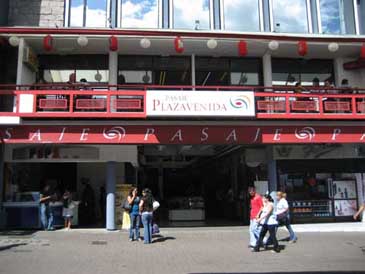 For those in the know, there is a clean, affordable, relatively quiet gastronomic surprise off the pedestrian mall in downtown San Jose. Between Arenas clothing store and the Patio Restaurant, behind a perfume counter and a Pops Ice Cream sits a food court without a McDonald's, Wendy's, Subway or Church's Chicken in sight. Tropical Food is a counter selling relatively healthy food. While their batidos aren't as delicious as the ones found at FrutiLand in Mall San Pedro, the water-or-milk- blended-with-fruit drink is a refreshing treat to carry during your walk along Avenida Central. A batido with the fruit of your choice mixed with water costs 650 colons, with milk, 750 colons. That's from $1.30 to $1.50. Adding honey or granola takes you up to a still-reasonable 900 colons ($1.80). The store also peddles fruit salads, ranging from 700 to 1.600 colons ($1.40 to $3.20). Marisqueria produces delicious looking and smelling seafood dishes. A customer-friendly hanging chalkboard lists their menu and respective prices. A small corvina ceviche will set you back 1,950 colons ($3.90). Get a small rice with shrimp for 2.150 colons ($4.30), 2,800 ($5.60) for a larger serving. Or try one of the fish filets prepared several different ways, the cheapest being with oil and garlic for 2,600 ($5.20) colons, the priciest fish filet dish is 3,600 colons ($7.20) for relleno with ham and cheese. Click here to read more |
Festive season proves troublesome even for established restaurant 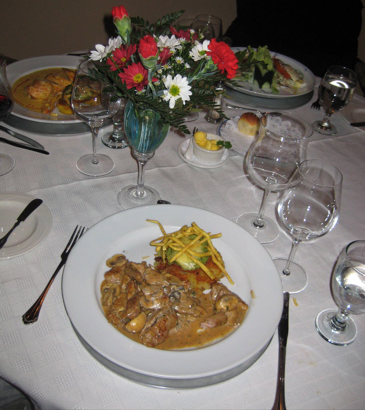 Being a chef in a
busy kitchen must be a pretty stressful job, but
around Christmas stress is something any successful restaurant should
factor in as inevitable. Being a chef in a
busy kitchen must be a pretty stressful job, but
around Christmas stress is something any successful restaurant should
factor in as inevitable. On a second visit to well-reputed French restaurant Le Chandelier, it soon became obvious that the staff were poorly equipped for the onslaught of Christmas party diners on a Tuesday night, leaving the usually decent food to deteriorate into a procession of almost inedible starters and bland entrees. Set in an old San Pedro house with brick ceilings and wooden beams that was converted into a restaurant around 15 years ago by Swiss owner Claude Dubuis, Le Chandelier purports to offer French cuisine that has been developed over generations of experience. Click here to read the full review A great meal is not all in the presentation 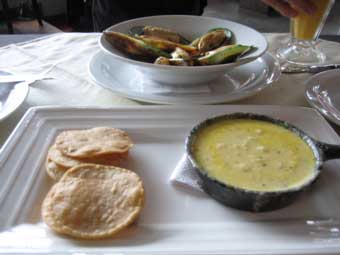 With a vaulted
glass ceiling, palm trees lining the pathway and posh lighting, one
would not expect Saga restaurant to be settled behind a dull parking
lot in Escazú. With a vaulted
glass ceiling, palm trees lining the pathway and posh lighting, one
would not expect Saga restaurant to be settled behind a dull parking
lot in Escazú. Although this restaurant may look out of place, it doesn't deviate much from the norm in Escazú, an area many would classify as suburban sprawl. The majority of the cuisine at Saga seems to fit with the setting: classy presentation, yet lacking any profound flavors. Although the restaurant boasts itself as an “international food restaurant” on its Web site, much of the inspired cuisine is lacking the depth which would be found in authentic dishes. Click here to read the full review |
||
| Festivals ... |
|||
| International acts to make rare
festival appearance in Costa Rica Excitement is rising over the announcement of headline acts for Festival Imperial, Costa Rica's most highly anticipated music festival of the year. Costa Rica is often missed off the list when world-famous bands are compiling their top international touring spots, but the second edition of the beer-backed festival is set to attract a few top names. Two years ago, the first Festival Imperial brought Sting and Jamiroquai to Costa Rica, while also promoting national bands such as Gandhi and Malpais, and April 2008's edition of the event promises similar quality. Read more - click here |
 British
group Duran Duran will headline Festival
|
||
| Books ... |
|||
Land use in Costa Rica documented by Fulbright scholar Forty years of living in the jungle, moving between secluded forestry stations and research labs, has led Louisiana resident and NASA veteran
Click here to read more |
New book dwells on the social aspects of food Food is not just a selfish pleasure or a way to stifle hunger, but is central to the evolution of art, according to a new book published by Museos del Banco Central. Artworks by Costa Rican painters are the main content of the hardback book, “Imagenes para Comer,” which follows the representation of food in art since still life painting became popular in the Renaissance. Full-color pictures of both traditional and modern works are far more common than recipes, as the author Marjorie Ross only provides seven recipes within the book. All are traditional Costa Rican dishes showing influences from different sections of the community, such as corn fritters, white beans and chorizo and fruit salad. The book focuses on the meanings that food has within society, and how these are portrayed by art. Click here to read more |
||
| Teaching poker is like teaching golf | |
|
I’m terrible at golf but
I love the game with a passion. Some golf instructors get overly technical and teach the mechanics of the ideal swing. That approach didn’t work for me. So, I found a pro that didn’t insist that I learn Tiger’s swing. He accepted my physical limitations and improved my game by focusing on the minimal golf skills that I have. That same teaching approach applies to poker, too. That’s why the online instructional course that I designed for www.PokerVT.com addresses the learning needs of both beginning and advanced players. In golf, no one learns to hit a draw, a fade, or a cut shot until they’ve been taught how to hit the ball straight. Similarly, novice poker players need to learn how to “hit it straight” before taking on more difficult concepts. While sophisticated plays can work in poker, if attempted by an inexperienced player, they’ll usually backfire. Elaborate bluffs and check-raises are best left to experienced players. It’s just like golf; don’t try to hit a tricky flop shot with that 25-handicap of yours! You see, poker players are not all created equal. Some learn faster than others because they have better people skills, card sense, or maybe they’re just downright smarter. But all players should learn the game from the bottom and work their way up. Don’t skip the valuable lessons that you’ll need to learn in order to improve your game. A big mistake beginners make is that they jump ahead too quickly, looking for bigger, tougher games where they are simply outclassed. You have to pay your dues in poker. The game is just as much about bankroll management, ego, psychology, and emotional control as it is about learning starting hand requirements and basic probabilities. In golf, some pros succeed because they can hit the ball a mile while others rely on their deadly putting skills. On the pro poker circuit, some players win because they are super-aggressive while others succeed by playing a more controlled game. There are many paths to success. You just have to pick the one that works best for you. I’m naturally aggressive so adopting an assertive poker style works best for me. That approach won’t work for everyone, though. That’s okay. |
 But whatever poker style you do adopt, you must learn how to adjust your game in response to different situations. In golf terminology, use all of the clubs in your bag. Here’s one important distinction between golf and poker. In golf, it doesn’t really matter what your swing looks like as long as you get the ball in the hole. In poker, your style does matter. How you decide to play a hand greatly impacts the decisions that other players will make against you. That’s because poker is a cat-and-mouse game. Your objective is to play to your comfort level while injecting enough deception to cause your opponents to make mistakes. For example, if an opponent thinks I bluff excessively, I’ll make an adjustment and will bluff less. If another player believes that I’d never bluff on the river, well, you’d better watch out when I throw out that last big bet. Golf and poker can be frustrating. Golfers can struggle because they lack basic physical skills that limit their ability to succeed. Poker players can face similar challenges on the felt. You may never play poker like Doyle Brunson or golf like Tiger Woods but that doesn’t mean you can’t learn to improve your game and have more fun. Just find an instructor who will teach you a style of poker play that accentuates your strengths and de-emphasizes your shortcomings. Visit www.cardsharkmedia.com/book.html for information about Daniel Negreanu’s new book, "Hold’em Wisdom for All Players." © 2008 Card Shark
Media. All rights reserved.
|
|
|
|
|
|
|
|
|
|
|
|
|
| What we published this week: | Monday | Tuesday | Wednesday | Thursday | Friday | Earlier |
|
|