|
 |
Costa Rica Your daily |
 |
|
|
|
|
|||||||||||||||||||||||||
|
|
|||||||||||||||||||||||||
 |
|
|
|
|
|
|
|
|
| What we published this week: | Monday | Tuesday | Wednesday | Thursday | Friday | Earlier |
|
|
| A.M. Costa Rica Second newspage |
 |
||||||||
| Home |
Tourism |
Calendar |
Classifieds |
Entertainment |
Real
estate |
Rentals |
Sports |
About
us |
|
| San José, Costa Rica, Thursday, March 4, 2010, Vol. 10, No. 44 | |||||||||
 |
| Costa Rica Expertise Ltd http://crexpertise.com E-mail info@crexpertise.com Tel:506-256-8585 Fax:506-256-7575 |
 |
 Click HERE for
great
hotel discounts
|
|
Policía
Nacional name
sought for Fuerza Pública By the A.M. Costa Rica staff
The executive branch is seeking to change the name of the Fuerza Pública to the Policía Nacional, a force that will include a number of the separate law enforcement branches that now exist. Janina del Vecchio, the security minister, appeared before a legislative committee Wednesday to outline the proposal. The proposed law also would stipulate that the police academy training for new officers would be a year and that the trial period for officers would not begin until they left the academy. In the Costa Rican system, the security ministry supervises the prevention police. These are the Fuerza Pública, the Policía de Fronteras and the Policía de Turismo. Investigations are handled by the Judicial Investigating Organization, a dependency of the judicial system. There are many police agencies, including the tax police and the immigration police that have been created by separate statutes. Lawmakers can lump these all together or continue some as independent agencies. Ms. del Vecchio also said she wanted to strengthen the police reserve to make it a permanent arm of the police force. She appeared before the Comisión de Seguridad of the legislature. Members said that they wanted to pass the new police law before the legislature ends May 1. Even if they do not, the proposal would remain intact for incoming lawmakers. Our reader's opinion
Eliminating point systemis a benefit for wealthy Dear A.M. Costa Rica: Once again Costa Rican law, regulations and, indeed, lawmakers have collectively shot themselves in the foot while over protecting the guilty. A common malady, right? A "No-points" traffic law equates to the wealthy able to do whatever the law says they are not supposed to do with impunity. (Similar to Jacó where tourists, mostly Americans, can do whatever they are not allowed to do in the United States.) And, the heavy traffic fines will simply line the pockets with bribes to the under paid "transitos." Possible and likely, those with money will still drive faster than allowed, be more careless than allowed, only slow at red lights, etc because it is just money. The only possible deterrent from running a red light while talking on the newest hand-held cellular and running over a pedestrian (hyperbole) is to add up the points per traffic violation and take away the damn license to drive. It is a privilege to drive a car and not a right, as the assembly has declared. How convoluted is it to premise the "no points" factor on the argument that some people who are repeat traffic law offenders will not be able to drive to and from work? Give me a break! If they are repeat offenders they should not be driving at all! Not to work, not to the disco, not to the beach....NOT!. That's a fact and the only true deterrent that is equal for both the wealthiest as well as the poorest of our country. Take away the privilege to drive a car, taxi bus or moto, and we are the same. (Not even a bike) Then, the all new immigration rules are like a mixed salad. As of this letter nobody has a clue. Let's see, by law the perpetual tourist needs to leave the country every 90 days but can pay $100 for an additional 90 day stay and then needs to leave the country for 72 hours to another country but cannot go to the same country twice and after the third try, has to be out of Costa Rica for 15 days? To where? I don't know. AAAAAAAAAAGH! But, good news! Immigration director Zamora says that this is not the case at all. (He must be right. After all he is the DIRECTOR!) His take is, the law be damned! Stay as long as one year and just pay $100 to some unknown entity (Maybe ICE, the telephone company? As a last resort I always pay ICE) every 91st day of your stay. Or perhaps the president-elect is right because she is thinking seriously about reenacting the old 1970 rules that welcomed pensionados (retirees) as permanent, albeit limited, residents of Costa Rica with a laundry list of incentives to retire here similar to what Panamá now offers? (That's because the economy, especially real estate, is not looking so good. However, like the 80s, when the high rollers come back — goodbye old folks.) Sportsbooks are okay, but casinos are not because they seem to foster prostitution which is legal in Costa Rica. Sportsbooks are not. Certainly, we do not want to do anything against nor prohibit the free expression of law. We might not like it, but law is law unless there are six exceptions then it becomes a regulation in Costa Rica. (Joking) The rules are, you can sell it, but you cannot market it. However, the reportedly 300 or so sportsbooks of which maybe 290 rent a room with a computer plus three telephones and have raped the country of its educated, bilingual youth, give jobs to illegals and they are 100 percent unlicensed by anybody, go unregulated, pay zero taxes to Costa Rica and park all of their cash outside of our borders but are, for some unknown reason, "welcome." Can we all spell, "payoff?" Finally, I count 11, not 10, mayors who are either being investigated for corruption or malfeasance. How is this possible in a country of 4.2 million people? What do we do about it? It is what you let your wallet do about it that counts and nothing more because as expats, you have no legal "say" except stop buying, stop paying and stop coming. John Holtz
Santa Ana
|
|||||||||||||||||||||||||||||||||||||||||||
 |
||||||||||||||||||||||||||||||||||||||||||||
| Home |
Tourism |
Place
classified ad |
Classifieds |
Entertainment |
Real
estate |
Rentals |
Sports |
About
us |
|
| What we published this week: | Monday | Tuesday | Wednesday | Thursday | Friday | Earlier |
| The contents of this page and this Web site are copyrighted by Consultantes Río Colorado 2001, 2002, 2003, 2004, 2005, 2006, 2007 and 2008 and may not be reproduced anywhere without permission. Abstracts and fair use are permitted. Check HERE for details | ||||||
 |
Good Grief! You still are spending half your ad budget on paper? You better call us! |
| A.M. Costa Rica third newspage |
 |
||||||||
| Home |
Tourism |
Calendar |
Classifieds |
Entertainment |
Real
estate |
Rentals |
Sports |
About
us |
|
|
|
|||||||||
| Lawmakers asked to approve use of monitoring devices |
|
|
By the A.M. Costa Rica staff
The executive branch is asking the legislature to pass a new bill that would permit the use of monitoring devices on criminal suspects and convicts. President Óscar Arias Sánchez signed the appropriate paperwork Wednesday that will send the concept to lawmakers. Although the devices are called bracelets, they usually are worn on the ankle. Officials have hopes that they can be used as a warning device for women who have a no-contact order for a former companion. Officials said that the technology exists to alert the woman when her accused domestic abuser approaches within 600 meters or nearly 2,000 feet. The devices also would be used for prisoners who have been awarded conditional freedom. |
Casa Presidencial said that the
devices will allow Adaptación Social,
as the prison agency is called, to keep track of those at liberty and
save a substantial amount of money that now goes to keep an eye on such
individuals. Such devices are used elsewhere to keep track of persons on parole or bail. There also is the possibility of house arrest. There have been several high-profile murders of women by former companions against whom judicial no-contact orders have been issued. Although electronic devices may alert women to stalkers, would-be murderers seem to disregard all rules. In one case, the man was so upset he embarked on a campaign of vandalism against the possessions of the woman's family before invading the home where she was and killing her. Considering the schedule of the current legislature, the measure probably will not even be sent to committee until a new group of lawmakers takes office May 1. |
| Woman wins old-age pension despite employer's failures |
|
|
By the A.M.
Costa Rica staff
A homeowner is about to get a bill for 21 years of missed Caja payments for a domestic worker. With interest. The Sala II labor high court has decided that an elderly woman who worked for years without the protection of the Caja Costarricense de Seguro Social should get an old-age pension. The court ordered the Caja to pay the pension. The woman is one of many domestic workers whose employers do not enroll them in the Caja for health and pension benefits. This is a violation of the law, but such activity is widespread. The court suggested that the Caja Costarricense del Seguro Social should have taken action to make sure the woman was enrolled. |
Some workers willingly work without
Caja benefits because enrollment
means that about 10 percent is deducted from their paycheck. Employers,
too, have to add to the employee contribution. The woman who won the pension is a Guanacaste resident who started work in 1965 and stopped working in the household in 2001. However, the court decision only covered 21 years. The woman and her lawyer lost twice in lower courts because judges reasoned that she had not paid a premium so she did not deserve the pension. The Caja now has the option of seeking back payments from the former employer of the woman. There also is the possibility of criminal charges. |
 |
| You need to see Costa Rican tourism information HERE! |
| Home |
Tourism |
Place
classified ad |
Classifieds |
Entertainment |
Real
estate |
Rentals |
Sports |
About
us |
|
| What we published this week: | Monday | Tuesday | Wednesday | Thursday | Friday | Earlier |
| The contents of this page and this Web site are copyrighted by Consultantes Río Colorado 2001, 2002, 2003, 2004, 2005, 2006, 2007 and 2008 and may not be reproduced anywhere without permission. Abstracts and fair use are permitted. Check HERE for details | ||||||
| A.M. Costa Rica fourth news page |
|
||||||||
| Home |
Tourism |
Calendar |
Classifieds |
Entertainment |
Real
estate |
Rentals |
Sports |
About
us |
|
| San José, Costa Rica, Thursday, March 4, 2010, Vol. 10, No. 44 | |||||||||
 |
xx |
 |
| New rail sevice extension results in
full passenger cars |
||
|
By Manuel Avendaño Arce
of the A.M. Costa Rica staff The new train route from the former Atlantic train station to San Pedro seems to be popular because passengers are complaining about crowding. The train now services stops at the Universidad de Costa Rica and Universidad Latina. Until now, passengers from Heredia had to get off the train in San José and board the valley line if they wanted to go to Universidad Latina. There still are complications. Those traveling east on the new route have to get off the train and cross busy Calle 23 to board the cars that will take them east. On the return trip, they must cross the thoroughfare again. This is the street that runs past the former Feria Internacional de Costa Rica exhibition hall, now known as the Antigua Aduana. The train leaves the Estación al Atlántico for Heredia at 5:30 a.m. each morning and runs every half hour until 8 a.m. The trips are repeated in the afternoon starting at 3:30 p.m. until 7:30 p.m. The hours are similar coming from Heredia. The first train leaves there at 6 a.m. and the last morning train leaves at 8:30 a.m. Evening runs are from 4 p.m. to 8 p.m. every half hour. The new runs to the Universidad de Costa Rica and Universidad Latina leave at 6:30 and 7:30 a.m. From the universities the train leaves at 6:15 a.m. with a schedule that allows passengers to reach Heredia at 7 a.m. The afternoon trains leave the universities at 4:15 p.m. and at 6:15 p.m. |
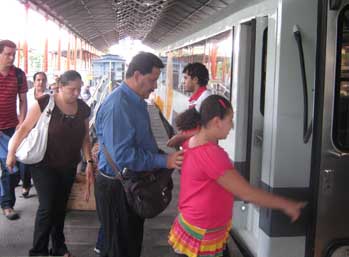 A.M. Costa Rica/Maneul
Avendaño Arce
Passengers hustle to get a seat on the
packed train
The 6:30 p.m. train from Heredia arrives at the Atlantic station at 7 p.m., and those continuing to the universities have 10 minutes to cross the street and board a train that leaves for the east at 7:10 p.m. Ana Cecilia Fernández of the Instituto Costarricense de Ferrocarrilles, said that the special trains to the universities are in the testing stage. The rail institute will take three months to evaluate the results of the trips to San Pedro de Montes de Oca. Some passengers are complaining that there is no space for those seeking to board the university train at the Atlantic station. The institute also hopes to be able to offer a direct service from Heredia to the universities without the intermediary train change, the spokeswoman said. |
|
| Mrs. Clinton was scheduled to arrive
here Wednesday night |
||
|
By the A.M. Costa Rica staff
and wire service reports Hillary Clinton, the U.S. secretary of State, was due to arrive in Costa Rica late Wednesday for the Pathways to Prosperity in the Americas meeting of ministers at the Intercontinental Hotel in Escazú. The event started Wednesday, but the session this morning is when Mrs. Clinton is scheduled to speak. Pathways seeks to stimulate Latin economies. Intel and Ad Astra Rockets were involved in the program Wednesday. Mrs. Clinton is expected to address the issues of micro-credits and credits for small businesses headed by women. She will leave Costa Rica Friday after meeting with local politicians and President-elect Laura Chinchilla. Mrs. Clinton is coming from Brazil where discussions |
there had a
geopolitical emphasis. She met with President Luiz Inacio da
Silva in
Brasilia. He is on friendly terms with Iran. Mrs. Clinton said she doubts Iran will negotiate seriously about its nuclear program unless the U.N. Security Council approves new sanctions against it. Mrs. Clinton made her appeal even though da Silva reaffirmed his opposition to early sanctions before meeting the secretary, saying the world community should not push Iran into a corner. The Brazilian president said he wants the same right for Iran as he does for Brazil, to the development of peaceful nuclear energy, and that if Iran abides by that it will have Brazilian support. At a press event with Brazilian Foreign Minister Celso Amorim, Mrs. Clinton said she doubted Iran will bargain in good faith unless a new set of sanctions is approved by the Security Council, of which Brazil is a current member. |
|
| Home |
Tourism |
Place
classified ad |
Classifieds |
Entertainment |
Real
estate |
Rentals |
Sports |
About
us |
|
| What we published this week: | Monday | Tuesday | Wednesday | Thursday | Friday | Earlier |
| The contents of this page and this Web site are copyrighted by Consultantes Río Colorado 2001, 2002, 2003, 2004, 2005, 2006, 2007 and 2008 and may not be reproduced anywhere without permission. Abstracts and fair use are permitted. Check HERE for details | ||||||
| A.M. Costa Rica fifth news page |
 |
||||||||
| Home |
Tourism |
Calendar |
Classifieds |
Entertainment |
Real
estate |
Rentals |
Sports |
About
us |
|
|
|
|||||||||
 |
| New
approach suggested to stem cyber hackers By the A.M. Costa Rica wire services
Computer programmers and users should be more receptive to changing security measures to reduce the risk of being targeted by hackers. The cyber-attacks that recently targeted Google, and perhaps 100 other companies, shows that relying on “known virus scanners” is not enough. So says Roger Thompson, chief security officer at AVG, a leading international computer security company. “The worst hack is the one you don’t know about,” said Thompson. He says there needs to be a push to use different anti-virus products that work at detecting behavior rather than anti-virus products that look for specific viruses and bits of malicious code. A example of suspicious behavior might be a bit of malicious program attempting to install itself from opening an office document. In order to reduce the threat, Thompson suggests adding a behavior layer. "If a certain behavior has never been seen before," Thompson explains, "it would exhibit the sort of activity that would look suspicious to another program.” Thompson notes that every antivirus lab in the world daily gets thousands of new and unique samples of malicious code every day. The problem is, he says, it takes time to respond to the threats. "The bad guys create massive numbers exactly to confuse the anti-virus labs, and they know that in five or ten days all of those samples will be added, but in the meantime there’s another 20-30,000 brand new ones,” he says. Thompson says Internet security issues need to be addressed especially in light of the increased threat of cyber-terrorism. He points to the apparent use of forged diplomatic passports by alleged assassins of a Hamas commander in Janurary. "Seemingly, 11 or 12 people came in on forged passports, killed a guy, and then got out again," Thompson said. "Forged passports and identity theft are all tying into the same lack of privacy. It’s a brave new world.” While governments are trying to stay ahead of cyber-thieves, Thompson says the problem they face is learning how to stay one step ahead. "“We have significantly less privacy than we’ve ever had in our lives, and it’s possible to find out stuff about almost anyone at anytime, “ he said. Thompson’s comments come as the world's largest conference on cyber-security is held this week in San Francisco. The RSA Conference brings together IT professionals, developers, and policy makers exchange ideas on preventing hacking, cyber-terrorism, identity theft, secure web services and related topics.
|
|
 |
| Home |
Tourism |
Place
classified ad |
Classifieds |
Entertainment |
Real
estate |
Rentals |
Sports |
About
us |
|
| What we published this week: | Monday | Tuesday | Wednesday | Thursday | Friday | Earlier |
| The contents of this page and this Web site are copyrighted by Consultantes Río Colorado 2001, 2002, 2003, 2004, 2005, 2006, 2007 and 2008 and may not be reproduced anywhere without permission. Abstracts and fair use are permitted. Check HERE for details | ||||||
| A.M. Costa Rica sixth news page |
|
|||||||||
| Home |
Tourism |
Calendar |
Classifieds |
Entertainment |
Real estate |
Rentals |
Sports |
About us |
||
|
|
||||||||||
Latin American news Please reload page if feed does not appear promptly |
Chile
quake rocked the world and shortened the day By the A.M. Costa Rica wire services
The earthquake that struck Chile was so powerful that it appears to have jolted Earth's axis into a new position and increased the planet's rotation speed. Calculations by a research scientist at NASA's Jet Propulsion Laboratory indicate the earthquake shortened the length of a day on Earth by more than one-millionth of a second. The U.S. space agency's Richard Gross used a complex mathematical model to simulate the earthquake's effect. He estimates that the days are now 0.00000126 seconds shorter than they were last week. That's 1.26 microseconds, or millionths of a second, and Gross says the change will be permanent. Earth's axis also was pushed about eight centimeters away from its normal position by the earthquake on Saturday, one centimeter more than the displacement produced by the mighty Sumatra earthquake of December 2004. The Indonesian earthquake, measured at a magnitude of 9.1, was much more powerful than the 8.8-magnitude jolt that hit southern Chile. However, Gross says the Chilean quake shook Earth's axis even more than the catastrophic shock in Indonesia that sent huge tsunamis racing across the Indian Ocean. This was because the two earthquakes had different positions on the globe, as measured in distance from the equator. Also, the fault in Earth's crust that produced the Feb. 27 earthquake had a steeper vertical angle. Earth wobbles on its axis in response to the sudden shift of mass that occurs during a huge earthquake, and the angle of the Chilean fault intensified the effect of last week's temblor. Gross says his calculations cannot be verified, because even the most careful observation of the length of a day is not accurate below five millionths of a second. The space agency explained the scientist's work on its Web site. |
Latin American news feeds are disabled on
archived pages.
|
|
| Home |
Tourism |
Place
classified ad |
Classifieds |
Entertainment |
Real
estate |
Rentals |
Sports |
About
us |
|
| What we published this week: | Monday | Tuesday | Wednesday | Thursday | Friday | Earlier |
| The contents of this page and this Web site are copyrighted by Consultantes Río Colorado 2001, 2002, 2003, 2004, 2005, 2006, 2007 and 2008 and may not be reproduced anywhere without permission. Abstracts and fair use are permitted. Check HERE for details | ||||||