|
 |
Your daily |
 |
|
|
|
|
|
|
|
|
|
|
|
|
|||||||||||
|
|
|||||||||||
 |
| A.M. Costa Rica Second newspage |
 |
||||||||
| Home |
Tourism |
Calendar |
Classifieds |
Entertainment |
Real
estate |
Rentals |
Sports |
About us |
|
|
|
|||||||||
 |
| Costa Rica Expertise Ltd http://crexpertise.com E-mail info@crexpertise.com Tel:506-256-8585 Fax:506-256-7575 |
 Click HERE
for great
hotel discounts
|
|
that Costa Rica now joins By the A.M. Costa Rica wire services
Five countries, including Costa Rica, have joined the U.N. Security Council as non-permanent members for two-year terms. Among them is Libya, which Thursday also assumed the Security Council's rotating presidency for the month of January. In doing so, Libya moved deeper into the fold of the international community, taking up the helm of the very same body that had previously sanctioned it as a state sponsor of terrorism. Libya's ambassador to the U.N., Giadalla Ettalhi, told reporters in New York Thursday that this reversal has great significance for his country. "For us, you know, for a country that was for a decade under the sanctions of the Security Council, it is very important and very significant, I think, that to be back in the Security Council," he said. "It means that we are back to normal, at least from the perspective of the others. We have considered ourselves always in the right way, but this is very, very important for us." In addition to Costa Rica, Burkina Faso, Croatia and Vietnam joined Libya as new members. Unlike the five permanent members of the Security Council, non-permanent members do not have veto power. Several high priority issues will be on the Council's agenda in January, including the deployment of a joint U.N.-African Union peacekeeping force to Sudan's Darfur region and the continuing issue of Kosovo's future status. Libya was elected to the Security Council in October, after the U.S. vetoed two previous bids. The United States did not block Libya's most recent effort. Relations between the two nations have warmed since 2003, when Libya accepted responsibility for the 1988 bombing of a U.S. airliner over Lockerbie, Scotland, that killed 270 people. Earlier, Tripoli had turned over two suspects for trial in the case. Relations further improved between the U.S. and Libya after Tripoli renounced weapons of mass destruction in late 2003. The two countries resumed full diplomatic relations in 2006 after more than a two-decade break, and Libya's foreign minister was in Washington Thursday, meeting with U.S. officials. Ambassador Ettalhi says his government is pleased relations have normalized. "We have good relations with the United States," he added. "At least they are back to normal and, I think, moving in the right direction. Perhaps, not at the desirable speed, but they are really going in the right direction. We are happy about that and I think that they are happy about that." The rotating presidency of the Security Council is designated in alphabetical order, and Libya enters the body as president for the month of January, taking over from Italy Amateur bull fighter dies at festival in Zapote By the A.M. Costa Rica staff
The Costa Rica game of bull baiting has turned fatal at the holiday fiesta in Zapote. A bull caught up with one of the young men who try to show their valor by getting into the ring. The man died after he received a horn of a bull in the chest. He was one of hundreds treated since Christmas Day at the small clinic adjacent to the bull ring, but he died a short time later at hospital Calderón Guardia. The death was televised and replays are common on local channels. Officials said that the New Year's Day death of Moravia resident Roldolfo González, in his 20s, was only the second in 37 years at the festival. However, there had been periodic deaths of amateur bull fighters at events in other towns. The Zapote fiesta continues through Sunday.
 |
|
on our real estate page HERE! |
|
 |
| A.M. Costa Rica third newspage |
|||||||||
| Home |
Tourism |
Calendar |
Classifieds |
Entertainment |
Real
estate |
Rentals |
Sports |
About us |
|
|
|
|||||||||
 |
| Strong
winds and more flooding are results of cold front |
|
|
By the A.M. Costa Rica staff
The January cold spell has turned nasty with more flooding in the northern zone and strong winds lashing the Central Valley. The nation's emergency commission declared an informational alert Thursday because of the damaging winds and the flooding in Upala, San Carlos, Los Chiles and Guatuso in the northern zone and Pococí, Guácimo, Matina and Limón in the Caribbean slope. An alert also was called for Sarapiquí in the Provincia de Heredia. The Comisión Nacional de Prevención de Riesgos y Atención de Emergencias said that more than 20 incidents of wind damage had been reported Thursday. Most included events like trees falling or roof panels being blown away. The commission said that winds reached 70 kph in the Central Valley. That's 43.5 mph. Juan Santamaría airport registered a 68.6 kph gust during the day. The northern Pacific also was facing strong winds, said the commission. Costa Ricans in the Central Valley also were bracing for a chill. This is the same cold front that has brought near-freezing temperatures to cities in Mexico and caused much more damaging winds in other Central American |
states as well as freezing to the
Florida orange crop. Cartago was expected to see a low of 13 C (55.4 F) with 15 C (59 F) in the San José area. Temperatures were expected to be colder at higher elevations. And the wind can create a perception of colder temperatures with the chill factor. Most Costa Rican homes are not designed to keep out strong wind gusts. At 11 p.m. the San José temperature was 22 C or 72 F with occasional wind gusts. Wind damage was reported mainly in Quebrada Honda de Nicoya, Tilarán and Bagaces in Guanacaste and in Turrialba, Tres Ríos, Guarco, La Unión and Río Azul de Cartago There also were incidents reported in Hatillo 8, Desamparados, Paso Ancho, Zarchi, Acosta and Grecia. The Central Valley was spared the rain that drenched the northern zone and parts of the Caribbean slope. And the coastal area of Limón did not get the rain and the winds that other locations did. The Instituto Metoerológico Nacional said that the cold spell will last through the weekend with some gradual warming. |
| A life-enriching passion does not have to be a big deal |
|||
| I have reached an age
when I
feel I have acquired some wisdom. At least I hope I have. I
have learned enough not to make a single New Year’s resolution.
Who needs disappointment in self after a certain age? I have also come to the conclusion that the three things that make life worth living are good friends, good food, and a passion that gets you up in the morning, plus the ability to enjoy those three things. Good health is nice, but by itself it can be meaningless. I don’t include it as such because we know that three, when it comes to wishes, is the magic number. If you can start the New Year with those three ingredients, you’ve got a head start on a good year. I managed to do just that. It all started at the beginning of this century. Two dear friends, Grady and Bill, and I had adjourned to my apartment near Barrio Lujan after hearing some jazz at the Centro Cultural in Los Yoses. I had clipped from some newspaper the “100 best books of the 20th Century.” It is hard for me not to turn everything into a game, so I was giving them hints so they could guess the top 10. Then I decided to act the titles out, and soon we were taking turns and playing charades. I have always loved charades. Academics (especially those in the humanities) and theater and movie people enjoy playing charades, and both those worlds have been my worlds at times. In Los Angeles, our friends who were involved in everything Hollywood has to offer were regulars at our tiny home in the Silver Lake district where we played “The Game” late into the night and ate my homemade pizza (with the crust made from a Betty Crocker recipe). That is when we began the tradition of playing charades on New Year’s Day. The mini charades game with Grady and Bill rekindled my love for the game, so I started a monthly charades get-together, continuing the tradition of playing on New Year's Day After a while, Jim, a newcomer to Costa Rica, asked if he could organize some games. Organizing them can get complicated and time-consuming, and I was happy to hand over the responsibility. Alas, Jim, who was both a psychologist and an ordained minister, had a heart larger than his pocketbook and soon had to leave Costa Rica to go back to the States to work. That is when Janet took over, and she is still at it today. |
The game got
hilarious (I do, however, question the authenticity of those "Chinese"
proverbs that began with “Man who….”), and was punctuated with the
screeching of their pet cockatoo and the mad dashing of their two
puppies. If I could add a fourth ingredient to a good life, it
would
be laughter. I
know a number of people whose passion is bridge. Omar Sharif gave
up
full-time acting to play contact bridge. It is only fair that I add the disclaimer that
many of my friends think many of my theories are half-baked, off the
wall, totally unsubstantiated by science or just plain crazy. |
||
 |
|
||
 |
|
|
|
|
| You need to see Costa Rican tourism information HERE! |
| A.M. Costa Rica fourth news page |
|||||||||
| Home |
Tourism |
Calendar |
Classifieds |
Entertainment |
Real
estate |
Rentals |
Sports |
About us |
|
|
|
|||||||||
 |
| Costa
Rican tracking study rewrites theory on bird survival |
|
|
By the Stanford University News Service
Some tropical forest birds can survive alongside humans if given a helping hand, according to a recent study by Cagan H. Sekercioglu, senior scientist at the Stanford University Center for Conservation Biology in California. The results, published in the journal Conservation Biology, could influence the way countries approach endangered species protection in agricultural areas, Sekercioglu said. "Even modest restoration efforts can increase their land cover and help some forest birds more than you would think," he said. The study was conducted in Costa Rica at the Las Cruces Biological Station of the Organization for Tropical Studies, where most of the forested terrain has been converted to open coffee plantations or pasture — unfavorable habitats for birds, according to Sekercioglu. In previous studies, researchers had identified nearly 200 bird species in coffee plantations by simply capturing or observing them there. "If you do that, you might think, 'Well, these birds are doing fine in coffee plantations,'" Sekercioglu said. However, he felt that simply seeing the birds in coffee plantations was not sufficient evidence to conclude that they had adapted to life outside their native habitat. Sekercioglu said he wanted to follow the birds more closely. He and his team set up a comprehensive bird-banding and radio-tracking system to monitor the birds' positions throughout the day. First, they hung mist nets in various places in the coffee plantations to catch a large sample size of birds of three particular species. Then, they tagged each bird with two colored leg bands and an aluminum ring with an identification number. Using false-eyelash glue, they attached a radio-transmitter with a battery life of one to three months. The team tagged and tracked 156 birds during the study. "We had a Pathfinder packed with 10 people and gear," he recalled. "A couple times we had people hanging onto the outside. It's lot of fun." The researchers encountered a few surprises during the study. One assistant tracked a slow-moving radio signal to the forest floor, a strange occurrence since most of the bird species prefer tree branches. As the signal became louder, the researcher suddenly realized it was coming from a bushmaster, the deadliest snake in Latin America. The 15-foot snake had eaten both the bird and its radio. "It just started slithering away and the signal faded," Sekercioglu said. Every day, each team member would be assigned to track from one to six birds. They generally worked from dawn to dusk. "We start before the birds are awake and moving," Sekercioglu said. "We leave the station at 4:30 a.m." The researchers recorded every bird's information in a database, including its species, band number and the number of daily sightings. The team tried to record at least 50 to 100 sightings for each of the 156 birds scattered across a period of at least 10 days, Sekercioglu said. After eight months of tracking over two seasons, the team concluded that many tropical forest birds tend to avoid coffee plantations, even though they were frequently observed there by researchers in previous studies. "When you radio-track birds, you realize many go through coffee because they have to," Sekercioglu said. "Seeing them in coffee does not necessarily mean they like it there." Because the coffee plant is not native to Costa Rica, local birds have not evolved to eat the fruit or to live among the open fields of the plantations, he said. "Although we caught all these birds in coffee, most of them prefer remnant forest fragments, individual trees and trees along rivers, which are called riparian corridors." He added, "Most birds don't like to eat the coffee fruit. Caffeine evolved as a pesticide to keep pests away." |
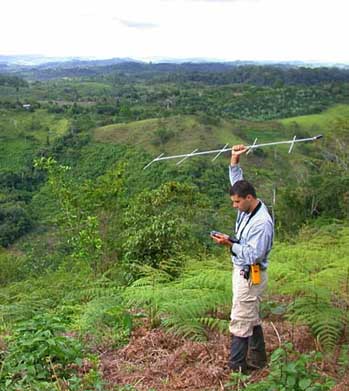 Stanford News Service/Scott Loarie
Cagan Sekercioglu of the Center for Conservation Biology used
a radio
antenna to monitor bird positions in the agricultural countryside at
Las Cruces Biological Station in Costa Rica.The team compared percentages of land-cover type in the area to the birds' preferred locations. "Remnant trees—individual trees—only covered 1.4 percent of the landscape, but some of the birds spent 25 to 30 percent of their time in these few trees," Sekercioglu explained. Similarly, some birds spent up to half their time in riparian corridors, which cover only 4.6 percent of the area. "These small patches of trees are critical for these native birds," Sekercioglu said. Sekercioglu is optimistic about the implications of his findings for endangered bird species. "Even modest restoration efforts to increase tree land cover can help these birds more than you would think," he said. Furthermore, the research demonstrated the ability of some tropical forest birds to survive in human-dominated agricultural countryside. "That's good news," Sekercioglu said. "Even though they didn't spend a lot of time in coffee plants themselves, they did fine in a coffee-dominated landscape, as long as there were some trees around." These findings suggest that humans and birds may be able to successfully coexist if farmers leave small reserves of forest, riparian strips or single trees interspersed throughout agricultural land, Sekercioglu said. "Even though we would like to have big national parks with a lot of forest, sometimes when you can't have that, when you have to have agriculture, it's really important to have these reserves of native trees and native forests, which can support large numbers of native birds and other organisms," he added. Sekercioglu's recommendations are helping to shape a Las Cruces project encouraging local people to plant native trees around their farms and villages, and Sekercioglu and his colleagues are planning a workshop at Las Cruces on restoration ecology. "It's starting to have an impact, so that's exciting," he said. In addition to banding and tracking birds, the research team monitored over 300 nests. Also, they have collected more than 10,000 feather samples to determine the protein content in birds' diets and have taken nearly 2,000 blood samples for genetic analyses and to study avian malaria, Sekercioglu said. "The more we learn, the more we realize we don't know," he said. "That's why you need a multi-pronged approach to look at birds' habits from every level." |
|
|||||||||||||||||
| News from
the BBC up to the minute |
BBC sports news up to the minute | ||||||||||||||||
| BBC news and sports feeds are disabled on archived pages. |
|||||||||||||||||
| A.M. Costa Rica Sports news local and from the wires |
 |
|
|
|
|
|
|
|
|
|
|
||||||
|
||||
|
|
|
|
|
|
|
|
|
|
|
|
| What we published this week: | Monday | Tuesday | Wednesday | Thursday | Friday | Earlier |
|
|